However, rather than receiving institutional support, Ali-Keffi alleged that powerful interests moved against him once he began uncovering sensitive information.
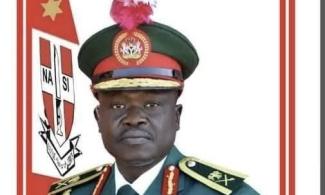
A retired senior officer of the Nigerian Army, Major General Danjuma Ali-Keffi, has narrated how he was forced out of service, detained in solitary confinement, and subjected to humiliating treatment after uncovering individuals he described as suspected financiers and sponsors of terrorism in Nigeria.
Ali-Keffi, who once commanded the Army’s 1 Division as General Officer Commanding (GOC), said his ordeal began shortly after he was appointed in 2021 to lead Operation Service Wide (OSW), a multi-agency investigative task force mandated to identify Boko Haram masterminds, expose their financial backers, and dismantle networks supporting the insurgency.
According to the retired General, he was handpicked during the Muhammadu Buhari administration to steer the sensitive operation.
He said OSW’s mandate included tracking the financial architecture sustaining Boko Haram and identifying high-profile individuals linked to the group.
However, rather than receiving institutional support, Ali-Keffi alleged that powerful interests moved against him once he began uncovering sensitive information.
64 Days In Solitary Confinement And Forced Retirement
Ali-Keffi said he was later arrested and detained for 64 days in solitary confinement, where he slept on the floor, resulting in what he described as serious health consequences.
He said this period of detention preceded the process that ultimately forced him out of the Nigerian Army.
“When I reported, they even stripped me of my shoes, belt, wrist watches and money,” he stated.
‘Presidency Told Me Not To Report To NARC’
The retired General narrated that during his initial interrogation, he was questioned about why he did not report to the Nigerian Army Resource Centre (NARC) after being removed as GOC on August 8, 2021.
He insisted that he followed instructions allegedly relayed from the Presidency, saying, “I responded that the Presidency told me not to report. The liaison between me and President Buhari told me that it was the former President’s directive. So, I complied for a while until I smelled a rat.”
Ali-Keffi said he believed former President Buhari was not genuinely committed to the counter-terrorism project he oversaw. He linked this to an earlier investigation he led in 2020 into 295 fuel-laden tankers smuggled into Benin Republic through Ilesa Baruba in Kwara State.
According to him, the findings from that investigation, which were submitted to the Presidency, placed Buhari in a difficult position. The report recommended that the Nigerian Financial Intelligence Unit (NFIU) trace individuals involved in terrorism financing, and Buhari publicly accepted these recommendations in February 2020.
Ali-Keffi said the NFIU later conducted extensive work, collaborating with 33 foreign financial intelligence agencies and securing documents such as a certified translated copy of the Dubai Judgment Report.
The NFIU reportedly submitted its findings directly to Buhari and recommended establishing Operation Service Wide (OSW) as an independent task force staffed by credible personnel from the military and intelligence agencies. He believed Buhari accepted this proposal reluctantly because the evidence presented by the NFIU made it difficult to reject.
As OSW proceeded, especially after the arrest of suspects linked to prominent Nigerians and the killing of Boko Haram leader Abubakar Shekau, which he attributed partly to OSW’s activities, resistance began to mount.

Ali-Keffi said he received intelligence suggesting that powerful individuals felt threatened and planned his elimination. He also claimed that these individuals deceived Buhari by alleging that he and the late Chief of Army Staff, Lt. Gen. Ibrahim Attahiru, posed a threat to the administration.
He suggested that Attahiru’s death in the May 2021 military plane crash may have been connected to these tensions, although he acknowledged he could not prove this.
“I learned from credible intelligence sources, but I can’t prove this, that the powerful individuals who planned our elimination first lied to the President that Attahiru and I were a threat to his regime,” he said.
“Now, whether Buhari approved the elimination of Attahiru in the manner that he and the other nine passengers were killed in an aircraft explosion, I cannot say.”
He questioned the federal government’s reaction to the crash, noting that neither Buhari nor Vice President Yemi Osinbajo attended the funeral in Abuja the following day despite being in the city.
He contrasted this with the high-level attendance at the burial of the late General Lagbaja under the Tinubu administration, saying, “However, the absence of Buhari, his vice (Osinbajo) as well as a high powered FGN delegation at the funeral in Abuja the day after the incident, May 22, 2021, despite that they (Buhari and Osinbajo) were both in town indicated that something was amiss.
“Recall the burial of Late General Lagbaja. Not only was Tinubu and Shettima present but the leadership of NASS, the Judiciary and so many other prominent politicians were present.”

Ali-Keffi said he was informed that President Buhari would direct then-Minister of Defence, Gen. Salihi Magashi (rtd.), to instruct the Chief of Army Staff (COAS) to reverse his posting to NARC since he was on a presidential assignment. But when no action was taken, he grew suspicious.
Fearing for his life, he said he decided to turn himself in rather than rely on assurances from those he believed were involved in a plot against him.
Alleged Plot To Assassinate Him On Abuja–Kaduna Highway
He also stated that credible intelligence reached him indicating that a plan had been put in place to assassinate him on the Abuja–Kaduna highway, staged to appear as an attack by bandits.
“When nothing was forthcoming, and I got reliable information that the Presidency was part of the plot to ‘deal’ with me, I had to turn myself in,” he said.
“Furthermore, I received credible intelligence that a plan had been made to assassinate me along the Abuja-Kaduna highway and then to make it appear as a bandit attack, I knew that I couldn’t trust whatever Buhari or the Presidency were telling me. I believed that I was being set up.”
‘They Feared What Would Come To Light In Court’
While in detention, and later in retirement, Ali-Keffi said he learned that his persecution was linked to claims that he had not shown respect to the former Chief of Army Staff, Lt Gen Faruk Yahaya, while serving as GOC 1 Division.
He questioned why, if this was the case, he was not arrested immediately after his removal, but instead taken into custody two months later, on October 18, 2021, without being properly posted for jurisdiction.
The retired General further queried why due process was not followed, asking, “Why didn’t they follow due process before throwing me out of the Military by placing me on charge as well as court martial me?”
He contrasted his treatment with that of ex-Major Generals H.O. Otiki and U.M. Mohammed, who he said were charged and court-martialled for offences he considered “far less serious” than what he was accused of.
According to him, the failure to subject him to a proper legal process stemmed from fear that exposing details of OSW’s findings in court would damage the reputation of powerful individuals.
High-Profile Links To Terror Financing
Ali-Keffi insisted that he still does not know the actual offence for which he was targeted, arguing that his uncompromising stance and the sensitive information he uncovered during Operation Service Wide placed him at odds with influential figures.
“I don’t know the offence(s) that I committed. I believe that my uncompromising stance coupled with the information I had on some prominent individuals as a result of their links to some of the suspects led to my ordeal,” he said.
“They (powerful individuals) knew that they would be implicated if we proceeded with the operation (OSW) and more importantly, if we had arraigned the suspects in court.”
Al-Keffi’s 2023 Letter To Tinubu
In a letter dated June 21, 2023, retired Ali-Keffi informed President Bola Tinubu that he faced severe backlash following the success of OSW, the covert counter-terrorism task force he led.
He said OSW’s efforts to disrupt Boko Haram’s financing networks threatened powerful individuals in government, the military, and the Presidency, including a senior banker, who he believed were either benefiting from or collaborating with the criminal activities of the insurgents.
According to him, the dangers facing the task force were so significant that some OSW personnel considered the May 21, 2021 air crash that killed General Ibrahim Attahiru and others to be suspicious.
In his letter, he noted that after handing over command of 1 Division on August 10, 2021, Ali-Keffi went to the Presidential Villa to brief then-President Muhammadu Buhari on his redeployment.

He said Buhari instructed him to continue leading OSW and assured him that his posting to the Nigerian Army Resource Centre (NARC) would be amended so the assignment would not be affected.
He continued working with OSW based on this assurance and was later informed that the Minister of Defence had been directed to ensure the adjustment of his redeployment.
Ali-Keffi said he was shocked when, in mid-October 2021, he received an invitation from the Provost Marshal (Army) to appear for an investigation interview.
After notifying the Presidency and receiving reassurance, he honoured the invitation on October 18, accompanied by OSW’s legal adviser. That day, he was detained, stripped of personal items, and held in solitary confinement.
His detention lasted 64 days.
He described the experience as humiliating and traumatic. He said he slept mostly on the bare floor, underwent repeated interrogations, and was denied communication with his family, who were unaware of his location throughout his detention.
Despite presenting documents indicating that he was on a presidential assignment, investigators continued to question him, including seeking information about his bank accounts.
He said financial checks revealed nothing and that investigators then accused him of treason and undermining counter-terrorism operations.
As part of the investigation, four secretly recorded private phone calls between him and the Military Secretary (Army) were played back, although he insisted they contained nothing incriminating.
Ali-Keffi said the questioning demonstrated that the detention had nothing to do with his posting to NARC and that investigators appeared to be searching for evidence against him.
He stated that he was subjected to physical and psychological pressure and was denied medical treatment for an ENT condition until he collapsed and was hospitalised for three days in a prison medical facility.
On December 21, 2021, he was released and immediately handed a letter conveying his compulsory retirement from the Nigerian Army.
He said the manner of his exit, after more than 30 years of service and an unblemished career, including training at the Nigerian Defence Academy and the Royal Military Academy Sandhurst, amounted to a humiliating dismissal despite carrying out a presidential directive.
He noted that he had previously served the army with distinction, attended various professional military courses, and represented Nigeria at international engagements, including serving as chief planner for the U.S.–Africa Land Forces Training Conference held in Abuja in April 2018.
“In my opinion, the OSW was closing in on the top government, military and other powerful officials who were either involved in TF of the BHT and other insurgents' or were benefitting from the criminality which were ongoing in the northern part of the country,” he said in his letter.
“The mistreatment that I received under the former administration was, in my opinion, to protect the criminal enterprise which BHT and other insurgents' groups represent.”