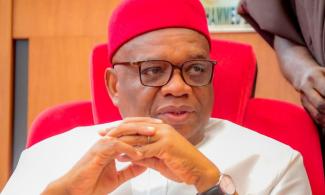
Kalu stressed that the late Biafran leader, Chukwuemeka Odumegwu Ojukwu, never supported another armed struggle.
In the wake of renewed tensions following the imprisonment of Indigenous People of Biafra (IPOB) leader Mazi Nnamdi Kanu, former Abia State Governor and current Senator representing Abia North, Orji Uzor Kalu, has restated his position on the destructive impact of separatist violence in the Southeast.
Kalu stressed that the late Biafran leader, Chukwuemeka Odumegwu Ojukwu, never supported another armed struggle.
Speaking on Arise Television, Kalu revealed that during extensive conversations with Ojukwu in his final years, the former war-time commander made it clear that while the first struggle for Biafra was born out of necessity, any attempt to revive it through violence and coercion would be neither rational nor justifiable.
“It wasn’t the same struggle as the civil war, the one General Odumegwu Ojukwu, General Effiong, Christopher Ukibo, and many other Igbo leaders fought. I am full-blooded Igbo, and I was with Ojukwu in his later years. Mrs. Bianca Ojukwu can testify that he told me the first struggle was necessary, but a second one is no longer necessary,” Kalu said.
The senator lamented that the Southeast, once a commercial hub of Nigeria, has been economically crippled by years of enforced sit-at-home orders, violent reprisals, and internal conflicts among separatist factions.
He argued that any struggle that stifles commerce in Igboland betrays the vision of the late Biafran leader, who championed education, enterprise, and strategic negotiation.
“Look, there is no more commerce in the entire Igbo land. How are we going to live?” Kalu asked. “These boys must think about the families who have lost loved ones, lost businesses, and lost their sense of security. Enough is enough. Let us stop destroying ourselves.”
Kalu also responded to IPOB spokesperson Emma Powerful, who accused him of sponsoring violent factions and demanded that he substantiate his claim that over 30,000 lives have been lost due to separatist-linked violence.
Kalu dismissed the allegations as “childish,” insisting that his concerns are motivated by the welfare of the Igbo people, not malice.
“You cannot claim to fight for Igbo liberation while shutting down markets, burning vehicles, and hunting down your own people on Mondays. It is not rational,” he said.
The former governor emphasized that resolving the Nnamdi Kanu issue, and broader agitation in the Southeast, requires structured dialogue with the Federal Government rather than continued aggression.
“I thought that after what happened to Nnamdi Kanu, these boys would come together and ask: how do we negotiate? How do we secure a political resolution? Instead, we cannot continue with this old-fashioned approach of intimidation and bloodshed,” Kalu said.
He maintained that his criticisms do not diminish his Igbo identity, highlighting his loyalty to Ojukwu and referencing Ambassador Bianca Ojukwu, who shares her late husband’s view on the futility of a second armed conflict.
“Even Ojukwu’s wife agrees with what I am saying. Nobody who truly understands the pains of the civil war will support the destruction happening today,” Kalu stated.
The senator urged all separatist factions, ideological groups, and political actors to return to dialogue, economic restoration, and communal healing, warning that the Southeast cannot survive while commerce is stifled and insecurity persists.
“The Southeast must find peace, rebuild commerce, and stop killing its own people. That is the only way forward,” he added.