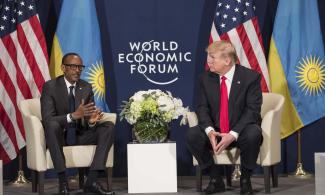
Kagame said the process stood out because it brings together the leaders of Rwanda and the DRC with the President of the United States, something he said had never happened before in efforts to address the conflict.
Rwandan President Paul Kagame has described a proposed agreement aimed at resolving Rwanda’s long-running conflict with the Democratic Republic of Congo (DRC) as unprecedented, citing the level of international attention and the direct involvement of the United States.
Speaking in an interview with AlJazeera on December 7, 2025, Kagame said the process stood out because it brings together the leaders of Rwanda and the DRC with the President of the United States, something he said had never happened before in efforts to address the conflict.
“The conflict goes a long way, many years, and we have never had anything like this,” Kagame said.
He noted that the visibility, energy and pressure surrounding the talks marked a significant departure from previous attempts to resolve the crisis. According to him, the framework of the proposed agreement is also notable because it addresses what he described as the fundamental drivers of the conflict.
Kagame explained that the approach focuses on understanding the root causes of the crisis while incorporating political, security and economic dimensions.
“I think it captures everything in terms of the theory,” he said, adding that the real challenge would lie in implementation.
“What remains is the practice or the implementation part of it. That is always where the complications arise.”
When asked what distinguishes President Donald Trump’s involvement from previous US administrations, Kagame contrasted two broad approaches to engagement with Africa.
He said one approach emphasises global narratives around democracy, freedom and human rights, which, in his view, have often remained theoretical and failed to translate into tangible improvements in people’s lives.
He argued that the alternative approach, which he associated with the current US administration, focuses more on concrete issues such as trade, economic interests and measurable outcomes.
“It focuses on tangible things… what do you give, what do you gain, what are the results,” Kagame said, adding that this transactional approach makes it easier to assess the value of engagements. He said he personally preferred this model, describing it as more practical and productive.
Kagame also suggested that prolonged management of unresolved problems in Africa had, in some cases, become an “industry” in itself, perpetuating crises rather than resolving them.
While acknowledging external responsibility, he said African leaders also share blame for failing to take sufficient ownership of their challenges.
On whether President Trump had changed US engagement with Africa, Kagame said the president’s direct interest in the Rwanda-DRC situation was significant.
He pointed to Trump’s decision to invite regional leaders and others previously involved in the peace process as evidence of a shift.
“One can give credit for that,” Kagame said, adding that he preferred to focus on areas where progress could realistically be made rather than broader debates about the administration’s policies.
In early December 2025, the White House was the stage for what Donald Trump hailed as a “great day for the world.”
With much fanfare, Rwandan President Kagame and Congolese President Félix Tshisekedi signed the Washington Accords for Peace and Prosperity, a deal meant to end decades of hostility between their nations.
The agreement promised not only peace but also economic cooperation, with Washington pledging to buy rare earth minerals from both countries.
Yet, less than two weeks later, the optimism has begun to fade. Reports from eastern Congo describe renewed clashes involving the M23 rebel group, widely believed to have ties to Rwanda.
Instead of ushering in stability, the accord seems to have triggered fresh accusations. U.S. officials, including Secretary of State Marco Rubio, have publicly declared that Rwanda has “clearly violated” the terms of the deal. Washington now faces the uncomfortable task of enforcing an agreement it championed.
Diplomatic tensions are rising. A U.S. ambassador warned that Kigali’s actions are dragging East Africa closer to war, while Burundi’s foreign minister went so far as to call Rwanda’s behavior a “middle finger” to the United States.