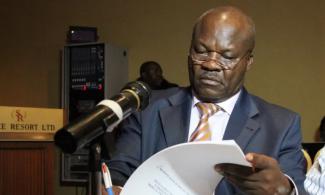
Lumbala headed the Rally of Congolese Democrats and Nationalists (RCD-N) during the conflict, which prosecutors said targeted members of the Nande and Bambuti ethnic groups in the north-eastern provinces of Ituri and North Kivu between 2002 and 2003.
A French court on Monday sentenced Roger Lumbala, a former Congolese rebel leader and politician, to 30 years in prison after finding him guilty of complicity in crimes against humanity committed during the Second Congo War, more than two decades ago.
According to BBC, the Paris court ruled that Lumbala, 67, ordered or aided and abetted acts including torture, summary executions, rape amounting to torture, sexual slavery, forced labour and large-scale looting while leading a Ugandan-backed rebel movement in eastern Democratic Republic of Congo.
Reading the verdict, the presiding judge said Lumbala bore responsibility for “inhumane acts committed as part of a systematic campaign against civilian populations,” particularly during a brutal military operation known as “Erase the Slate.”
Lumbala headed the Rally of Congolese Democrats and Nationalists (RCD-N) during the conflict, which prosecutors said targeted members of the Nande and Bambuti ethnic groups in the north-eastern provinces of Ituri and North Kivu between 2002 and 2003.
A United Nations investigation later described the campaign as being marked by “premeditated operations using looting, rape and summary execution as tools of warfare.”
Although he was present in court to hear the verdict, Lumbala did not attend the trial, which opened last month, and has consistently rejected the authority of the Paris court.
He was arrested in France nearly five years ago after fleeing DR Congo, where authorities had issued a warrant accusing him of backing the M23 rebel group, currently active in the east of the country.
Lumbala previously served as a minister in DR Congo’s transitional government between 2003 and 2005 and later as a member of parliament.
The case was tried under the principle of universal jurisdiction, which allows French courts to prosecute crimes against humanity committed outside France.
Five non-governmental organisations, including Trial International and the Clooney Foundation for Justice, supported the prosecution by assisting survivors, coordinating testimonies and providing expert analysis. Trial International said 65 survivors, witnesses and experts testified during the proceedings.
In a statement released after the verdict, two survivors, David Karamay Kasereka and Pisco Sirikivuya Paluku, said the ruling represented long-delayed recognition of their suffering.
“We were scared but came all the way here because the truth matters. For years, no one heard us,” they said.
“We would have preferred to face Roger Lumbala, to look him in the eyes. But this verdict marks a first step toward reclaiming pieces of ourselves that were taken from us,” they added.
During the trial, Kasereka, now 41, told the court how his father and neighbours were tortured and killed by Lumbala’s fighters. Paluku, a 50-year-old nurse, testified that rebels robbed and injured him, murdered his uncle and raped his friend’s wife.
“We hope this will serve as a lesson to those who continue to bring grief to the people of Congo, and particularly to Ituri,” Paluku told Reuters.
Lumbala’s lawyers, who have 10 days to appeal, described the sentence as excessive. Prosecutors had sought life imprisonment.
Human rights groups hailed the ruling as a landmark moment for accountability over atrocities committed during the Second Congo War (1998–2003), a conflict involving nine African countries and multiple armed groups that claimed an estimated two to five million lives.
“This verdict is historic,” said Daniele Perissi of Trial International. “For the first time, a national court has dared to confront the atrocities of the Second Congo War and show that justice can break through even after decades of impunity.”
Eastern DR Congo, a region rich in minerals, has endured more than three decades of violence, despite repeated peace agreements.
While several militia leaders, including Thomas Lubanga, Germain Katanga and Bosco Ntaganda, have been convicted by the International Criminal Court, campaigners say Lumbala’s conviction signals that international justice can still reach those long shielded by power and time.