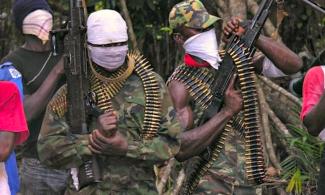
According to Musa, corruption remains a fundamental driver of Nigeria’s security challenges and the proliferation of hard drugs.
A security expert has identified corruption, arms diversion, procurement fraud, economic injustice and violations of the rule of law as major enablers of insecurity and drug trafficking in Nigeria.
This position was articulated by Dr. Olusegun Awe-Obe in a paper delivered on behalf of a security expert, Dr. Oluwasegun Musa, at the Coalition Against Corruption and Bad Governance’s (CACOBAG) 2025 Annual Convention and 25th Anniversary held in Lagos.
According to Musa, corruption remains a fundamental driver of Nigeria’s security challenges and the proliferation of hard drugs.
Musa said, “The statement that the anti-corruption struggle is the only way to fight insecurity and curb the menace of hard drugs for Nigeria's greatness is a powerful argument based on the concept of corruption as a root cause or an enabler of these other critical national challenges.”
He added that while corruption may not be the only factor, it is central to addressing the nation’s deep-seated problems.
“While not the single factor, eliminating corruption is arguably the most fundamental and necessary step because it addresses the systemic weaknesses that allow insecurity and drug trafficking to flourish,” he said.
Musa described corruption as directly undermining Nigeria’s capacity to guarantee security by weakening the entire security architecture and creating fertile ground for criminal activity.
He noted that the diversion of arms and procurement fraud have had devastating consequences.
“Billions of Naira allocated for military hardware and counter-terrorism are routinely embezzled or misused,” Musa stated.
As a result, “This leaves troops underequipped, demoralized, and vulnerable in the fight against highly armed terrorist groups (like Boko Haram) and bandits.”
Musa further alleged that “Rogue officials at checkpoints also accept bribes to allow illegal arms and ammunition to flow into the country, increasing the severity of conflicts.”
On internal corruption within the armed forces, Musa highlighted the issue of ghost workers.
“‘Ghost Soldiers’ and Patronage: Corruption leads to the existence of ‘ghost soldiers’ on the payroll, diverting funds meant for operational allowances, maintenance, and troop welfare, further degrading the effectiveness of the armed forces,” he said.
Musa also identified the erosion of public trust as a critical consequence, saying, “When citizens perceive the police and judiciary as corrupt, taking bribes to release high-profile criminals or delaying trials, they lose faith in the state.”
He warned, “This collapse of public trust leads to a failure to report crimes or collaborate with security agencies, severely hindering intelligence gathering and law enforcement success.”
Musa linked corruption to worsening socio-economic conditions, arguing that the diversion of public funds fuels poverty and unemployment.
“Corruption diverts public funds intended for welfare, education, and job creation,” he said.
He added, “This economic injustice leads to massive unemployment and poverty, making millions of young, disenfranchised Nigerians easy targets for recruitment by criminal gangs, militant groups, and extremist organizations.”
On the justice system, Musa warned that corruption entrenches impunity.
“A corrupt judicial system allows wealthy criminals, including financiers of terrorism and kidnapping syndicates, to buy their way out of justice, fostering a pervasive culture of impunity that encourages further criminal acts,” he stated.
Musa also examined the nexus between corruption and transnational drug trafficking, describing corruption as essential to the operations of organized crime networks.
He noted, “Corruption is essential for transnational organized crime, including drug trafficking, to operate with impunity in Nigeria.”
“Huge profits from the illicit drug trade are used to intimidate and corrupt public officials at borders, ports, and airports,” he said.
Musa alleged, “Corrupt customs and law enforcement officers are bribed to facilitate the smuggling of drugs (cocaine, heroin, and methamphetamine) and allow criminal networks to move goods and cash unimpeded.”
He further warned that drug trafficking fuels violent crime and insurgency.
He said, “Drug trafficking serves as a lucrative venture for criminal groups, with profits used to fund other illicit activities, including the purchase of weapons, recruitment of fighters, and sustaining insurgencies that threaten national security.”
On drug control agencies, Musa observed that corruption weakens enforcement efforts.
“Agencies like the National Drug Law Enforcement Agency (NDLEA) struggle against corruption within their own ranks,” he noted.
Musa added, “Narco-corruption allows powerful drug cartels to operate with minimal interference, weakening the overall drug control mechanism and emboldening criminal organizations.”
He stressed that tackling corruption is central to Nigeria’s future.
“Fighting corruption is not merely an ethical pursuit; it is a national security imperative and an economic necessity for Nigeria to achieve its potential,” Musa said.
He argued that addressing corruption would allow Nigeria to properly fund its security sector.
“By successfully tackling corruption, Nigeria can: Fund Security Properly, ensure that budgeted funds for defense and security are actually spent on equipment and troop welfare, leading to a more effective military,” Musa said.
He further stressed the need to restore public confidence in the justice system.
“Restore the Rule of Law, create a judicial system that holds criminals and corrupt officials accountable, restoring public faith and stripping criminal networks of their sense of impunity,” he stated.
In addition, Musa called for greater investment in human capital.