The President had proposed a capital expenditure of ₦26.08 trillion, while recurrent (non-debt) spending was put at ₦15trillion.
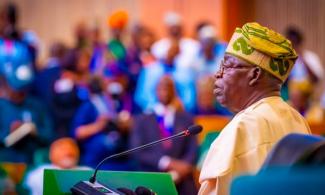
President Bola Tinubu on Friday presented the N58.18trillion 2026 Appropriation Bill to the National Assembly, with debt servicing projected to gulp N15.52 trillion.
The President had proposed a capital expenditure of ₦26.08 trillion, while recurrent (non-debt) spending was put at ₦15trillion.
The proposal had been titled “Budget of Consolidation, Renewed Resilience and Shared Prosperity.”
Meanwhile, the N15.52 trillion earmarked for debt servicing represents about 26.7 per cent of the total expenditure, exceeding allocations to several key sectors and remaining one of the largest single spending items in the budget.
The Peoples Democratic Party (PDP) had criticised President Bola Tinubu’s 2026 budget proposal, describing it as a document that consolidates economic hardship, deepens poverty, and reflects a failure of economic management.
In a statement signed by its National Publicity Secretary, Comrade Ini Ememobong, the PDP had dismissed Tinubu's economic claims, arguing that Nigerians have endured worsening living conditions since the administration assumed office.
“We see it rather as a budget of consolidated renewed sufferings, because what Nigerians have witnessed since the birth of this administration is nothing but unmitigated hardship on the people, while the governing class relishes in affluence,” the party said.
The PDP said Nigerians have suffered severe economic hardship under the Tinubu administration, noting that economic growth figures alone do not translate into improved living standards.
President Tinubu also cited a 3.98 per cent GDP growth rate as proof of economic stabilisation.
However, the PDP argued that growth without inclusiveness has failed to lift millions out of poverty.
Citing the 2025 World Bank Poverty and Equity Brief, the party said more than 30.9 per cent of Nigerians live below the international extreme poverty line.
“This shows that there is growth without prosperity for our citizens, meaning that despite GDP growth, poverty remains endemic,” PDP said, adding that any economic gains recorded are not reaching the majority of Nigerians.
The opposition party also faulted the President for failing to identify the sectors driving the reported growth or those benefiting from it.
It compared the 3.98 per cent growth rate to the 6.87 per cent recorded in 2013 under the previous PDP-led administration, which it said was largely driven by non-oil sectors such as agriculture and trade.
“The President celebrates a 3.98 per cent growth rate, whereas a reality check reveals excruciating hunger, a high cost of living, and other indices of economic hardship which Nigerians are currently facing,” the PDP said.
On security, the party acknowledged the allocation made in the 2026 budget but warned that funding alone would not resolve Nigeria’s security challenges.
It called for transparent and effective utilisation of security funds to deliver modern equipment, adequate ammunition, improved intelligence capabilities, and better welfare for security personnel.
The PDP noted that security operatives remain deployed across multiple theatres of conflict where criminal non-state actors are alleged to possess superior weapons to those of government forces.
The party also raised concerns over what it described as the President’s admission that the execution of the 2024 capital budget had been extended to December 2025, while the 2025 budget remains in force.
According to the PDP, this confirms long-standing reports of the concurrent operation of multiple budgets, a practice it said undermines fiscal discipline, transparency, and accountability.
“No two budgets should operate concurrently,” the statement said, adding that the development represents “another unprecedented negative feat” by the All Progressives Congress (APC)-led administration.
The PDP called for increased transparency and accountability in the management of public finances, warning that the absence of these principles erodes public trust and weakens governance.
“Financial accountability and transparency are critical to public trust-building and effective public administration,” the party said.
The 2026 budget proposal will be subjected to legislative scrutiny in the coming weeks as lawmakers debate its provisions amid rising concerns over inflation, unemployment, poverty, and insecurity across the country.