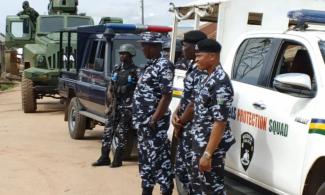
According to the sources, some police officers affected by the withdrawal order have resorted to wearing uniforms of vigilante groups and the Nigeria Security and Civil Defence Corps (NSCDC) to evade detection, while continuing their duties as before.
The directive by the Nigeria Police Force to withdraw officers attached to private individuals and VIPs has been widely undermined, with officers reportedly returning to duty through disguises, bribery, and administrative manipulation, credible sources have told SaharaReporters.
According to the sources, some police officers affected by the withdrawal order have resorted to wearing uniforms of vigilante groups and the Nigeria Security and Civil Defence Corps (NSCDC) to evade detection, while continuing their duties as before.
As part of the recent directive by President Bola Tinubu to the Inspector General of Police (IGP), Kayode Egbetokun, to withdraw all police personnel from non-essential VIP protection duties, officers were instructed to return to their base and return their service rifles for redeployment to core policing roles.
However, SaharaReporters has learnt that the same weapons have be reissued to the personnel after the payment of as much as ₦500,000. Afterward, the officers reportedly resumed duty under informal arrangements.
“Police officers are now disguising themselves in vigilante and Nigeria Security and Civil Defence Corps uniforms to evade the so-called withdrawal order,” one of the police sources said.
“Each officer was instructed to return their service rifle, only to have the same weapon reissued after paying ₦500,000. They then resumed duty as usual.”
Sources also disclosed that several police guards have adopted alternative disguises, including wearing corporate suits and operating as private drivers for VIPs, while still providing armed protection.
According to the sources, the majority of affected officers have already returned to work despite the withdrawal directive.
“Some police guards now wear suits and operate as private drivers for VIPs. Most officers have already returned to work,” the source said.
Although the Inspector-General of Police constituted a monitoring team to enforce compliance, sources claimed that the enforcement exercise was largely symbolic.
“The team arrested a few officers for show and they were immediately released,” one of the sources said.
The sources described the withdrawal policy as ineffective, arguing that it has not led to any meaningful reduction in the deployment of police officers to private individuals.
Instead, they alleged that the process has primarily benefited senior officers, while the practice it was meant to stop continues largely unchanged.
“This so-called VIP police withdrawal has changed nothing. It has merely enriched senior officers while the charade continues,” another source said.
The Presidential Directive
On November 23, 2025, during a high-level security meeting with service chiefs, President Tinubu directed that police officers attached to VIPs be withdrawn and redeployed to core policing duties.
The rationale was clear. Nigeria faces escalating insecurity, including mass kidnappings in Kebbi and Niger states, and the police force is overstretched. Meanwhile, thousands of officers are assigned to politicians, businessmen, and celebrities, leaving ordinary citizens vulnerable and leading to many ungoverned spaces.
Tinubu emphasised that VIPs who still require protection should seek personnel from the Nigeria Security and Civil Defence Corps (NSCDC) instead. To strengthen the police, he also approved the recruitment of 30,000 additional officers.
Reactions and Resistance
While many Nigerians welcomed the move as pragmatic, seeing it as a way to redirect manpower to fight crime, the directive has met stiff resistance from parts of the political elite.
For instance, some senators have expressed reservations about the presidential directive.
They argued that without police escorts, they might be unable to safely visit their constituencies, given the worsening insecurity. Senate President Godswill Akpabio also voiced these concerns during Tinubu’s presentation of the 2026 Appropriation Bill.
This directive is not unprecedented; previous administrations made similar attempts at withdrawals, but enforcement was ineffective.