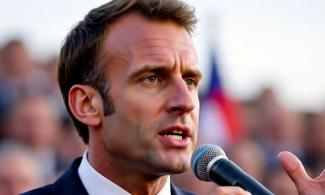
Macron described the move as an attempt to undermine Europe’s regulatory independence in the digital space.
French President, Emmanuel Macron, has condemned recent visa restrictions imposed by the United States on former European Union commissioner, Thierry Breton, and four other European activists for allegedly seeking to “coerce” American social media companies into suppressing viewpoints they oppose.
Macron described the move as an attempt to undermine Europe’s regulatory independence in the digital space.
In a statement issued on his verified X (formerly Twitter) account on Wednesday, December 24, 2025, Macron said the visa restriction by the U.S. government amounts to intimidation and coercion aimed at undermining European digital sovereignty.
Macron said, “France condemns the visa restriction measures taken by the United States against Thierry Breton and four other European figures.”
He added, “These measures amount to intimidation and coercion aimed at undermining European digital sovereignty.”
The United States State Department had announced visa bans on the former European Union commissioner and four others, accusing them of seeking to “coerce” American social media companies into suppressing viewpoints they oppose.
In a statement, U.S. Secretary of State Marco Rubio said the affected individuals were part of what he described as a coordinated effort to promote censorship against American speakers and firms.
“These radical activists and weaponised NGOs have advanced censorship crackdowns by foreign states, in each case targeting American speakers and American companies,” Rubio said, according to the BBC.
Among those named is Thierry Breton, the former European Commission commissioner responsible for the internal market and digital regulation.
The State Department described Breton as the “mastermind” behind the EU’s Digital Services Act (DSA), legislation that imposes strict content moderation obligations on major technology platforms.
But Macron stressed that the European Union’s digital rules were lawfully adopted through the bloc’s institutions, noting that, “The European Union’s digital regulations were adopted following a democratic and sovereign process by the European Parliament and the Council.”
According to the French president, the regulations are designed to ensure fair competition and accountability within the EU’s digital market, not to single out foreign countries.
“They apply within Europe to ensure fair competition among platforms, without targeting any third country, and to ensure that what is illegal offline is also illegal online,” he said.
He further emphasised Europe’s right to regulate its own digital environment, declaring that, “The rules governing the European Union’s digital space are not meant to be determined outside Europe.”
Macron concluded by reaffirming France’s alignment with EU institutions on the matter, saying, “Together with the European Commission and our European partners, we will continue to defend our digital sovereignty and our regulatory autonomy.”
Macron’s comments also come amid rising tensions between Washington and Brussels over the European Union’s digital regulatory framework, particularly the Digital Services Act (DSA) and the Digital Markets Act (DMA).
These laws impose stricter obligations on major technology platforms, including content moderation standards, competition rules, and transparency requirements.
Thierry Breton, a former European commissioner for the internal market and one of the most vocal defenders of the EU’s digital regulations, has previously clashed with US-based technology companies and American officials over issues of online content moderation and platform governance.
The U.S. move has drawn sharp criticism from European leaders and officials, who argue that the EU’s digital laws are sovereign regulations applied uniformly within Europe.
The dispute highlights broader transatlantic disagreements over free speech, platform regulation, and the balance of power between governments and large technology firms, as both sides push competing visions for the future of the global digital space.