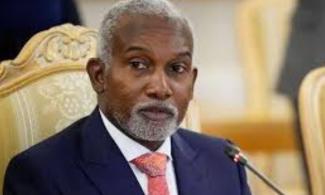
Tuggar made these remarks during a CNN interview monitored by SaharaReporters on Friday, following U.S. military airstrikes in northwest Nigeria on Christmas Day.
Nigeria’s Minister of Foreign Affairs, Yusuf Tuggar, stated that any decision to allow U.S. "boots on the ground" to combat terrorism would depend on the recommendation of the Nigerian armed forces and relevant security agencies.
Tuggar made these remarks during a CNN interview monitored by SaharaReporters on Friday, following U.S. military airstrikes in northwest Nigeria on Christmas Day.
When asked directly if Nigeria would permit the presence of US troops on its territory going forward, the minister said the matter fell outside his immediate remit.
“These are operational issues that would have to be considered by our military. I am heading foreign policy, I’m heading the Ministry of Foreign Affairs and Diplomacy, and it’s something that the Minister of Defence and some of our security agencies would be in a better position to respond to,” Tuggar said.
He, however, confirmed that Nigeria collaborated with the U.S. in carrying out the Christmas Day military strikes in Northwest Nigeria, stressing that the operation was authorised at the highest level of government.
“But for now, we have collaborated on this attack. It was a collaborative effort between Nigeria and the U.S., and President Tinubu gave the go-ahead before it took place, and we don’t see it violating our sovereignty or territorial integrity, which is very important,” he said.
Tuggar also dismissed suggestions that the joint operation was driven by religious considerations, insisting that the focus was purely on security.
“And it is not about religion, it’s about the protection of lives and property of Nigerians and our neighbours as well,” he added.
Addressing concerns and criticisms surrounding the operation, the foreign minister said the government was prioritising outcomes over philosophical debates.
“It’s a matter of what I can only describe as perhaps the choice between deontology and consequentialism,” he said.
According to him, Nigeria’s approach is firmly rooted in achieving tangible results against terrorism.
“So for us in this particular matter, we’re focusing more on consequentialism. So the end, the end is to fight against terrorism, to stop the terrorists from killing innocent Nigerians, be they Muslims, Christians, atheists, whatever religion. And to also understand that this is a regional conflict,” Tuggar stated.
He noted that insecurity in Nigeria cannot be isolated from wider instability across West and Central Africa.
“It is happening in West Africa. It’s happening in the Sahel region. It’s happening in the Lake Chad Basin region,” he said.
Emphasising Nigeria’s openness to international cooperation, Tuggar said the country was willing to work with any partner committed to combating terrorism.
“So this is important. But for us, whoever is prepared to work with us to fight terrorism, we’re ready, willing and able,” he added.
The minister further argued that recent developments demonstrated Nigeria’s resolve to confront terrorism, despite longstanding challenges.
“What took place yesterday clearly underscores the fact that Nigeria is not lacking in will and a commitment to the fight against terrorism,” he said.
He pointed to institutional constraints, including restrictions imposed by the United States in the past, as obstacles Nigeria has had to navigate.
“We may have institutional challenges, partly due to, for instance, the Leahy Law that stopped the sale of military equipment, both kinetic and non-kinetic, to countries like Nigeria,” Tuggar said.
He recalled that despite those restrictions, Nigeria was able to acquire key military assets during Donald Trump’s first term as US president.
“And I have to say here also that even when the Leahy Law was in effect, President Trump in his first administration acquiesced to the sale of aircraft, military aircraft, the Super Tucano, to Nigeria,” he said.
Tuggar added that those aircraft had since been deployed in active operations.
“And we appreciate that. And you could see that it was, the aircraft were put to work. And this is a sort of collaborative effort that is required in the fight against terrorism, in securing the region,” he said.
He further described Nigeria as a frontline state in the global fight against terrorism, citing the concentration of extremist violence in the Sahel.
“And we are at the forefront of the fight against terrorism globally, because most of the threat is taking place in the Sahel region,” Tuggar said.
According to him, available data show the scale of violence in the region.
“And you can even see from the records that the Sahel registered more deaths in terms of terrorist acts than any other part of the world,” he added.
He also rejected attempts to frame the crisis in religious terms.
“And when you talk about the Sahel, the majority are Muslims, they’re not Christians,” Tuggar said.
Simplistic labels don’t solve complex threats. On @CNN, I made clear that terrorism in Nigeria is not a religious conflict; it is a regional security threat.
Nigeria’s focus remains the protection of innocent lives and the defeat of terrorism through coordinated action with… pic.twitter.com/p83FSp9CTw
— Hon. Yusuf Maitama Tuggar (@YusufTuggar) December 26, 2025