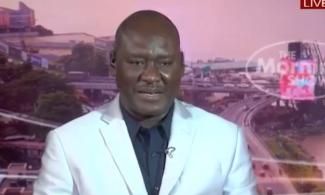
Rafsanjani made this assertion on Friday, while speaking on Arise Television, where he criticised Nigeria’s handling of the situation and described the federal government’s response as an attempt to manage public perception rather than assert sovereignty.
Civil society organisation leader and Executive Director of the Civil Society Legislative Advocacy Centre (CISLAC), Auwal Rafsanjani, has said that the United States did not inform Nigeria nor seek its permission before carrying out airstrikes against terrorists in the Northwest, stressing that Washington acted independently of the Nigerian government.
Rafsanjani made this assertion on Friday, while speaking on Arise Television, where he criticised Nigeria’s handling of the situation and described the federal government’s response as an attempt to manage public perception rather than assert sovereignty.
According to him, the United States proceeded without consulting Nigerian authorities, insisting that no formal approval was requested or granted.
“The American government did not get any approval for it to take any action in Nigeria. In fact, as a matter of fact, what the Nigerian government has done is face-saving,” Rafsanjani said.
He further argued that the posture of the United States, as reflected in the public announcement made by former President Donald Trump, showed clearly that Nigeria’s consent was not required for the action taken.
“America does not need Nigeria's approval to carry out their action, it's clear even in the way and manners in which Trump had made his announcement,” he added.
Rafsanjani linked the development to what he described as Nigeria’s weak foreign policy and failure to effectively communicate its position on security matters to the international community. He said the situation underscored broader governance and policy challenges confronting the country.
“This incident is a pointer to the fact that the country is failing in its constitutional obligation, the country is failing in its mandate,” he stated.
He maintained that the inability of the state to protect lives and property had further weakened Nigeria’s standing and leverage in its engagements with foreign powers.
“The mandate to protect lives and property has been failed. We probably have an outdated foreign policy document that fails to allow us communicate properly,” Rafsanjani said.
The CISLAC executive director also cautioned against narratives suggesting that insecurity in Nigeria is driven by religious conflict, warning that such claims are misleading and dangerous.
“This attack promoted misleading information that the country is in a religious war between the Muslims and Christians and that is a very dangerous framing. We all know as Nigeria is and that is not the case,” he said.
He stressed that violent extremism affects Nigerians across religious and geographical divides.
“We have terrorists terrorising Nigerians irrespective of their religion, geo-graphical locations,” Rafsanjani added.
Rafsanjani called on the federal government to urgently review its security and foreign policy frameworks to strengthen Nigeria’s sovereignty, improve international engagement and restore public confidence.
Earlier, the Nigerian Government confirmed that President Bola Tinubu had approved the recent U.S. airstrikes against terrorist targets in Nigeria’s North-Western region, dismissing claims that the operation violated the country’s sovereignty.
Minister of Foreign Affairs, Yusuf Tuggar, disclosed this on Friday, hours after the U.S. Department of War and President Donald Trump announced that American forces had carried out strikes against terrorists operating in the region.
According to Tuggar, the airstrikes were conducted with Nigeria’s full knowledge and consent, following consultations at the highest level of government.
The minister said President Tinubu personally gave the go-ahead for the operation, stressing that the action was part of joint efforts to combat terrorism and protect Nigerian lives and property.
“Now that the US is cooperating, we would do it jointly, and we would ensure, just as the President emphasised yesterday before he gave the go-ahead, that it must be made clear that it is a joint operation, and it is not targeting any religion nor simply in the name of one religion or the other,” Tuggar said while speaking on Channels Television’s Sunrise Daily.
He emphasised that Nigeria remains a plural and multi-religious society and that security operations are not directed at any faith group.
“We are a multi-religious country, and we are working with partners like the US to fight terrorism and safeguard the lives and properties of Nigerians,” the minister said.
The airstrikes have sparked public debate, with some critics describing the action as a violation of Nigeria’s territorial integrity and an infringement on national sovereignty.
However, Tuggar rejected such concerns, insisting that the Federal Government would not authorise any military action that undermines Nigeria’s independence or territorial control.
He maintained that the strikes were carried out within the framework of international cooperation and mutual respect between Nigeria and its allies.
The minister’s clarification comes amid heightened security challenges in Nigeria’s North-West, where armed groups have continued to carry out attacks on communities, security personnel and critical infrastructure.
The American Government Did Not Get Any Approval to Take Action in Nigeria – Rafsanjani
The way and manner Trump made his announcement to carry out this action shows there was no discussion and dialogue.
Auwal Rafsanjani, Executive Director, Civil Society Legislative Advocacy… pic.twitter.com/om1v0rYoS9
— ARISE NEWS (@ARISEtv) December 26, 2025