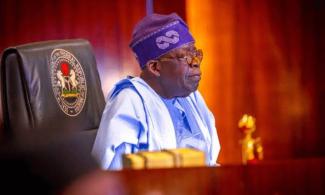
The organisation warned citizens to brace for widespread hardship and heightened insecurity from 2026.
A socio-cultural organisation, Ìgbìnmó Májékóbájé Ilé-Yorùbá, has expressed concerns over what it described as an alleged plan by the Bola Tinubu administration to deploy a “forged” tax law to seize Nigerians’ properties without judicial oversight.
The organisation warned citizens to brace for widespread hardship and heightened insecurity from 2026.
In a statement issued on Saturday, the group accused President Tinubu’s government of altering a tax reform law passed by the National Assembly and forwarding a different version for gazetting.
This move, it added, strips Nigerians of constitutional protections and empowers tax authorities to confiscate and sell properties within 14 days of alleged tax default, without a court order.
The statement was jointly signed by the union’s Convener, Olusola Badero, and released through its Home Director, Princess Balogun.
The organisation described the alleged action as “anti-people,” “anti-business,” and capable of pushing millions of Nigerians closer to poverty and social breakdown.
According to the group, the controversy only came to light after Abdusammad Dasuki, a lawmaker from Sokoto State, reportedly exposed discrepancies between the version of the tax bill passed by lawmakers and the one gazetted by the executive.
“If not for the courage of Abdusammad Dasuki, Nigerians would never have known that the president allegedly altered the law as passed by the National Assembly and sent a different version for printing and gazetting at the National Archives,” the group said.
“It is a monumental international embarrassment for the president of Africa’s most populous nation to be accused of forging a law that will affect the lives, livelihoods, and properties of over 220 million people.”
Ìgbìnmó Májékóbájé Ilé-Yorùbá said lawmakers had clearly stipulated during legislative deliberations that tax authorities must obtain a court order before seizing or selling any citizen’s assets over tax liabilities.
However, the union alleged that this safeguard was deliberately removed in the gazetted version published by the Tinubu administration.
“Lawmakers have publicly stated that a court order was mandatory before any asset seizure,” the statement noted.
“Yet the version released by the executive allegedly goes as far as stating that courts cannot review administrative decisions of tax offices regarding asset seizures. This is dangerous, unconstitutional, and authoritarian.”
The group described the development as a direct attack on the rule of law, warning that unchecked administrative powers would open the door to abuse, intimidation, and politically motivated seizures.
The Yoruba union argued that the alleged tax provisions would cripple small and medium-scale enterprises already struggling under rising inflation, fuel price hikes, currency devaluation, and declining purchasing power.
“How can a government that has implemented policies making survival almost impossible now seek to seize people’s businesses and properties?” the group asked. “Does the president expect crime not to rise when citizens are pushed to the wall and stripped of their means of survival?”
The organisation warned that arbitrary property seizures would lead to job losses, business closures, and an increase in social vices, including theft, armed robbery, and other forms of crime.
“Crime inevitably rises where there is no enabling environment for citizens to survive,” the statement said. “This is not theory; it is reality.”
Ìgbìnmó Májékóbájé Ilé-Yorùbá further questioned the moral basis of aggressive tax collection in a country where, according to it, citizens see little or no benefit from public revenue.
“Since this government has been collecting taxes, how many vulnerable Nigerians have benefited?” the group queried.
“Basic amenities are largely absent. Millions of children remain out of school. Hundreds of schools and hospitals are dilapidated or non-functional. Health workers and teachers are poorly paid and demoralised.”
The group also criticised Nigeria’s political elite for seeking medical care abroad with public funds while ordinary citizens suffer from a collapsing healthcare system.
“For the slightest headache, Nigerian politicians rush abroad for first-class treatment using taxpayers’ money, yet the same taxpayers are subjected to policies that push them closer to an early grave,” it said.
The union called on Nigerians across ethnic, religious, and political lines to rise against what it described as a dangerous and anti-people tax regime.
“Nigerians must stand up and resist this alleged forged tax law before it destroys lives and livelihoods,” Yoruba Union said . “Silence now will amount to collective consent to oppression.”
Describing forgery as a serious criminal offence under Nigerian law, the group demanded a thorough investigation into the alleged alteration of the tax legislation.
“Forgery is a grave crime in Nigeria,” Ìgbìnmó Májékóbájé said. “Those involved in forging this law must be identified, arrested, and prosecuted. No one is above the law.”
While acknowledging presidential immunity, the group insisted that officials who allegedly carried out the act on behalf of the president should face immediate legal consequences.
“Immunity is not a licence for impunity,” the union added. “And when President Tinubu eventually leaves office, he too must answer to the law if these allegations are proven. Justice must not be selective.”