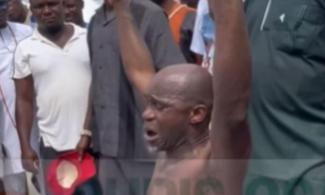
In a statement, Igelige described the incident, in which Obaseki was ambushed, kidnapped, stripped to his boxers, forced to kneel and crawl, and dragged to the Oba of Benin’s palace by a group claiming to act on behalf of the Benin Traditional Council, as criminal and shameful.
Rockson A. Igelige, an entertainment lawyer and former student of Dr Don Pedro Obaseki, has condemned the assault, public humiliation, and degradation of the Nigerian actor in Benin City on Sunday.
In a statement, Igelige described the incident, in which Obaseki was ambushed, kidnapped, stripped to his boxers, forced to kneel and crawl, and dragged to the Oba of Benin’s palace by a group claiming to act on behalf of the Benin Traditional Council, as criminal and shameful.
“Let me emphasise that the ambushing, kidnapping, stripping, molestation, harassment, tongue-lashing amidst threats of death, and coercive dragging of Dr Obaseki to the Palace of the Oba of Benin, under the claim that he is an “Oghionoba,” while he was on his regular football exercise at Uwa Primary School in Benin City, is barbaric, criminal, and totally unacceptable under the rule of law,” he said.
“This act is condemnable, shameful, and in every sense, very un-Benin,” Igelige added.
He stressed that the mob’s actions, which included molestation, threats of death, and public degradation, violated Obaseki’s fundamental human rights guaranteed under the Nigerian Constitution.
Igelige emphasized that no cultural, political, or personal dispute justifies mob violence or public humiliation.
He further stated that the perpetrators do not reflect the values, culture, or history of the Benin people, which he described as traditionally rooted in order, dignity, and respect for authority.
Highlighting Obaseki’s contributions to the arts, culture, and public discourse, Igelige said the actor has never posed a threat to public peace or communal harmony.
“Dr Don Pedro Obaseki is an illustrious son of Benin whose contributions to the creative industry, cultural advocacy, and public discourse are properly documented,” he said.
“He has consistently projected Benin customs, traditions, values, and history with intellectual depth. At no time has he posed a threat to public peace, communal harmony, or the authority of any traditional institution.”
Igelige called on the Edo State Government, the State Police Command, the Commissioner of Police, and relevant security agencies to launch a transparent and thorough investigation into the matter.
He urged that all individuals involved, regardless of status or affiliation, be held accountable.
“I stand in solidarity with Dr Don Pedro Obaseki, my lecturer in Theatre Arts for three years at the University of Benin at this painful and humiliating moment. He deserves respect, and redress,” Igelige concluded.
Earlier on Sunday, SaharaReporters reported that thugs claiming to be acting on behalf of the Benin Traditional Council had seized, stripped, and assaulted Obaseki, accusing him of being an “Oghionoba”, a term translated as an enemy of the Oba of Benin, Ewuare II.
Pedro Obaseki was dragged to the Benin Kingdom Palace by a group of Benin youths over claims of recent activities and remarks they described as disrespectful to the Oba.
Sources said the incident followed Pedro Obaseki’s recent attendance at a meet-and-greet event in London organised in honour of his cousin, former Edo State Governor Godwin Obaseki, who they also labelled “Oghionoba.”
In a viral video seen by SaharaReporters, the actor was stripped to his boxers, forced to kneel, and crawl within the palace premises.
He was subsequently taken before individuals dressed in white attire and adorned with beads, believed to be palace chiefs or officials, who escorted him into the palace while the mob remained outside.
Background
The rift between former Governor Obaseki and the Oba of Benin, Oba Ewuare II, is a complex dispute involving cultural heritage, administrative power, and a deep-seated historical family rivalry.
The conflict gained significant public attention around 2021 and escalated until the end of Obaseki's tenure in 2024.
The most public flashpoint was the repatriation of thousands of artifacts (the Benin Bronzes) looted by British forces in 1897.
The Oba maintained that the artifacts were stolen from the Palace and should return to the Palace. He advocated for a Benin Royal Museum to be built within the Palace grounds.
However, the then-governor proposed the Museum of West African Art (MOWAA), managed by a private entity called the Legacy Restoration Trust. He envisioned this as part of a broader cultural district to boost tourism.
In 2023, the Federal Government of Nigeria stepped in and officially recognized the Oba of Benin as the legal owner and custodian of all repatriated artifacts, effectively siding with the Palace and dealing a blow to Obaseki’s plan.
Also, a major administrative clash occurred when several Enigie (traditional dukes) in Edo South requested the state government to create new, independent traditional councils.
The Palace saw this as a "divide and rule" tactic by Obaseki to "balkanize" the Benin Kingdom and weaken the Oba's central authority.
When the Oba suspended some of these dukes for "rebellion," they took the Oba to court, an act considered an abomination by many Bini people. Critics of the governor alleged he was funding and encouraging these legal challenges against the monarch.
Following his exit from office, the Palace alleged that Obaseki withheld statutory monthly allocations to the Benin Traditional Council for seven months.
It also alleged that the state government revoked the concession of the Oba Akenzua II Cultural Centre, which the Palace intended to use for artifact storage, and reportedly converted parts of it into a motor park.
Since the inauguration of the new governor, Monday Okpebholo, the relationship between the Edo State Government and the Palace has shifted dramatically.
The Oba has publicly expressed relief at the change in administration, while the new government has moved to restore the Palace's statutory entitlements and distance itself from Obaseki’s museum projects.