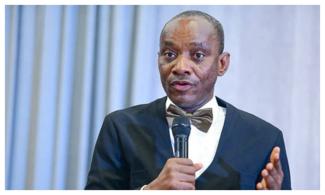
Standing near one of the school’s crumbling buildings, Amadi lamented the neglect that has reduced the institution to ruins despite decades of democratic governance and enormous public spending.
A former Chairman of the Nigerian Electricity Regulatory Commission (NERC), Dr. Sam Amadi, has blamed Africa’s persistent underdevelopment on decades of poor and destructive leadership, citing the deterioration of once-thriving public institutions as stark evidence of governance failure.
Amadi made the remarks while reflecting on the state of Owerri Grammar School in Imo State, a secondary school established in 1958 by the late Dr. Nnanna Ukaegbu, whom he described as a visionary committed to human capital development.
Standing near one of the school’s crumbling buildings, Amadi lamented the neglect that has reduced the institution to ruins despite decades of democratic governance and enormous public spending.
“This building you see behind me is part of Owerri Grammar School Imerienwe built in 1958 by Dr. Nnanna Ukaegbu,” Amadi said. “He was just 29 years old at the time, a young man with a vision for human capital development in a rural community.”
He contrasted the foresight of the school’s founder with the current state of decay.
“Now look at this side and you will see how the whole place is completely dilapidated,” he said. “In 1958, a young developmentalist built this great secondary school. In 2025, instead of upgrading it, there is total deterioration.”
Amadi noted that the decline of the school reflects a broader national failure rather than an isolated community problem.
“Many decades later, this is what remains of that great vision,” he said. “This is not just about my community, Ngor Okpala. It is the same story across the country.”
According to him, Nigeria, and Africa more broadly, has regressed in critical sectors such as education and healthcare since independence, despite the promise of democracy and increased public revenues.
“We have had many democracies, with billions and trillions budgeted and spent, yet instead of progress, what we see is destruction,” Amadi said. “Democracy and development after independence have been retarded. We have not developed.”
He also recalled how the same visionary leadership once provided quality healthcare for the community.
“This same Dr. Nnanna Ukaegbu built St. Bertha Hospital, a 160-bed hospital,” Amadi said. “Today, this community near Owerri does not have a general hospital of any note, nothing substantial; not even quality private hospitals.”
Amadi urged African scholars and intellectuals to rethink prevailing narratives that blame colonialism alone for the continent’s challenges.
“I think African intellectuals should sit back and ask hard questions,” he said. “How did we under-develop ourselves? Not how Europe underdeveloped us, but how we underdeveloped ourselves after independence.”
He added that the post-independence dream of economic convergence with the developed world has largely collapsed.
“What happened to the dream of catching up?” Amadi asked. “Where did we get it wrong? Democracy failed. Development failed in Africa.”