The organisers said the dialogue was aimed at encouraging critical reflection on foreign military involvement in Nigeria and its long-term consequences, especially as the country continues to grapple with widespread insecurity.
Civil society and research groups have held a special dialogue to examine the implications of recent United States airstrikes in Nigeria, raising concerns over foreign military intervention, sovereignty, and the future of the country’s security architecture.
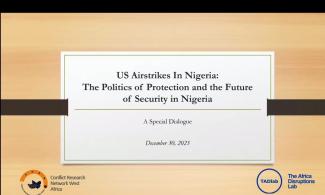
The dialogue, titled “US Airstrikes In Nigeria: The Politics of Protection and the Future of Security in Nigeria,” was organised by the Conflict Research Network (CORN) West Africa and The Africa TADLab Disruptions, with scholars and policy analysts interrogating what they described as the deeper political interests behind American involvement.
Speaking during the session, Professor Mojubaolu O. Okome, who chaired the dialogue, questioned the narrative that the US intervention was driven solely by humanitarian concerns.
“I did not say Trump came of his own volition. I said some of the Christians invited him. He agreed and said he’s coming to their rescue. He and US intervention is not the solution,” Okome said.
She argued that the intervention aligns with broader American strategic interests rather than Nigeria’s security needs.
She said, “The US is interested in pushing out the Chinese and taking control of the minerals Nigeria has that they need.”
Okome urged participants to interrogate official US policy positions, stating, “Please read the most current National Security Document of the US.”
She further warned that Washington’s interests extend beyond Nigeria, adding, “America also wants to control what’s happening in the AES states. It lost its drone base in Niger and won’t mind having one in Nigeria to replace it.”
According to the professor, recent developments could expose Nigeria to deeper exploitation.
“Finally, the US has now been enabled to take whatever it wants from Nigeria unimpeded,” she said, cautioning that foreign military involvement often becomes entrenched.
“Historically, there are no short interventions. Nigerians who are happy will regret this development,” Okome added.
She also warned of the dangers civilians could face as a result of airstrikes, noting that “there are also possibilities of stray missiles and what is described as ‘collateral damage.’”
In another remark during the dialogue, Okome criticised public celebration of foreign military action, saying, “Gloating about the success of an external actor that is not accountable to the citizens of a country is naive.”
Another participant, Omowumi Asubiaro Dada, questioned the moral basis of the intervention, particularly in light of previous US immigration policies toward Nigerians.
She argued that military action could worsen fear among civilians rather than improve security.
“There are better ways to help Nigerians than bombing land and further creating fear in the people because that single act now means people will live in fear not knowing when they will be bombed,” Dada said.
However, the dialogue also reflected differing views. Another participant, Reginald Mbawuike, challenged the rejection of foreign intervention outright, questioning the implications of opposing such actions.
“Unfortunately, ‘Nigerians being killed’ doesn’t lead to American sentiment to save Nigerians from being killed,” Mbawuike said.
He asked, “So, is Mojubaolu Okome saying that there should be no language to lead to foreign intervention targeting the killers of the citizens of Nigeria, because you are uncomfortable with the foreign language or sentiment?”
The organisers said the dialogue was aimed at encouraging critical reflection on foreign military involvement in Nigeria and its long-term consequences, especially as the country continues to grapple with widespread insecurity.