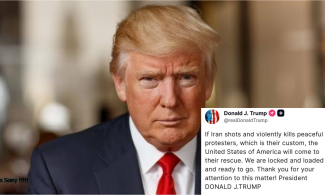
Trump made the statement on Truth Social, warning Tehran against what he described as its “custom” of shooting and killing peaceful demonstrators.
The United States President Donald J. Trump has issued a fresh threat against Iran, declaring that the U.S. is prepared to intervene militarily if Iranian authorities violently crack down on protesters.
Trump made the statement on Truth Social, warning Tehran against what he described as its “custom” of shooting and killing peaceful demonstrators.
“If Iran shots (sic) and violently kills peaceful protesters, which is their custom, the United States of America will come to their rescue,” Trump wrote. “We are locked and loaded and ready to go. Thank you for your attention to this matter!”
The post immediately sparked reactions online, with critics describing it as inflammatory and reckless, while supporters praised it as a tough stance against alleged human rights abuses in Iran.

Iran swiftly pushed back. A senior Iranian official and top adviser to Supreme Leader Ayatollah Ali Khamenei, Ali Larijani, warned that any U.S. interference in Iran’s domestic affairs would destabilise the entire Middle East.
“American people should know that Trump started the adventurism. They ought to watch over their soldiers,” Larijani said, noting Iran’s regional influence through allied groups in Lebanon, Iraq and Yemen.
His comments came amid escalating tensions inside Iran, as a local official in western Iran, where several deaths have been reported, was quoted by state media as warning that any unrest or illegal gatherings would be met “decisively and without leniency,” raising fears of further bloodshed.
The warnings follow the largest wave of protests Iran has seen in three years. Demonstrations over soaring inflation and economic hardship have spread across the country, with deadly clashes between protesters and security forces concentrated in the western provinces of Lorestan and Chaharmahal and Bakhtiari.
State-affiliated media and human rights groups say at least six people have been killed since Wednesday.
Among the dead is a man authorities identified as a member of the Basij paramilitary force, which is affiliated with Iran’s powerful Revolutionary Guards.
Iran has repeatedly faced major bouts of unrest in recent decades, often suppressing protests through mass arrests and heavy security deployments. However, analysts say deepening economic woes may have left the authorities more vulnerable this time.
The current demonstrations are the largest since nationwide protests erupted in late 2022 following the death of a young woman in police custody, unrest that paralysed the country for weeks and left hundreds dead, according to rights groups.
During the latest unrest, Iran’s President, Masoud Pezeshkian, struck a rare conciliatory tone, pledging dialogue with protest leaders over the cost-of-living crisis, even as rights groups accused security forces of firing on demonstrators.
Speaking on Thursday, before Trump’s threat, Pezeshkian acknowledged that government failures were largely responsible for the crisis.
“We are to blame… Do not look for America or anyone else to blame. We must serve properly so that people are satisfied with us,” he said. “It is us who have to find a solution to these problems.”
Pezeshkian’s administration is pursuing an economic liberalisation agenda, but one key policy, loosening currency exchange controls, has triggered a sharp fall in the value of Iran’s rial on the unofficial market.
The currency slide has worsened inflation, which has remained above 36 percent since March, even by official estimates, in an economy battered by Western sanctions over Iran’s nuclear programme.
Additional pressure has come from Israeli and U.S. strikes last year, the ousting of Syria’s Bashar al-Assad, a close ally of Tehran, and Israel’s sustained bombardment of Hezbollah targets in Lebanon.
Iran continues to back armed groups in Iraq that have previously targeted U.S. forces, as well as Yemen’s Houthi movement, which controls much of the country’s north.
The Hengaw human rights group reported that at least 29 protesters have been arrested in the latest wave of demonstrations, including 14 ethnic Kurds, seven Lors, seven women and two children.
In Lorestan Province, a senior judicial official warned that there would be “no tolerance for illegal actions that threaten public order and safety.” State media said security forces had arrested several “disruptive individuals” in the counties of Azna and Delfan.
Chaharmahal and Bakhtiari Province has also witnessed unrest. Iran’s semi-official Fars News Agency reported that three protesters were killed and 17 others injured during an attack on a police station in western Lorestan.
Both Fars and Hengaw reported additional fatalities in Lordegan, while authorities confirmed one death in Kuhdasht, Lorestan. Hengaw also reported another death in Iran’s central Isfahan Province.