By Haruna Mohammed Salisu
The Auditor General’s findings went beyond Government House and major ministries. WikkiTimes found that Bauchi’s public university, polytechnic, colleges, and agencies also failed to manage public funds properly. These institutions are supposed to set an example, keep good records, train professionals, and carefully manage the resources they receive.
Instead, the audit report shows that these institutions often failed to document expenditures, settle advances, remit revenue, or follow basic financial rules.
Many of these institutions showed the same problems as the ministries. Payment vouchers were created without documents. Advances were given but not settled. Revenue was collected but not sent to government accounts. Store records were incomplete, ignored or documents forged to justify payments.
At Sa’adu Zungur University, the state’s flagship public university, the audit findings span multiple reporting periods and financial control categories. For the period between January and June 2024, auditors recorded that payment vouchers totaling ₦63,561,228.33 were paid without supporting documentation. During the same period, advances totaling ₦12,069,200 granted to officers were not retired, in violation of financial regulations.
WikkiTimes found that between July and December 2023, payment vouchers totaling ₦48,008,949.41 were not presented for audit scrutiny. Without these vouchers, auditors could not verify whether the expenditures complied with financial rules. In another finding, discrepancies totaling ₦9,164,485 were observed between the total amounts on the payment vouchers and the attached receipts.

The audit also recorded inflated diesel costs of ₦14,559,300, in violation of store regulations. In addition, tax deductions from staff salaries amounting to ₦84,288,684.54 were not remitted to the Bauchi State Government. Another finding showed that ₦101,047,015 in payment vouchers was not posted to the payment cash book, thereby prevent the tracing of funds.
Named after a man whose life was defined by moral, ethical, and intellectual discipline, Sa’adu Zungur University’s appearance in the audit report betrays this creed. The audit report shows that the University now moves funds without documentation,obligations that deviate from the founding legacy of Sa’adu Zungur.
ATAP and the missing trail
At Abubakar Tatari Ali Polytechnic, the audit presents one of the most detailed accounts of financial disorder in the entire report. The findings cut across revenue remittance, payment documentation, store control, advances, and loan recovery.
Auditors found that ₦21,416,265, representing 30 percent of government revenue due from the polytechnic, had no evidence of remittance to government coffers. The audit report found no evidence that the funds were transferred, lodged, or otherwise accounted for as required by revenue remittance rules.
In addition, ₦13,417,279 in payment vouchers was paid without supporting documents. Another ₦15,165,983.06 in payment vouchers was not presented for audit scrutiny, contrary to Section 125 of the Constitution and the Bauchi State Public Sector Audit Law of 2021. When vouchers are not presented for audit, auditors cannot confirm the legitimacy of the expenditure.
The audit also highlighted failures in store control. Purchases totaling ₦28,635,393 were recorded on store receipt vouchers but not posted to the store ledgers. Without store ledger entries, auditors could not ascertain how the items were distributed or whether they were used for their intended purposes.
Advances and imprests granted to officers also remained unretired. Auditors recorded ₦760,000 in unretired advances and ₦2,210,000 in unretired imprests, contrary to Financial Regulation No. 1010 of 2001. These regulations require that advances be retired within specified periods to prevent their conversion into informal loans.
Payments to the polytechnic’s consultancy unit raised further concerns. According to the audit, ₦5,797,688.70 was paid without proper documentation. In another finding, ₦32,881,847.10 was recorded as unauthorised payment vouchers, meaning the expenditures were not approved by the appropriate authority. The audit also recorded ₦5,238,580 in soft loans granted to officers without evidence of repayment.
Colleges and agencies where approvals failed
Other tertiary institutions and agencies showed similar weaknesses, even where the amounts involved were smaller. At A.D. Rufa’i College of Legal Studies, Misau, auditors recorded payment vouchers totaling ₦3,764,577 that were paid without supporting documentation. Another ₦5,045,500 was spent without authorisation by the officer controlling the vote, while ₦2,618,100 was paid without beneficiary acknowledgement receipts. Store ledger discrepancies amounting to ₦9,000,900 further weakened the institution’s financial records.
In August 2023, a WikkiTimes investigation found that the A.D. Rufa’i College imposed multiple overlapping fees on students for largely fictitious or undelivered services, thereby extorting multiple payments.
At the Bill and Melinda Gates College of Health Sciences, Ningi, the audit identified discrepancies in bank reconciliations, payment vouchers totaling ₦958,000 paid without supporting documents, and a discrepancy of ₦ 625,000 between payment vouchers and the cash book.
 These findings suggested weaknesses in basic accounting practices, including the reconciliation of payment vouchers with cash books and bank statements.
In October 2021, a WikkiTimes investigation found that admission malpractice, assault on a school law, and other abuses at Health College undermine academic quality, compromising standards and student welfare.
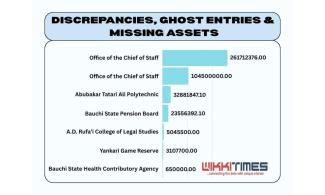
The Specialist Hospital Board was cited for ₦63,200,000 in diesel payments for generator operations, without retirement documents. Without retirement records, auditors could not verify whether the funds were used as intended. At the Bauchi State Health Contributory Management Agency, ₦650,000 was disbursed without approval, in violation of financial regulations.
All these findings point to the same fundamental problem observed in larger institutions: payments were made, but the required approvals and documentation were missing or incomplete.
Parastatals where revenue disappeared
In several parastatals, the audit shifted focus from undocumented payments to missing or unaccounted revenue. At Yankari Express Corporation, auditors recorded a difference of ₦ 165,521,434 between revenue collected and bank lodgements. This meant that the amount recorded as collected did not match what was deposited into bank accounts.
Additional findings at Yankari Express included ₦65,272,100 in bank reconciliation variances, ₦8,340,030 in payment vouchers not submitted for audit, ₦17,567,026 worth of items not posted to the store ledger, ₦165,521,434 difference between revenue collected and bank lodgement, 49,325,322 spare parts purchased without proof of installation, and ₦10,018,300 in payments without supporting documents. The audit also noted that three official vehicles, one Hilux and two Canter trucks, were missing.
At Yankari Game Reserve, WikkiTimes examination of the audit report finds that ₦23,889,633 in unauthorised payment vouchers and ₦21,021,641.63 in payments made without supporting documents. Bank withdrawals totaling ₦4,013,690 had no associated expenditure records. Other payments include ₦1,607,950 made without vouchers; ₦2,079,700.00 in Diesel purchases not recorded in the store ledger; ₦2,755,750 in revenue not accounted for; ₦ 3,107,700 in payments without approval; and another ₦14,675,895 payment to a ghost beneficiary.

The audit also found instances in which revenue was collected but not recorded, diesel purchases were not entered into store records, and payments were made without approval.
In every case, auditors did not guess what happened to the money. They simply reported what the records showed—and what was missing.
Explanations that never closed the file
In universities, polytechnics, colleges, and agencies, audit reports indicate that explanations rarely resolved the problems identified. Often, responses were missing or did not address the main issues.
Where vouchers were missing, they remained missing. Where revenues were unremitted, evidence of remittance was not produced. Where advances were unretired, the audit does not indicate that recoveries were made during the reporting period.
The audit report does not show that any disputed amounts were refunded, corrected, or penalized during the review period. Many issues remain unresolved in the public accounts.
How Violators Can Account for their Recklessness under the law
Under Nigerian law, public officers act as trustees subject to strict statutory obligations. Where audit reports, such as those in Bauchi State, reveal unauthorized spending or fictitious receipts, precise legal accountability mechanisms exist.
The 1999 Constitution mandates strict financial control. Section 120(2) stipulates: “No moneys shall be withdrawn from the Consolidated Revenue Fund of the State except to meet expenditure that is charged upon the Fund by this Constitution or where an Appropriation Law has authorised the issue of those moneys, Supplementary Appropriation Law or Law passed in pursuance of section 121 of this Constitution.” Spending outside these parameters, even under the limited exceptions of Section 122, remains constitutionally invalid.
Constitutional oversight is absolute. Section 125 (4) empowers the Auditor-General: “to conduct periodic checks of all government statutory corporations, commissions, authorities, agencies, including all persons and bodies established by a law of the House of Assembly of the State.” Withholding vouchers constitutes a violation and requires referral to the House of Assembly under Section 125(5).
Regarding fraudulent practices, Section 19 of the ICPC Act provides that: “Any public officer who uses his office or position to gratify or confer any corrupt or unfair advantage upon himself or any relation or associate of the public officer or any other public officer shall be guilty of an offence and shall on conviction be liable to imprisonment for five (5) years without option of fine.”
Section 46 of the EFCC Establishment Act 2004 categorizes tax non-remittance and fund diversion as economic crimes. Sections 17 and 20, regarding “Retention of proceeds of a criminal conduct” and “Forfeiture after conviction,” establish that subsequent restitution does not nullify the initial offense, thereby affording the EFCC and ICPC full legal authority to prosecute these violations.
This report is produced with support from Civic Media Lab (CML).