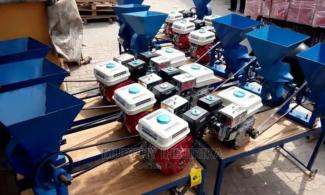
The budget description reads: "provision of welding equipment, grinding machines, mobile cart and vulcanising machines to empower youths and women in establishing small business in Niger Delta States."
A SaharaReporters' review of Nigeria’s 2026 approved budget has shown that the Cereals Research Institute plans to spend N1.1billion on grinding machines and welding equipment.
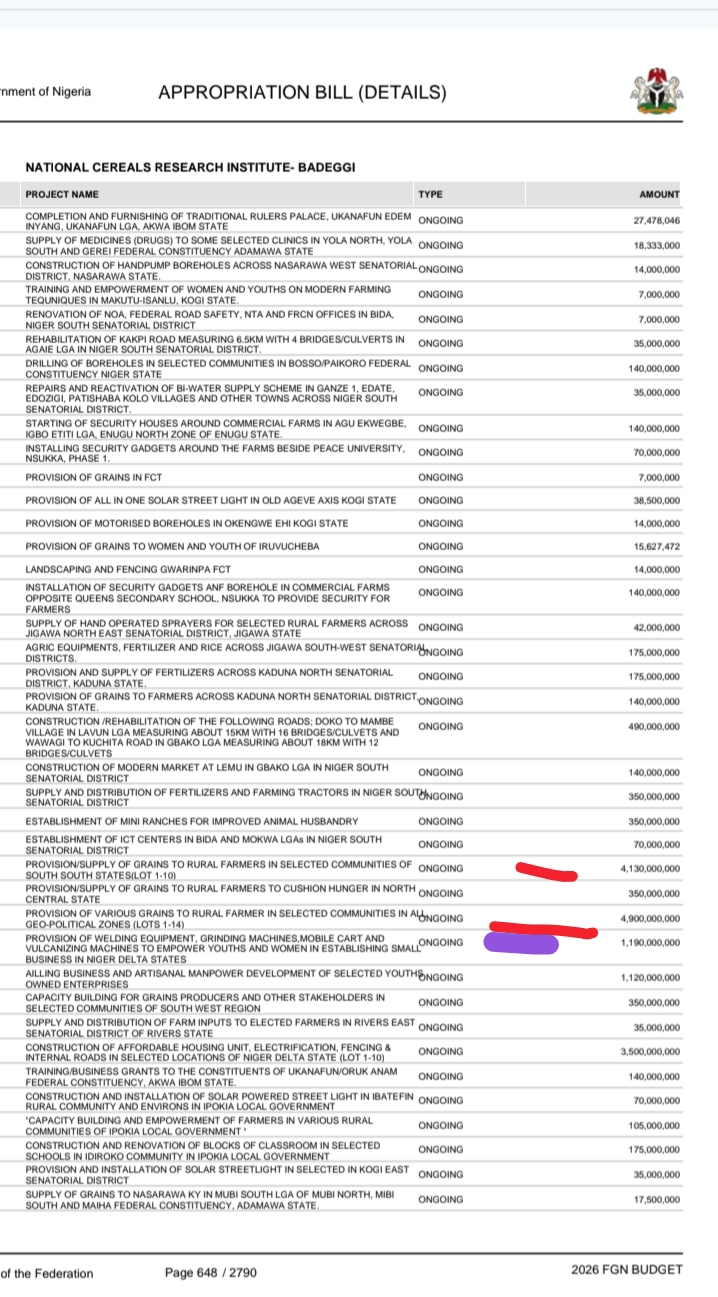
The budget description reads: "provision of welding equipment, grinding machines, mobile cart and vulcanising machines to empower youths and women in establishing small business in Niger Delta States."
Further review shows that a total of N4.1billion has been budgeted by the National Cereals Research Institute for the supply of grains to rural farmers in selected communities in the South-South region of Nigeria.
Another N4.9 billion is planned by the same institute for the purchase of grains for rural farmers across all geopolitical zones of the country.
Additionally, the National Cereals Research Institute plans to spend N350 million on capacity building for "Grain producers and other stakeholders in SouthWestern Nigeria."
In September 2025, SaharaReporters reported that a civic watchdog, the Civic Accountability Platform (MonITng), raised the alarm over what it described as the mismanagement of public funds under the guise of empowerment programmes in Aguata Federal Constituency, Anambra State.
In a statement, the group said: "Our team tracked how public funds are being mismanaged under the guise of empowerment programs in Aguata Federal Constituency, Anambra State."
The project in question, titled Vocational Training and Empowerment of Selected Youths and Women of Aguata Federal Constituency, Anambra State, with Project Code ZIP20250444, was facilitated by Hon. Engr. Dominic Ifeanyichukwu Okafor, the member representing Aguata Federal Constituency. It was executed through the Federal Co-operative College, Oji River, under the Ministry of Agriculture.
According to MonITng, the project was budgeted at ₦36 million in taxpayers’ money but was unveiled at Igboukwu Central School on Tuesday, September 9, 2025, as a distribution of wheelbarrows, hoes, and cutlasses.
The group lamented that rather than vocational training or the provision of meaningful tools, what was delivered fell far short of expectations.
"This exposes how constituency projects meant to tackle unemployment and poverty have been reduced to political handouts. Empowerment should mean equipping youths and women with skills like tailoring, ICT, agro-processing, welding, or renewable energy installation, alongside tools that can create real businesses and opportunities. Instead, ₦36 million was sunk into crude implements that belong to a bygone era."
MonITng questioned the rationale behind the project, stressing that such items could not meet the pressing needs of today’s economy.
"How does a cutlass or wheelbarrow empower a young graduate to compete in today’s economy? How does it provide women with sustainable livelihoods? The truth is: it doesn’t. These items only entrench poverty while politicians score cheap points with party loyalists."
The group argued that Nigeria risks falling further behind if leaders continue to prioritise outdated empowerment models.
"At a time when nations are investing in technology-driven agriculture and digital empowerment, using ₦36 million on cutlasses and wheelbarrows is not just misplaced priority, it is a waste of public funds."