
In a directive dated January 13, 2026, the Uganda Communications Commission (UCC) instructed all licensed Mobile Network Operators (MNOs) and Internet Service Providers (ISPs) to immediately suspend public internet services across the country.
Ugandan authorities have ordered a nationwide shutdown of public internet access and selected mobile services ahead of the country’s presidential election, citing security concerns and the need to curb misinformation and potential violence.
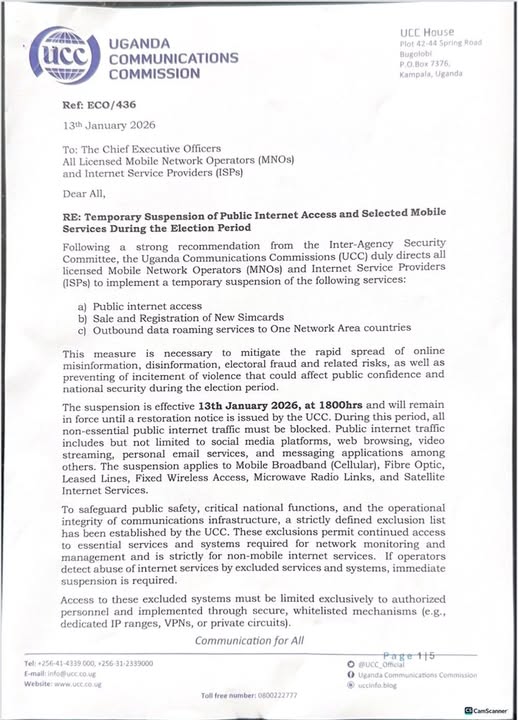
In a directive dated January 13, 2026, the Uganda Communications Commission (UCC) instructed all licensed Mobile Network Operators (MNOs) and Internet Service Providers (ISPs) to immediately suspend public internet services across the country.
The order, contained in a circular referenced ECO/436 and addressed to the chief executive officers of telecom operators, said the decision followed a “strong recommendation” from the Inter-Agency Security Committee.
According to the UCC, the suspension takes effect from 6:00 p.m. on January 13, 2026, and will remain in force until further notice.
The directive mandates the suspension of public internet access, the sale and registration of new SIM cards, and outbound data roaming services to countries within the One Network Area.
The commission stated, "Following a strong recommendation from the Inter-Agency Security Committee, the Uganda Communications Commissions (UCC) duly directs all licensed Mobile Network Operators (MNOs) and Internet Service Providers (ISPs) to implement a temporary suspension of the following services: Public internet access; Sale and Registration of New Simcards; and Outbound data roaming services to One Network Area countries.
"This measure is necessary to mitigate the rapid spread of online misinformation, disinformation, electoral fraud and related risks, as well as preventing of incitement of violence that could affect public confidence and national security during the election period.”
Under the order, all non-essential public internet traffic must be blocked. The UCC listed affected services to include social media platforms, web browsing, video streaming, personal email services and messaging applications.
The shutdown applies across multiple connectivity platforms, including mobile broadband, fibre optic networks, leased lines, fixed wireless access, microwave radio links and satellite internet services.
However, the commission said it had established a “strictly defined exclusion list” to allow continued access to essential systems required for critical national functions and network monitoring.
These exclusions apply only to non-mobile internet services and must be accessed solely by authorised personnel through whitelisted and secure mechanisms such as dedicated IP ranges, VPNs or private circuits.
"The suspension is effective 13th January 2026, at 1800hrs and will remain in force until a restoration notice is issued by the UCC. During this period, all non-essential public internet traffic must be blocked,” it stated.
"Public internet traffic includes but not limited to social media platforms, web browsing, video streaming, personal email services, and messaging applications among others. The suspension applies to Mobile Broadband (Cellular), Fibre Optic, Leased Lines, Fixed Wireless Access, Microwave Radio Links, and Satellite Internet Services.”
"To safeguard public safety, critical national functions, and the operational integrity of communications infrastructure, a strictly defined exclusion list has been established by the UCC,” it added.
“These exclusions permit continued access to essential services and systems required for network monitoring and management and is strictly for non-mobile internet services. If operators detect abuse of internet services by excluded services and systems, immediate suspension is required.”
The UCC warned operators that any abuse of the excluded services would attract immediate suspension.
"Access to these excluded systems must be limited exclusively to authorized personnel and implemented through secure, whitelisted mechanisms (e.g., dedicated IP ranges, VPNs, or private circuits)," the statement said.