The budget line item, listed under the “State House Headquarters,” was described as “Plant and Generator fuel cost,” with a total of N1.989 billion earmarked for the purpose.
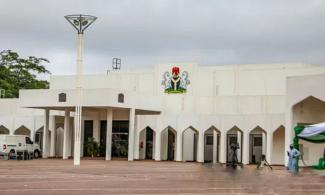
A SaharaReporters review of Nigeria’s 2026 budget document has shown that a sum of N1.9 billion has been budgeted for the fueling of generators at the State House, also known as the Aso Rock Villa.
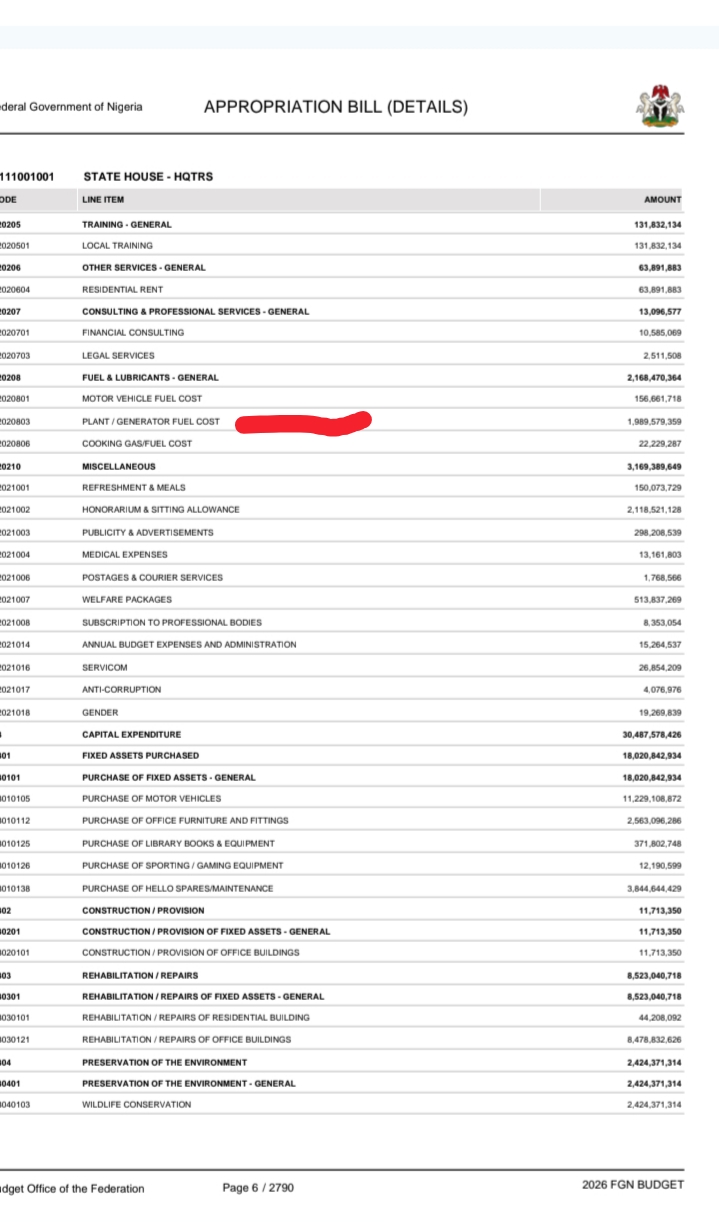
The budget line item, listed under the “State House Headquarters,” was described as “Plant and Generator fuel cost,” with a total of N1.989 billion earmarked for the purpose.
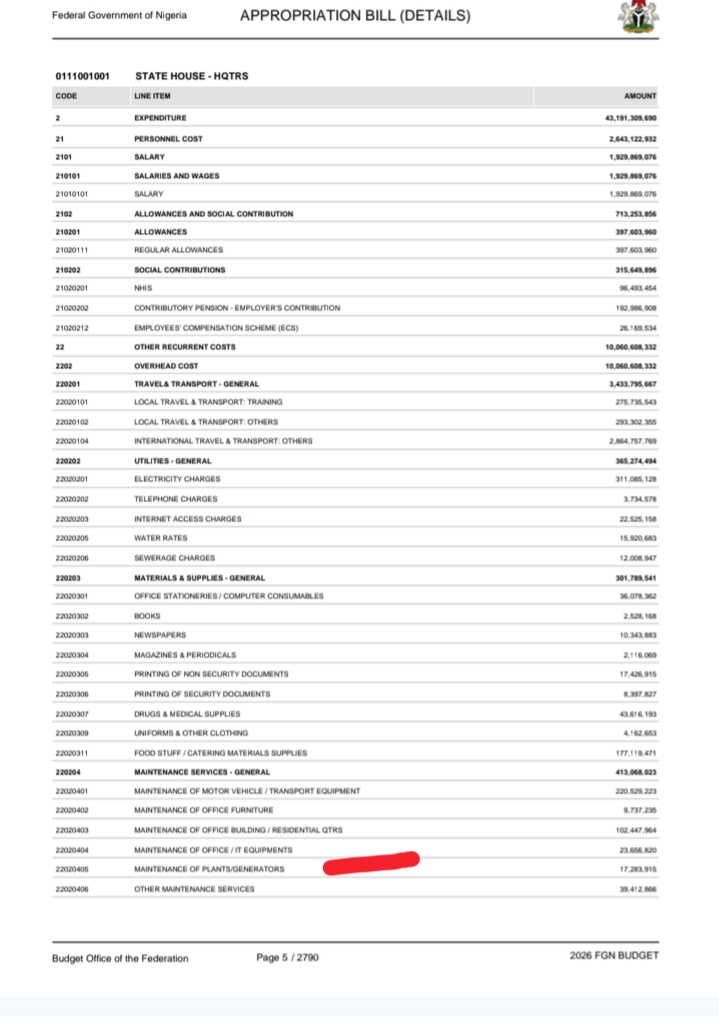
In addition, the State House plans to spend N17.2 million on generator maintenance in the 2026 fiscal year.
This brings the total amount earmarked for generator fueling and maintenance at the Aso Rock Villa in 2026 to approximately N2 billion.
This development comes despite an earlier allocation of N7 billion in the 2026 budget for the solarisation of the Aso Rock Villa. A similar project had N10 billion set aside for it in the 2025 fiscal year.
Details published by the Budget Office of the Federation listed the allocation under State House expenditures. The N7 billion was described as “provision of solarisation of Villa with solar mini grid.”
The move to develop a solar grid for Aso Rock, which houses the President and other top Presidency officials, comes amid persistent power failures experienced by average Nigerians across the country.
In April 2025, following public outrage over the initial N10 billion budget for the solarisation of the Aso Rock Villa, the Tinubu administration defended its decision.
The Presidency justified the approval of the N10 billion solar energy project for the State House, Aso Rock, describing it as a strategic long-term investment in sustainability and energy efficiency.
The defence came amid mounting public criticism over the cost and timing of the initiative, given Nigeria’s economic challenges and growing concerns about government spending.
Some Nigerians also criticised the Tinubu government for allegedly reneging on its promise to provide stable electricity, arguing that the adoption of solar power at the Presidential Villa suggested the administration could no longer fulfil that commitment.
While the government continues to promise improved electricity supply for citizens, ministries, departments and agencies have been exploring alternative power sources such as solar energy and generators.
According to the 2026 fiscal year budget document, the Police Academy, Wudil, budgeted N700 million for an alternative power supply (solar) for its cadet hostels, administrative block and Senate building.
The Office of the Auditor-General of the Federation also budgeted N225 million for solar power and inverter installation.
The Office of the Head of Civil Service of the Federation, in the 2026 budget, estimated N700 million for power generating sets.
Further review shows that the National Identity Management Commission (NIMC) plans to spend N1.8 billion on “power generating systems” for its headquarters data centres and its 36 state offices to ensure 24/7 electricity at its data centres.
The Federal Road Safety Corps budgeted N66.1 million for solar energy installations across three zonal commands, while the Police Service Commission headquarters budgeted N59.5 million for solar energy.
The Nigeria Security and Civil Defence Corps also budgeted N147 million for the “second phase of solar power installation” at its headquarters.