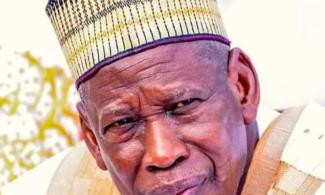
Ganduje, who is listed as the first defendant in the suit, was granted temporary relief on Wednesday after the court declined to issue a bench warrant compelling his arrest for failure to appear in court.
A Kano State High Court has refused an application by the state government seeking the arrest of a former governor of the state, Abdullahi Umar Ganduje, over his alleged role in the controversial ownership and management of the Dala Inland Dry Port Limited.
Ganduje, who is listed as the first defendant in the suit, was granted temporary relief on Wednesday after the court declined to issue a bench warrant compelling his arrest for failure to appear in court.
The application for an arrest warrant was brought by the Kano State Government through its counsel, Ya’u Adamu, who told the court that Ganduje and the other defendants had failed to present themselves for arraignment despite being aware of the proceedings.
According to the prosecution, the application was made pursuant to Section 388 of the Administration of Criminal Justice Law (ACJL) of Kano State, which empowers the court to issue a bench warrant against a defendant who refuses or fails to attend court proceedings.
The state’s counsel submitted that the defendants had failed to appear before the court, and therefore urged the court to issue a bench warrant to secure their attendance
Ganduje is facing trial alongside three other defendants: his former aide, Abubakar Bawuro; his lawyer, Adamu Aliyu-Sanda; and a former Managing Director of the Nigerian Shippers’ Council, Hassan Bello.
They are standing trial on a 10-count charge bordering on criminal conspiracy, misappropriation of public funds, criminal breach of trust, abuse of office, and conflict of interest.
However, the State High Court No. 2, sitting at the Audu Bako Secretariat Complex in Kano, declined the request for a bench warrant.
Delivering a ruling on the application, the presiding judge, Justice Yusuf Ubale, held that issuing an arrest warrant at this stage of the proceedings would be premature.
Justice Ubale ruled that there were outstanding legal issues raised by the defence which must first be resolved before the court could consider coercive measures such as a bench warrant.
Ganduje was represented in court by a Senior Advocate of Nigeria, A.S. Gadanya, who led other defence lawyers in opposing the application by the prosecution.
The defence team urged the court to first hear and determine their preliminary objections before proceeding with any arraignment or enforcement action against the defendants.
In particular, Ganduje filed a preliminary objection challenging the service of court processes on him.
His lawyers argued that the service effected by the prosecution was improper and went to the root of the court’s jurisdiction.
According to the defence, the order for substituted service granted by the court was invalid, a nullity, and ultra vires, beyond the legal powers of the court.
They contended that until the issue of proper service was resolved, the court lacked the jurisdiction to proceed against Ganduje or to issue any arrest warrant.
Justice Ubale agreed with the defence position and granted the application to hear the preliminary objections. He subsequently adjourned the case to February 23 for a hearing on the objections raised by the defendants.
The charges against Ganduje and the other defendants stem from allegations by the Kano State Government that they conspired to fraudulently alter the ownership structure of Dala Inland Dry Port Limited, a strategic logistics and trade infrastructure project in Kano.
According to the prosecution, the defendants allegedly transferred 80 per cent of the shares of the dry port company, including the Kano State Government’s 20 per cent equity stake, into private hands using a fictitious company known as “City Green Enterprise.”
The state government further alleged that the defendants diverted over ₦4.49 billion in public funds belonging to Kano State to execute infrastructure projects at the dry port for their personal and family benefit.
These projects reportedly included the construction of a double carriageway, provision of electricity, and erection of perimeter fencing at the facility.
The prosecution claimed that these expenditures were carried out using state resources but ultimately benefited private interests linked to Ganduje and his associates.
In addition, the defendants were accused of abuse of office and conflict of interest, with prosecutors alleging that they leveraged their official positions to redirect public funds and assets for personal gain, in violation of financial regulations and constitutional provisions.
One of the most serious allegations against Ganduje is that he secretly transferred the Kano State Government’s 20 per cent stake in the Dala Inland Dry Port to private ownership.
However, the move effectively stripped the state of its equity in the project and made Ganduje’s children co-owners of the facility.