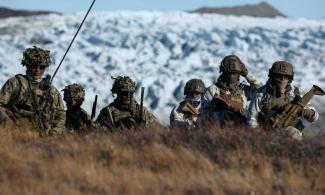
Denmark, which is responsible for Greenland’s defence, confirmed the deployment of troops and equipment as part of “Operation Arctic Endurance,” a joint exercise aimed at strengthening security cooperation in the region.
Several NATO member states have begun deploying military personnel to Greenland this week amid rising diplomatic tensions between the United States and its allies over the future of the strategic Arctic territory.
Denmark, which is responsible for Greenland’s defence, confirmed the deployment of troops and equipment as part of “Operation Arctic Endurance,” a joint exercise aimed at strengthening security cooperation in the region.
France, Germany, Sweden, and Norway have all announced plans to send small contingents of military personnel, including reconnaissance teams and officers preparing for coordinated exercises, to the sparsely populated island, according to CNBC.
French President Emmanuel Macron said on social media that French forces had already begun moving to Greenland and that more would follow as part of the exercise. Sweden’s Prime Minister Ulf Kristersson also confirmed the deployment of Swedish officers, saying they would work alongside other allies during the Danish-organised drills.
The military activity comes in the wake of high-level talks in Washington between Danish and Greenlandic officials and senior U.S. representatives, including Vice President J.D. Vance and Secretary of State Marco Rubio.
Ahead of the discussions, U.S. President Donald Trump reiterated that the United States “needs Greenland” for national security purposes, a stance that has alarmed Copenhagen and Nuuk.
Danish Foreign Minister Lars Løkke Rasmussen described the White House meeting as “frank but constructive”.
However, Rasmussen acknowledged there remained a “fundamental disagreement” over Trump’s comments about the island’s future.
“It’s clear that the president has this wish of conquering over Greenland,” Rasmussen said, stressing that Denmark’s position remained firm on Greenland’s sovereignty.
Greenland’s government, backed by Denmark and other European partners, has repeatedly rejected any notion of U.S. ownership or control, emphasizing that defence should be pursued through NATO and respect for international law.
Polls indicate overwhelming opposition among Greenlanders to U.S. control, and a strong majority supports eventual independence from Denmark.
Denmark has additionally pledged to increase its own military presence in and around Greenland, deploying aircraft, naval vessels, and troops alongside visiting NATO allies. Defence planners say the enhanced footprint is necessary not only for routine security but also to reassure the island’s population in the face of geopolitical pressures.
Though the United States already maintains military facilities on the island under long-standing agreements, Trump’s renewed push, framed as necessary to counter Russian and Chinese influence, has unsettled many European leaders who see any attempt to shift control as harmful to NATO cohesion and international norms.
As allied forces continue to arrive in Greenland, diplomats on all sides say efforts to establish common ground are ongoing, even as divisions over sovereignty and strategic priorities persist.
On Wednesday, Trump declared that the Americans “need Greenland for the purpose of National Security.”
He warned that Russia or China could take control of the territory if the US and its allies failed to act.
Trump made the remarks in a statement posted on his Truth Social account, where he linked Greenland’s strategic importance to what he described as a key US defence project.
“The United States needs Greenland for the purpose of National Security. It is vital for the Golden Dome that we are building,” Trump wrote.
Trump concluded by rejecting any alternative arrangement, declaring that “anything less than that (U.S. control) is unacceptable.”