
The figures show that power generation through diesel and petrol-powered generators remains a major recurrent cost for federal institutions amid persistent electricity supply challenges.
Security and law-enforcement agencies account for the bulk of Nigeria’s N6.626 billion budgeted for fueling generators and plants across 20 federal Ministries, Departments and Agencies (MDAs) in the 2026 fiscal year, according to an analysis of budget data.
The figures show that power generation through diesel and petrol-powered generators remains a major recurrent cost for federal institutions amid persistent electricity supply challenges.
The Economic and Financial Crimes Commission (EFCC) received the highest allocation, with N1.2 billion earmarked for fueling generators, representing about 18 per cent of the total amount set aside by the MDAs reviewed.
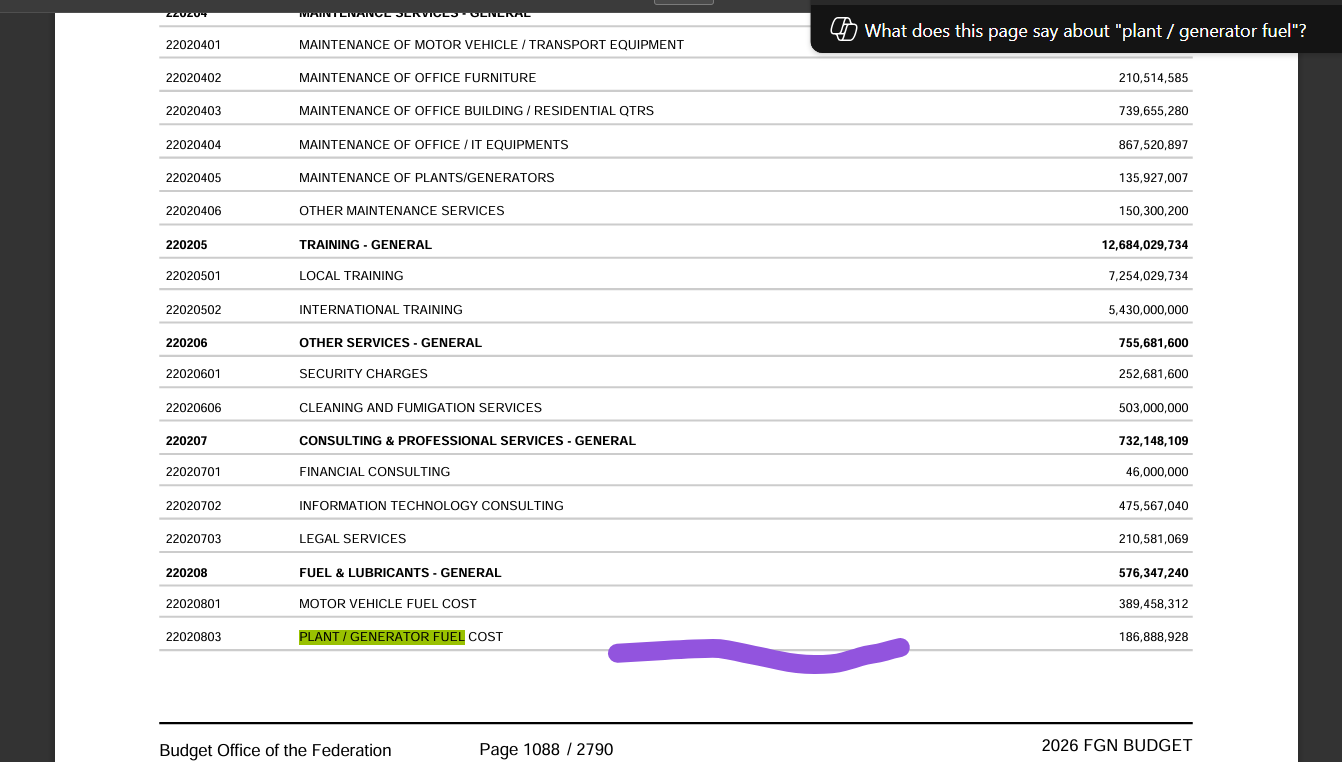
Other large allocations include N567.9 million for the Ministry of Foreign Affairs, N511 million for police formations and commands, and N455 million for the Ministry of Defence Headquarters. Together, these four institutions account for more than 40 per cent of the total N6.626 billion budget.
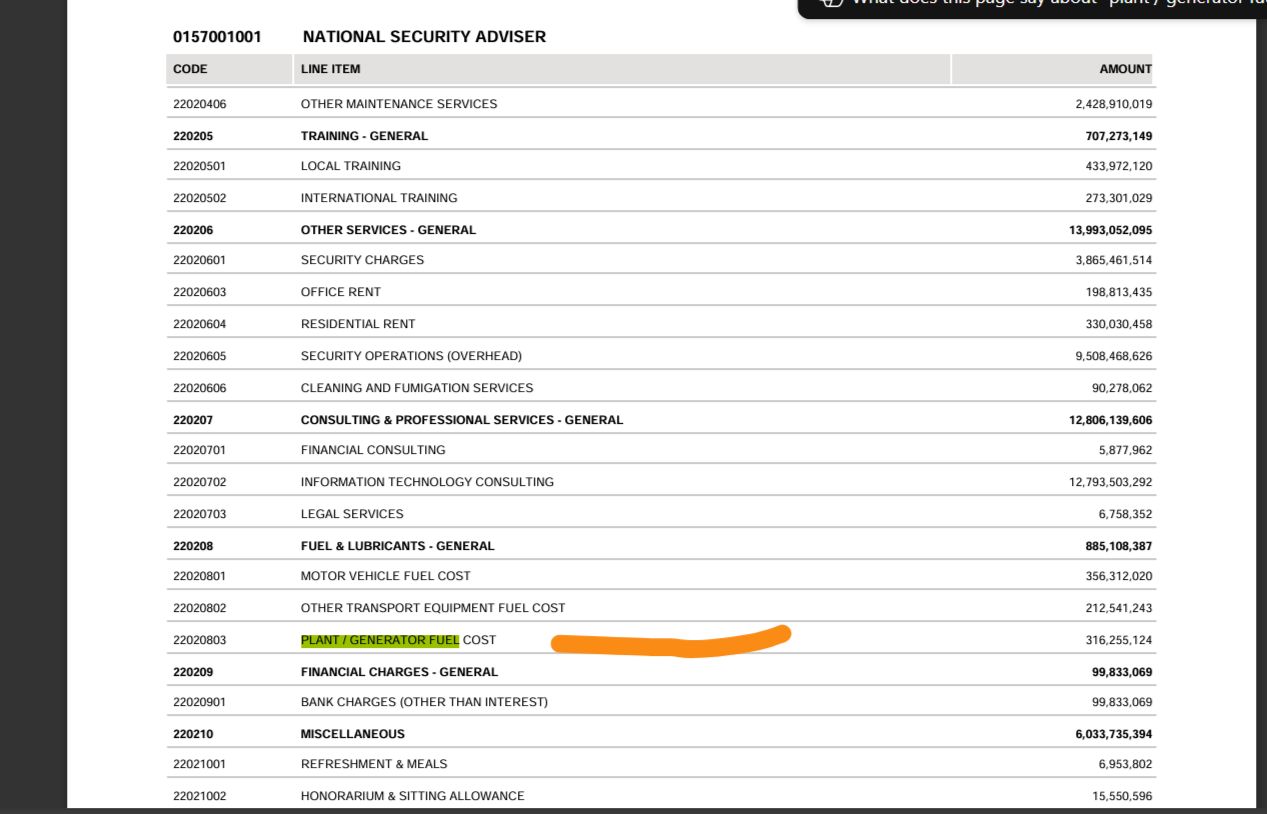
A breakdown of the data shows that security-related institutions dominate spending on generator fuel. Agencies such as the Ministry of Defence Headquarters, Nigerian Defence Academy, National Defence College, Police formations and commands, National Security Adviser, Directorate of State Security Service, Nigerian Immigration Service, Nigerian Correctional Service, Federal Fire Service and the Economic and Financial Crimes Commission (EFCC) collectively account for an estimated N4.17 billion, or about 63 per cent of the total allocation.
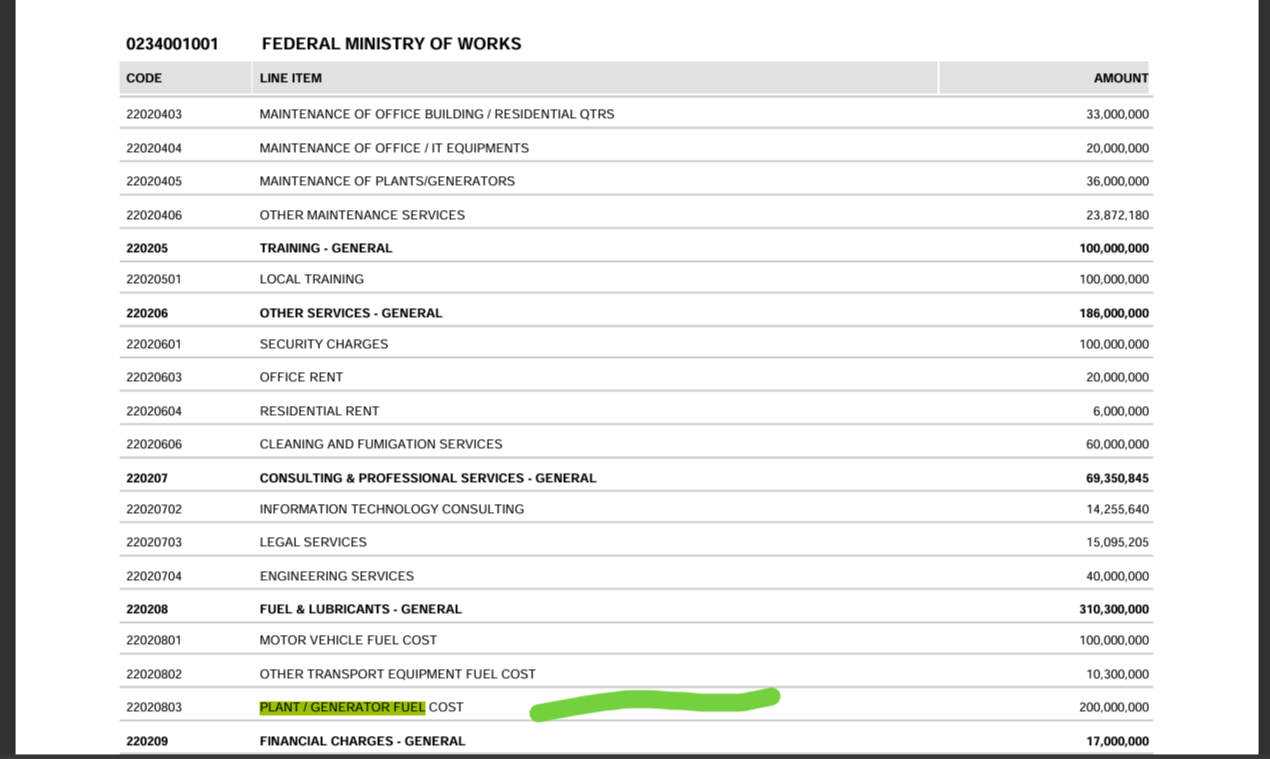
Outside the security sector, several civil and administrative institutions received allocations close to the overall average of about N331 million per agency. These include the Ministry of Finance (N325 million), the Office of the Head of Civil Service of the Federation Headquarters (N342 million), the Auditor-General of the Federation (N200.586 million) and the Ministry of Works (N200 million).
Media and information agencies were allocated relatively smaller sums. The Voice of Nigeria received N235 million, while the Federal Radio Corporation of Nigeria was allocated N136.8 million, bringing their combined total to N371.8 million.
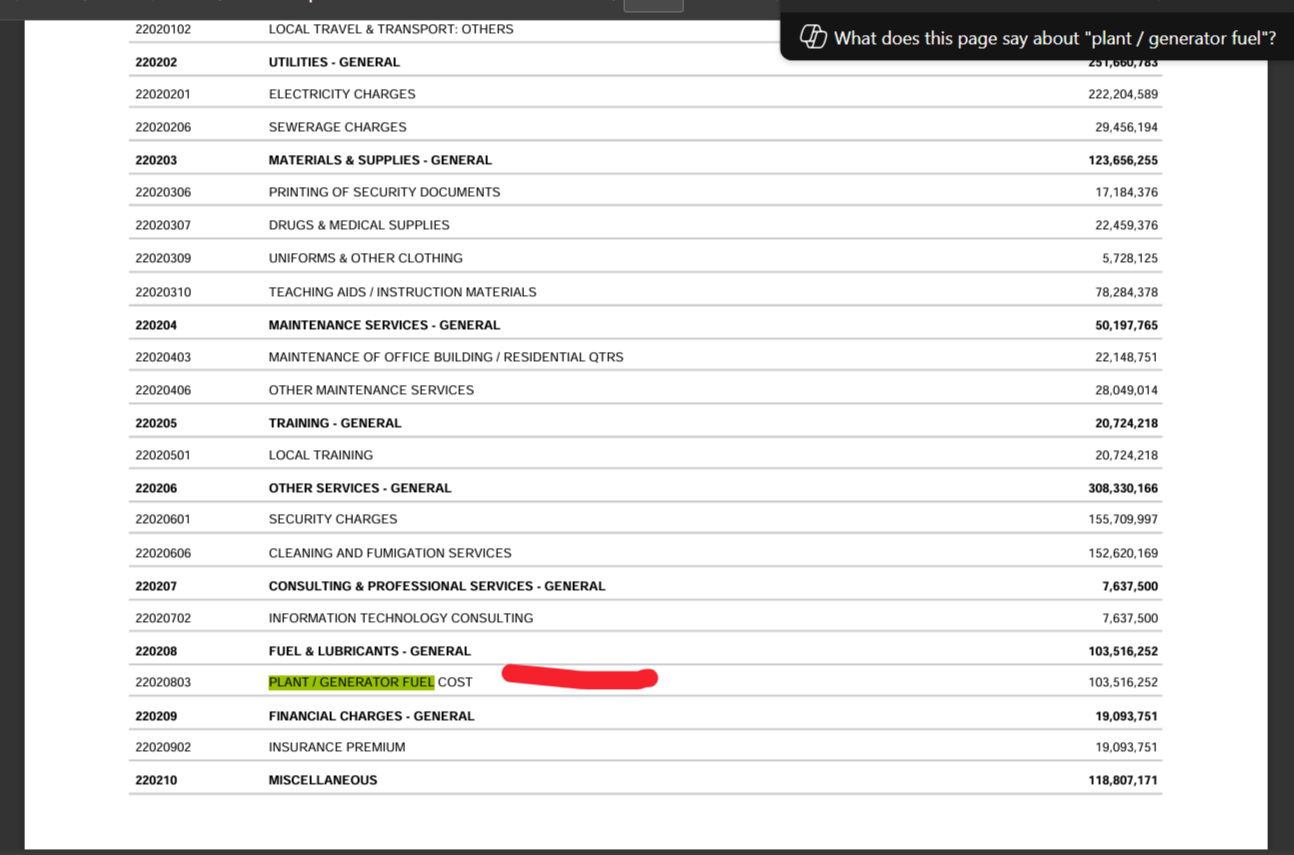
The lowest allocations in the dataset went to the Petroleum Training Institute (N103 million), the Federal Radio Corporation of Nigeria (N136.8 million) and the Ministry of Agriculture and Food Security Headquarters (N160 million).

Overall, the data reveal a wide disparity in generator fuel spending, ranging from N103 million to N1.2 billion, underscoring significant differences in institutional scale, infrastructure and operational intensity.
The continued reliance on generator fueling across federal MDAs highlights persistent power supply challenges and raises questions about the pace of investment in alternative and more sustainable energy sources within government institutions.
Earlier, a SaharaReporters review of Nigeria’s 2026 budget document showed that the sum of N1.9 billion had been budgeted for the fueling of generators at the State House, also known as the Aso Rock Villa.
The budget line item, listed under the “State House Headquarters,” was described as “Plant and Generator fuel cost,” with a total of N1.989 billion earmarked for the purpose.
In addition, the State House plans to spend N17.2 million on generator maintenance in the 2026 fiscal year.
This brings the total amount earmarked for generator fueling and maintenance at the Aso Rock Villa in 2026 to approximately N2 billion.
This development comes despite an earlier allocation of N7 billion in the 2026 budget for the solarisation of the Aso Rock Villa. A similar project had N10 billion set aside for it in the 2025 fiscal year.
Details published by the Budget Office of the Federation listed the allocation under State House expenditures. The N7 billion was described as “provision of solarisation of Villa with solar mini grid.”
The move to develop a solar grid for Aso Rock, which houses the President and other top Presidency officials, comes amid persistent power failures experienced by average Nigerians across the country.
In April 2025, following public outrage over the initial N10 billion budget for the solarisation of the Aso Rock Villa, the Tinubu administration defended its decision.