The Trump administration and Minnesota officials have each blamed the other for fuelling anger and violence.
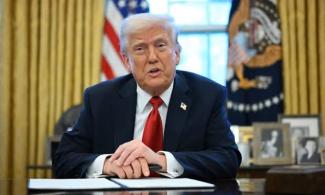
United States President Donald Trump has threatened to deploy the military to Minnesota under the Insurrection Act amid escalating unrest over a heightened immigration enforcement operation in Minneapolis.
The warning followed days of tense confrontations between residents and federal officers after an Immigration and Customs Enforcement (ICE) agent fatally shot U.S. citizen Renee Good in her car eight days ago.
Protests triggered by the killing have since spread to other cities, Reuters reports.
Trump’s threat came hours after another shooting in Minneapolis, in which an immigration officer wounded a Venezuelan man in the leg after authorities said he fled when agents attempted to stop his vehicle.
“If the corrupt politicians of Minnesota don't obey the law and stop the professional agitators and insurrectionists from attacking the Patriots of I.C.E., who are only trying to do their job, I will institute the INSURRECTION ACT,” Trump wrote on social media.
The Republican president has repeatedly criticised Minnesota’s Democratic leadership and referred to people of Somali origin in the state as “garbage” who should be “thrown out” of the country.
Nearly 3,000 federal officers have been deployed to the Minneapolis area. Armed officers wearing military-style camouflage gear and masks have patrolled the city’s streets amid loud, often angry protests by residents.
On Wednesday night, crowds gathered near the area where the Venezuelan man was shot. Some shouted in protest, prompting federal officers to deploy flash-bang grenades and release tear gas.
After most residents dispersed, a small group vandalised a car believed to belong to federal officers, spray-painting the words: “Hang Kristi Noem,” in reference to the Homeland Security secretary.
Since the surge began, federal agents have arrested both immigrants and protesters, at times smashing windows and pulling people from their cars. Officers have also been shouted at for stopping Black and Latino U.S. citizens to demand identification.
The Trump administration and Minnesota officials have each blamed the other for fuelling anger and violence.
One incident that drew national attention involved U.S. citizen Aliya Rahman, who was seized near the site where Good was killed. She said in a statement to Reuters that agents “dragged me from my car and bound me like an animal, even after I told them that I was disabled.”
Rahman said she repeatedly asked for a doctor while in ICE custody but was instead taken to a detention centre. She said she later lost consciousness in a cell and was taken to hospital.
A U.S. Department of Homeland Security spokesperson said an “agitator” ignored an officer’s commands to move her vehicle away from the scene of an enforcement action and was arrested for obstruction.
DHS identified the wounded Venezuelan man as Julio Cesar Sosa-Celis, who entered the United States in 2022 under the humanitarian parole programme of former president Joe Biden. The Trump administration has since revoked parole granted to Venezuelans and others admitted under the programme.
According to DHS, officers attempted to stop Sosa-Celis in his vehicle. He fled, crashed into a parked car, and ran on foot. During a struggle on the ground, two other Venezuelan men allegedly attacked an officer with a snow shovel and broom handle.
Sosa-Celis then struck the officer with “a shovel or a broomstick,” prompting the officer to fire “defensive shots to defend his life,” the DHS statement said. Reuters was not able to verify the account.
DHS said all three men were arrested after officers entered the apartment. Sosa-Celis and the officer were recovering in hospital, according to the department and city officials.
The Insurrection Act of 1807 allows a U.S. president to deploy the military or federalise a state’s National Guard to quell rebellion.
It has been used 30 times in U.S. history, according to New York University’s Brennan Center for Justice, and the Supreme Court has ruled that the president alone can determine when its conditions are met.
Trump has previously federalised National Guard troops for immigration enforcement in Democratic-led cities, including Los Angeles last year, a move a judge ruled unconstitutional in December.
A Reuters/Ipsos survey released this week showed the issue has divided Republicans, with 59% supporting immigration arrests even if people are hurt, while 39% said officers should prioritise avoiding harm even if it means fewer arrests.