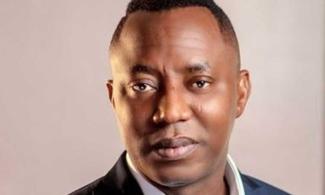
The order followed a strong objection raised by Sowore’s lead counsel, Abubakar Marshal, who argued that the provision of proof of evidence and particulars of witnesses is sacrosanct, fundamental, and mandatory under the law.
Justice Mohammed Umar of the Federal High Court sitting in Abuja has ordered the Department of State Services (DSS) to furnish human rights activist, Omoyele Sowore, with all necessary prosecution documents, including proof of evidence and a list of witnesses, to enable him adequately prepare for his ongoing cyberstalking trial.
The order followed a strong objection raised by Sowore’s lead counsel, Abubakar Marshal, who argued that the provision of proof of evidence and particulars of witnesses is sacrosanct, fundamental, and mandatory under the law.
Marshal maintained that denial of these documents grossly violates the defendant’s constitutional right to fair hearing and undermines due process. The lawyer insisted that Sowore cannot be compelled to proceed to trial without being properly served in line with legal requirements.
In a brief but firm ruling, Justice Umar agreed with the defence, stressing that compliance with due process is not optional. The judge noted that the prosecution must obey the law regardless of the nature of the witnesses it intends to call.
“Even if you are calling a spirit as a witness, you must follow the law,” Justice Umar remarked, drawing laughter in the courtroom.
The judge further emphasised that Section 36 of the 1999 Constitution (as amended), which guarantees the right to fair hearing, must be strictly observed, adding that the court would not condone any act capable of undermining justice.
Earlier, counsel for the DSS, Akinlolu Kehinde, SAN, insisted that the court should proceed with the trial despite the apparent procedural lapses.
However, in a startling admission, the prosecution counsel told the court that President Bola Ahmed Tinubu, who is listed as the complainant in the case, did not personally contact him to initiate or prosecute the matter.
The disclosure shocked observers in court and raised fundamental questions regarding whose instruction the prosecution counsel and the DSS acted upon in instituting the suit.
Speaking to journalists after the proceedings, Marshal described the prosecution’s failure to serve the defence with proof of evidence and witness statements as a clear violation of constitutional and statutory provisions.
He argued that without access to the allegations and witness statements, the defence was being denied adequate time and facilities to prepare for trial, as guaranteed by law.
“This is not the first time the government is bringing such cases to court,” Marshal said, noting that several similar matters have collapsed in the past due to failure to comply with due process.
The defence further described the case as symptomatic of broader governance challenges, arguing that at a time when Nigeria is battling terrorism and widespread insecurity, state resources are being deployed to suppress citizens for exercising their fundamental right to criticise the government.
According to the defence, the individual allegedly defamed has neither made a formal complaint nor reported the matter to any security agency.
“The person said to have been defamed has never come forward to complain or assert that the statements attributed to him were false,” Marshal stated.
Marshal also accused the DSS of abandoning its core mandate of intelligence gathering and national security to dabble in what he described as private disputes and political criticism.
He further questioned what he termed selective prosecution, noting that another prominent critic of the President, who had previously made similar allegations, was recently rewarded with a government appointment as an ambassador.
“If such criticism was indeed criminal, why was that individual compensated?” the defence queried.
The defence urged the government to focus on its primary responsibility of protecting lives and property rather than trivialising governance through suppression of dissent.
The case was adjourned to Thursday, January 22, 2026, for definite trial.