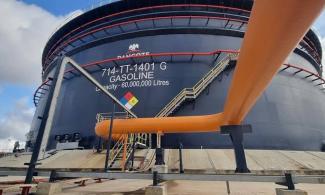
The importation highlights tightening product availability at the refinery, even as it maintains large-scale truck loading for the domestic market.
The Dangote Petroleum Refinery has begun importing gasoline components to sustain petrol (PMS) output, marking a notable shift as the mega-refinery turns to international markets while maintenance work continues at its Lekki facility.
This is according to shipping and trade-flow data reviewed by Petroleumprice.ng.
The importation highlights tightening product availability at the refinery, even as it maintains large-scale truck loading for the domestic market.
Industry sources say Dangote is bringing in the gasoline components strictly for blending purposes, underscoring a temporary reliance on external supply to support local petrol distribution rather than a halt in refining activity.
Shipping records show that at least two Medium Range (MR) product tankers carrying gasoline components are scheduled to discharge at the Dangote Refinery in late January, reinforcing the scale of the import programme.
One of the vessels, Ion M, loaded about 38,000 metric tonnes of gasoline blendstock at Immingham in the United Kingdom, a major Northwest European export hub.
The tanker, chartered to Dangote Refinery, was expected to arrive at the Lekki terminal on 21 January.
Another tanker, Silver Ginny, lifted a similar 38,000-metric-tonne cargo of gasoline components from Lavera, France, one of the Mediterranean’s largest refining and export centres.
Shipping estimates place its arrival around 25 January.
Both shipments consist of unfinished gasoline components rather than finished petrol, meaning they will undergo blending at the Lekki refinery before being released into the Nigerian market as PMS.
In addition to gasoline blend-stocks, trade data show that Dangote Refinery has also imported condensate and naphtha cargoes to support feedstock availability and optimise gasoline blending operations.
The vessel St Nenne, operated by Vitol, discharged condensate and naphtha at the refinery between 16 and 17 January, according to shipping data.
The tanker had anchored on 14 January after loading ex-Ningbo under a Bonny-linked trade route and was listed as the next vessel scheduled for discharge at the facility.
The cargo comprised an estimated 30,000 metric tonnes of condensate and 6,000 metric tonnes of naphtha, volumes consistent with refinery feedstock supplementation and blending optimisation for PMS production.
Gasoline components are unfinished or semi-finished petroleum products that cannot be sold directly to consumers.
They require blending with other refinery streams to meet PMS specifications before distribution to retailers across Nigeria.