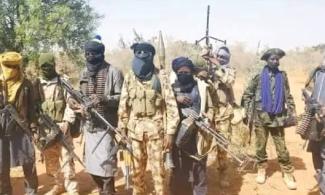
According to the sources, the clash was intense and lasted several hours, with both factions deploying fighters and weapons in a sustained battle for territorial dominance.
Dozens of fighters were reportedly killed on both sides on Tuesday following a renewed violent confrontation between the Islamic State West Africa Province (ISWAP) and elements of the Bukura faction loyal to Abu Umaima along the Lake Chad Basin axis of Abadam Local Government Area of Borno State.
It was learnt that the clash started in the early hours of Tuesday, around 6:00 a.m., and continued until about 10:15 a.m. around Dogon Chiku Buhari village, a border settlement in Abadam LGA, barely one kilometre from the Nigeria–Niger Republic border.
Meanwhile, the fighting involved heavily armed fighters from the Bukura faction, believed to be operating from settlements around the Lake Chad Basin on the Niger Republic side, who launched an assault on ISWAP elements resident on the Nigerian side of the border.
A security analyst and counter-insurgency expert, Zagazola Makama, while quoting multiple security sources, made this known on Thursday.
According to the sources, the clash was intense and lasted several hours, with both factions deploying fighters and weapons in a sustained battle for territorial dominance.
“The fighting took place around Dogon Chiku Buhari, east of Tubum Mota and the Bosso–Diffa axis in Niger Republic. It lasted several hours and resulted in heavy casualties on both sides,” one of the sources was quoted as saying.
Tubum Mota village is located east of Malam Fatori, about 19 kilometres from the town.
The area has remained a persistent flashpoint due to its strategic location along the Lake Chad Basin and its proximity to the Nigeria–Niger border, which allows armed groups to move with relative ease between the two countries.
The renewed violence is believed to be rooted in longstanding rivalries within the jihadist ecosystem in the Lake Chad region.
ISWAP has, over the years, sought to consolidate its authority across the basin by absorbing or eliminating splinter groups and rival factions.
However, the Bukura faction loyal to Abu Umaima has consistently resisted subordination, relying on cross-border mobility, local alliances and knowledge of the terrain to sustain its operations.
Zagazola noted that the porous nature of the Nigeria–Niger border continues to pose serious challenges to counterterrorism efforts.
Fighters frequently exploit the weak border controls to shift bases, regroup after clashes and evade military pressure, complicating operations by Nigerian forces and the Multinational Joint Task Force (MNJTF).