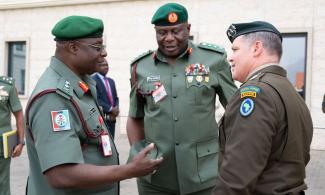
The initiative, known as the US–Nigeria Working Group, was formally inaugurated in Abuja on Friday, bringing together senior security and government officials from both countries.
Nigeria and the United States have launched a joint counter-terrorism working group aimed at deepening security cooperation, enhancing intelligence sharing and protecting vulnerable communities from violent extremism.
The initiative, known as the US–Nigeria Working Group, was formally inaugurated in Abuja on Friday, bringing together senior security and government officials from both countries.
According to a post on US, Africa command on it's X account on Friday, leading the U.S. delegation, Lt. Gen. John Brennan said the group establishes a new framework for coordination, accountability, and joint efforts to counter terrorism and protect the vulnerable.
https://x.com/i/status/
The launch follows Nigeria’s assertion that its security collaboration with the United States has significantly strengthened counter-terrorism operations, especially in the North-East, North-West and North-Central regions.
At a plenary session held at the Office of the National Security Adviser (NSA) to address Nigeria’s designation as a Country of Particular Concern (CPC), NSA Nuhu Ribadu and Minister of Information and National Orientation Mohammed Idris said Nigeria welcomed the partnership, noting that it respects the country’s sovereignty while prioritising civilian protection and accountability.
The U.S. delegation at the session was led by Under Secretary of State for Political Affairs, Allison Hooker.
Ribadu said the engagement marked the third high-level meeting with senior U.S. officials since November 2025 and reflected a relationship “grounded in trust, candour and shared responsibility.”
“These engagements have moved decisively beyond dialogue to action,” he said, noting that enhanced intelligence sharing and closer coordination between the U.S. military and Nigeria’s Defence Headquarters had contributed to operational successes recorded by Operation Hadin Kai in the North-East and North-West, and Operation Fasan Yamma in the North-Central.
According to Ribadu, recent operations have resulted in the killing of hundreds of terrorists, destruction of logistics hubs and interception of key collaborators.
He also commended U.S. commitments to the timely delivery of military equipment, including drones and helicopters, stressing that the cooperation respects Nigeria’s sovereignty.
Ribadu disclosed that President Bola Tinubu had declared security emergencies in vulnerable areas, authorised intensified joint operations and ordered sustained deployments to communities facing repeated attacks.
“Nigeria is a deeply plural society, and the protection of all citizens—Christians, Muslims and those of other beliefs—is non-negotiable,” Ribadu said. “Violence framed along religious lines is treated as an attack on the Nigerian state itself.”
In a statement issued by his Special Assistant on Media, Malam Rabiu, Information Minister Idris said the engagement underscored a serious and results-driven partnership.
“This bilateral partnership reflects not only our shared commitment to religious freedom and civilian protection, but also a mature strategic relationship grounded in trust and accountability,” he said.
Idris added that cooperation with the U.S. had yielded tangible operational gains, including intelligence-driven arrests, prosecutions and rescues of abducted persons, as well as commitments to deliver outstanding military equipment and spare parts procured over the past five years.
On domestic measures, he said the Federal Government was strengthening early-warning systems and developing a national database to provide verified data on deaths and casualties linked to violence, while terrorism cases were being actively investigated and prosecuted by security and justice agencies.
Speaking separately, Under Secretary of State Allison Hooker reaffirmed Washington’s commitment to broadening cooperation with Nigeria to counter terrorism and protect vulnerable communities.
She acknowledged progress made since Nigeria’s CPC designation last October, including increased police recruitment, arrests, prosecutions and coordinated airstrikes, but expressed concern over renewed abductions in parts of Kaduna State.
Hooker said advancing religious freedom and security would also strengthen cooperation in trade, health and regional stability, while disrupting terrorist financing and arms flows.
Both countries said the working group would remain focused on concrete outcomes aimed at reducing killings, abductions and displacement as efforts continue to “turn the tide on insecurity and terrorism” in Nigeria.