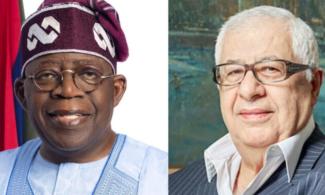
President Bola Tinubu had conferred the national honour of GCON on his Lebanese ally, Ambassador Gilbert Chagoury.
A former Lagos governorship candidate, Mr. Funso Doherty, has demanded a parliamentary probe into the conferment of the Grand Commander of the Order of the Niger (GCON) on Nigerian-Lebanese businessman, Mr. Gilbert Chagoury.
President Bola Tinubu had conferred the national honour of GCON on his Lebanese ally, Ambassador Gilbert Chagoury.
The conferment was contained in an instrument signed by the President, in which he cited his constitutional powers under the National Honours Act.
According to the instrument, the honour was awarded in recognition of Chagoury’s personal qualities and contributions to the country.
The conferment was dated January 8, 2026, and signed by President Tinubu in his capacity as President of the Federal Republic of Nigeria.
The awardee, Chagoury, has been subject of immense corruption allegations.
However, in an open letter dated Saturday, January 24, 2026, and addressed to the Speaker of the House of Representatives, Rt. Hon. Tajudeen Abbas, Doherty raised what he described as “serious procedural and legal concerns” surrounding the award, which he said was conferred by President Tinubu on January 8, 2026, allegedly to mark Chagoury’s birthday.
Doherty said beyond questions already being asked in the public space about the merits of honouring Chagoury, the manner in which the conferment emerged has cast doubt on its legality and integrity.
According to him, the Presidency did not make any official announcement regarding the award, noting that public awareness only followed a congratulatory message issued by a private individual on January 19, more than a week after the alleged conferment date.
He further argued that while the President has powers under the National Honours Act, such powers are subject to clear statutory procedures, including the issuance of a warrant and publication in the Federal Gazette, as stipulated by the National Honours Warrant.
Although the law allows for special warrants in exceptional circumstances, Doherty stressed that even such departures must be backed by a duly issued and documented enabling instrument, which, he said, has not been shown to exist.
The former candidate also drew attention to an “Instrument of Conferment” currently circulating in the public domain, which claims the award was given in Abuja on January 8, 2026, “under my Hand and the Public Seal of the Federal Republic of Nigeria.”
Doherty described this as particularly troubling, noting that it is public knowledge that President Tinubu was outside Nigeria on that date and was not in Abuja.
The letter reads in part, "In addition to concerns about the substantive merits of this conferment, about which several serious and legitimate public questions have already arisen, the circumstances surrounding the award raise additional issues that warrant the attention and scrutiny of the Honourable House.
"First, public knowledge of the conferment appears not to have come through any official Presidential or Government channel. Rather, the award only became known incidentally, following a congratulatory message issued by a private individual on Monday, 19th January 2026, more than one week after the stated date of conferment.
“This unusual mode of disclosure is troubling, particularly in light of the widely reported close personal association between the award recipient and Mr. President.
"Second, while the President's powers under the National Honours Act are undoubtedly broad, they are not unfettered. The law requires that such powers be exercised pursuant to a Warrant. Specifically, the National Honours Warrant, a subsidiary legislation made under the Act, provides that "the President shall, by notice in the Federal Gazette, signify his intention of appointing a person to a particular rank of an order."
Doherty noted that while the President may, in certain cases, act through a special warrant with different provisions, such actions still require a formally issued and documented enabling warrant.
He noted that as of now, there is no evidence that any such warrant was issued or published for this conferment, and no explanation has been provided for the deviation from the standard legal procedure.
"Third, an Instrument of Conferment currently circulating widely in the press and public domain, which instrument has not been disowned or contradicted by either the Presidency or the reported recipient, states that the award was ‘Given at Abuja, under my Hand and the Public Seal of the Federal Republic of Nigeria this 8th day of January, 2026,’” he said.
“This raises a further and troubling question, as it is a matter of public knowledge that Mr. President was outside the country and not in Abuja on that date. The president's power in this regard not being delegable, the very validity of the award is thereby called into question."
He called on the House of Representatives to invoke its constitutional oversight powers to investigate the matter, warning that issues surrounding national honours, especially of the rank of GCON, go to the heart of Nigeria’s values, integrity, and collective honour.
"In light of the foregoing, I respectfully call upon the National Assembly, and in particular the House of Representatives, to examine this matter in the exercise of its constitutional oversight responsibilities. Issues relating to National Honours, especially those of the exalted rank of Grand Commander, speak directly to the values, integrity, and collective honour of our Nation,” he said.
"In the words of our National Pledge, we all, including the President, are required ‘to uphold her honour and glory,’” the letter added.
Chagoury’s Controversies
SaharaReporters previously reported that the Lagos-Calabar Coastal Highway contract was awarded to Hitech Road Construction Company, a subsidiary of Hitech Construction, which is owned by Chagoury. Chagoury, a close associate of President Tinubu, also developed Eko Atlantic in Lagos.
Chagoury has a controversial past. In the 1990s, he reportedly benefited from contracts and oil franchises under the late dictator Sani Abacha.
After Abacha’s death, investigations traced stolen funds to Chagoury’s accounts worldwide. In 2000, a Swiss court convicted him of laundering some of Abacha’s funds; he paid a fine of about 1 million Swiss francs (around $600,000) and returned $66 million to Nigeria, though he denied knowledge that the money was stolen.
Internationally, Chagoury has faced scrutiny. He was banned from entering the U.S. over alleged support for Hezbollah and involvement in illegal political donations.
He donated millions to U.S. political campaigns, including to the Clinton Foundation, and helped fund the campaign of former U.S. lawmaker Jeff Fortenberry, who was later convicted of concealing information about Chagoury’s contributions. Chagoury reportedly paid $1.8 million in fines to resolve that investigation.
Chagoury has also been accused by U.S. and Lebanese authorities of past drug dealings. Despite these controversies, he has maintained significant business influence both in Nigeria and internationally.