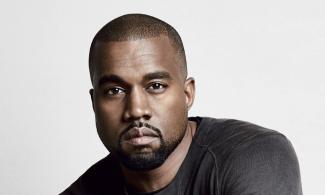
West framed his apology within a broader account of mental illness that he said went unrecognised for decades following a car accident 25 years ago that “broke my jaw and caused injury to the right frontal lobe of my brain.”
American rapper, Kanye West, now known as Ye, has issued a public apology to the Black community, acknowledging that his actions during prolonged periods of untreated mental illness caused deep disappointment and harm to a community he described as the foundation of his identity.
The apology formed a central part of a lengthy personal statement titled “To Those I’ve Hurt,” in which the artist reflected on years of public controversy, personal breakdowns and erratic behaviour that he linked to an undiagnosed brain injury and bipolar type-1 disorder.
Addressing Black communities directly, West wrote: “To the black community—which held me down through all of the highs and lows and the darkest of times. The black community is, unquestionably, the foundation of who I am. I am so sorry to have let you down. I love us.”
West framed his apology within a broader account of mental illness that he said went unrecognised for decades following a car accident 25 years ago that “broke my jaw and caused injury to the right frontal lobe of my brain.”
He said medical attention at the time focused only on visible injuries, while neurological damage remained undiagnosed until 2023.
“At the time, the focus was on the visible damage — the fracture, the swelling, and the immediate physical trauma,” he wrote. “The deeper injury, the one inside my skull, went unnoticed.”
According to West, the failure to diagnose the injury earlier contributed to worsening mental health and a later bipolar diagnosis. He described bipolar disorder as an illness often accompanied by denial, particularly during manic episodes.
“When you’re manic, you don’t think you’re sick,” he said. “You think everyone else is overreacting.”
West acknowledged that during those periods, he lost awareness of the weight his voice carried, especially within Black communities worldwide. “My words as a leader in my community have real global impact and influence,” he wrote. “In my mania, I lost complete sight of that.”
He admitted that his untreated condition led him to say and do things that deeply hurt people closest to him and alienated supporters who once saw him as a cultural voice for Black creativity and resilience. “I said and did things I deeply regret,” West stated. “Some of the people I love the most, I treated the worst.”
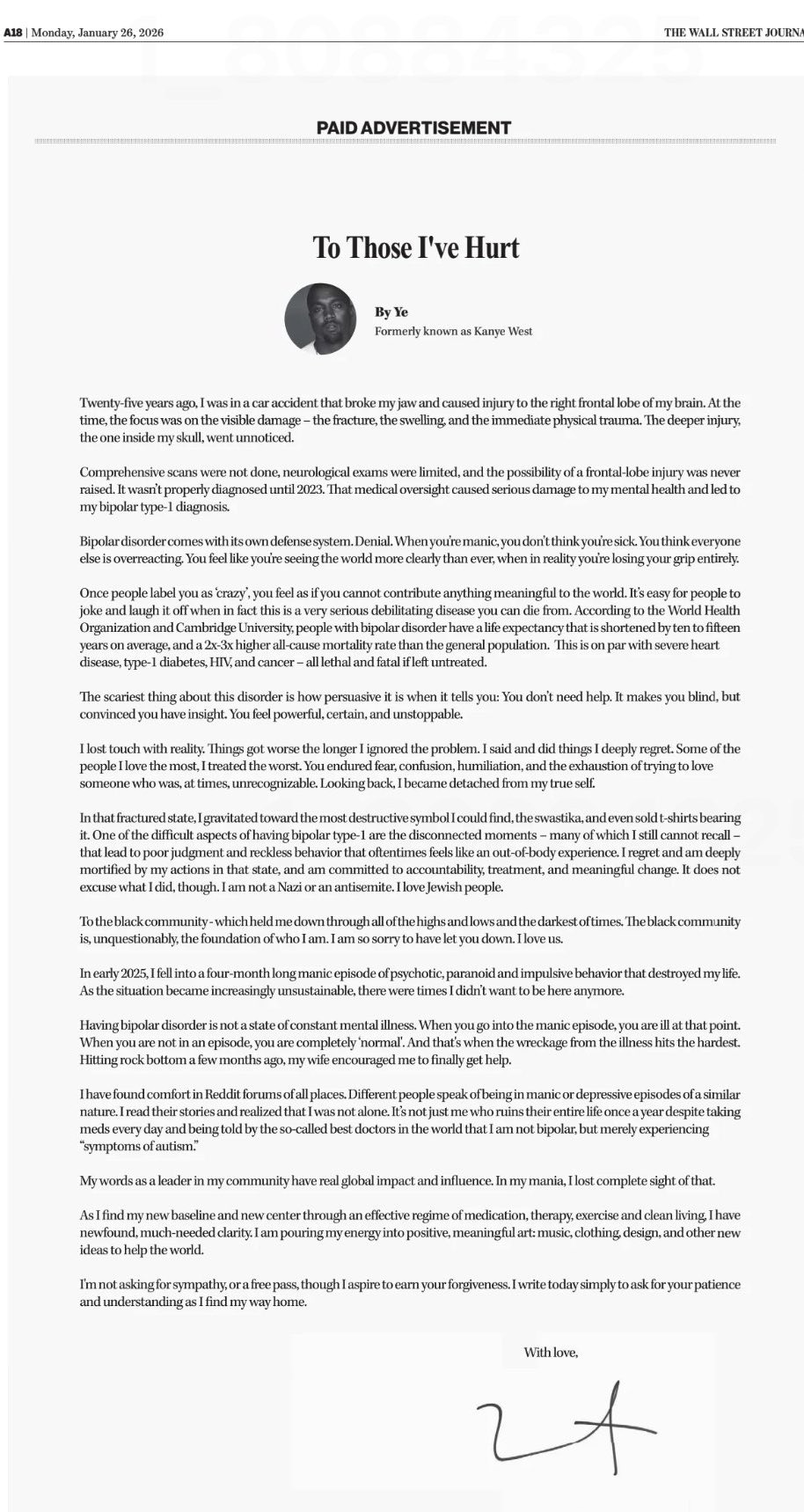
The artist also addressed his embrace of extremist imagery, which he described as one of the most damaging consequences of his illness. “In that fractured state, I gravitated toward the most destructive symbol I could find, the swastika,” he wrote, adding that he was “deeply mortified” by those actions.
“I regret and am deeply mortified by my actions in that state,” West said. “It does not excuse what I did, though. I am not a Nazi or an antisemite. I love Jewish people.”
West said the fallout from those actions was felt most acutely after manic episodes ended, when clarity returned and the consequences became unavoidable. “When you are not in an episode, you are completely ‘normal,’” he explained, adding that this is often when the damage becomes most apparent.
In early 2025, West said he experienced a four-month manic episode marked by “psychotic, paranoid and impulsive behavior,” which he said “destroyed my life.” He credited his wife with encouraging him to seek treatment after hitting “rock bottom.”
As part of his recovery, West said he found support through online forums, reading accounts from others living with bipolar disorder. “I read their stories and realized that I was not alone,” he wrote.
Now undergoing treatment, West said he is rebuilding his life through medication, therapy, exercise and lifestyle changes, and is refocusing on creative work he hopes will have a positive impact.
“I’m not asking for sympathy, or a free pass,” he wrote. “I write today simply to ask for your patience and understanding as I find my way home.”
The apology to the Black community, positioned as a central message in the statement, reflects West’s attempt to acknowledge the trust he believes he broke and to seek reconciliation with those who have long supported his career and cultural influence.
In 2022, SaharaReporters reported that Adidas cut its Yeezy partnership with Kanye West days after he showed a “White Lives Matter” T-shirt design at Paris Fashion Week.
Before then, it was reported that Adidas said it would review the Yeezy partnership with Kanye West over his anti-semitic comments.
The German sports brand, therefore, said recent comments and actions from West, who has officially changed his name to Ye, had been “unacceptable, hateful and dangerous, and they violate the company’s values of diversity and inclusion, mutual respect and fairness”, according to TheGuardian.
The company said it would take a “short-term” hit of €250m (£217m) to its income for this year after deciding to stop the brand’s business with immediate effect. It is to end production of items under West’s Yeezy brand and stop all payments to the musician and his companies.
West was also criticised after he presented a collection at Paris Fashion Week that included T-shirts with the slogan "White Lives Matter.”
The phrase “Black Lives Matter”, which represents opposition to racism and police brutality, was widely used after George Floyd, an unarmed black man, was killed by a police officer in Minneapolis in the summer of 2020.
Vogue's Gabriella Karefa-Johnson, who is global fashion editor-at-large at the fashion magazine, was among those that criticised West over the T-shirts, calling the move "hugely irresponsible."