Dr. Obiaraeri highlighted the contemptuous treatment meted out against Ndi’gbo in Lagos despite the major role they have played in transforming the city into Nigeria’s commercial hub.
Investment banker, Dr. Nnaemeka Obiaraeri, has called for a national dialogue on Nigeria’s unity and the treatment of its indigenous people, emphasising that the continued marginalisation of certain groups, particularly the Igbo, poses a serious threat to national cohesion and development.
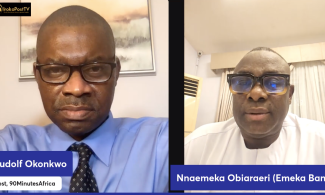
Speaking with Rudolf Okonkwo during an exclusive interview on 90MinutesAfrica, Dr. Obiaraeri dismissed claims that Nigeria’s unity is “non-negotiable,” describing such positions as unrealistic in the face of deep-seated grievances across the country.
According to him, sovereignty ultimately belongs to the people, and Nigerians must be willing to “sit down as a people and renegotiate our nationhood” in order to survive as a stable and prosperous nation.
In a specific reference to the South-East, the prolific entrepreneur stated that if an opinion poll were conducted in the region, a significant majority would likely favour separation from Nigeria.
He attributed this sentiment to the long-standing perception of exclusion and unfair treatment of the Igbo, despite their immense contributions to the country’s economic development.
Dr. Obiaraeri highlighted the contemptuous treatment meted out against Ndi’gbo in Lagos despite the major role they have played in transforming the city into Nigeria’s commercial hub.
“Over 70 percent of properties in Banana Island are owned by Igbo investors, who turned what was once a swampy area into one of the country’s most exclusive residential areas,” he stated.
He questioned why, despite such contributions, political leaders often pursue policies that alienate rather than empower these economic actors.
“It is counter-productive for any governor or leader to see such productive people and instead of harnessing their capacity to do more for the state, choose to marginalise them,” the ex-banker reiterated.
Beyond issues of ethnicity and national unity, Dr. Obiaraeri also criticised Nigeria’s governance and investment climate.
He argued that the lack of transparency, pervasive opacity, and criminality within the system are the primary reasons that foreign and local investments flowing into the country have declined significantly.
He cited the petroleum sector as an example, recalling that Nigeria’s first refinery was built by Shell BP in 1965. According to him, despite Nigeria’s vast crude oil resources, international oil companies have been unwilling to operate refineries in the country due to weak institutions and a lack of respect for the rule of law.
He noted that Shell operates a refinery in South Africa, a country without crude oil reserves, but has declined similar investments in Nigeria.
Dr. Obiaraeri further called for a return to what he described as the original “constitutional and fiscal principles” agreed upon by Nigeria’s founding fathers.
He insisted that the country can only function effectively by revisiting and reworking those foundational agreements that once defined how power and resources were to be shared.
“The time has come for indigenous peoples of Nigeria to sit down and rework the country based on those founding principles,” he said, adding that without such reforms, issues of disunity, economic stagnation, and distrust would continue to undermine national progress.