
The document shows that N1.6 billion of the amount was disbursed between October and December 2025 alone, representing spending over a three-month period.
A SaharaReporters review of the Borno State 2025 full-year budget performance document has revealed that the state government spent N4.3 billion on “livelihood support for Repentant Boko Haram members” during the year.
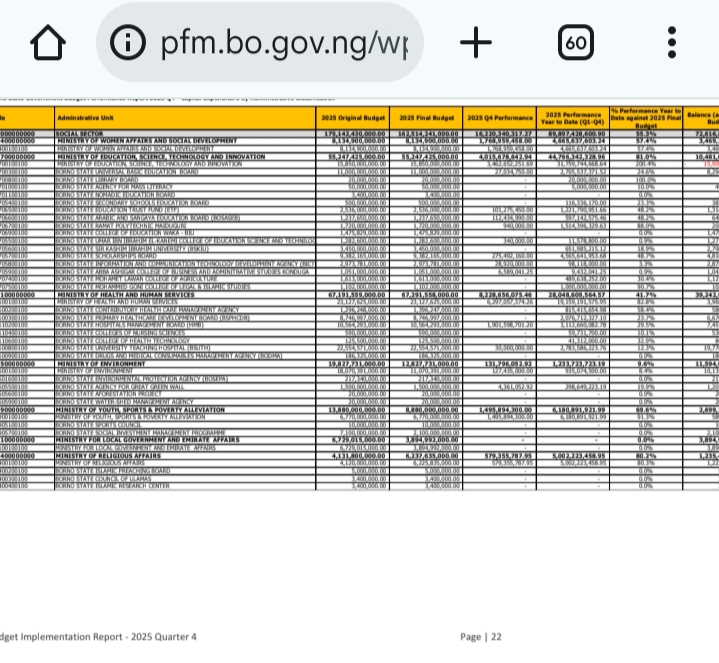
The document shows that N1.6 billion of the amount was disbursed between October and December 2025 alone, representing spending over a three-month period.
In contrast, the total capital expenditure for the Borno State Primary Healthcare Development Board for the entire 2025 fiscal year stood at N2 billion, over N2 billion less than what was spent on the livelihood support programme for former insurgents.
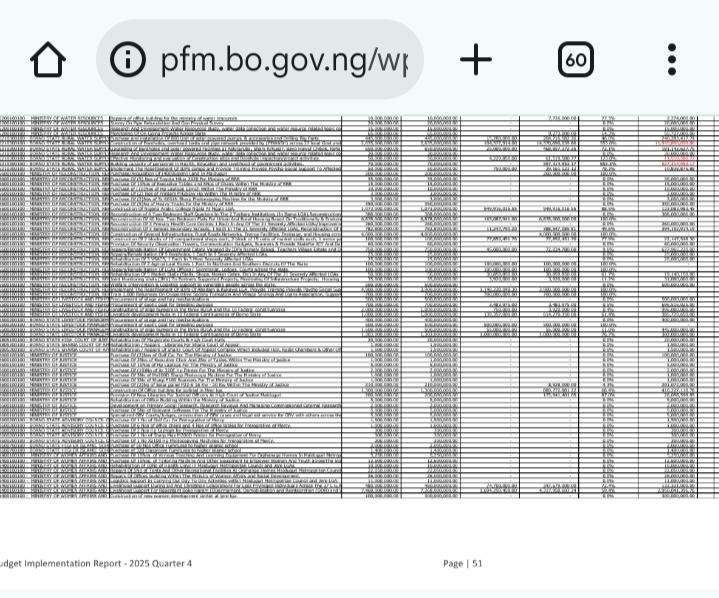
Similarly, capital expenditure for the Borno State University Teaching Hospital in 2025 was N2.7 billion, also lower than the amount spent on the reintegration programme. The capital expenditure of the state's hospital management board stood only at N3.1 billion in the 2025 fiscal year, less than the N4.3 billion spent on rehabilitating ‘repentant Boko Haram members’.
An earlier SaharaReporters review further showed that between January and September 2024, the Borno State Government spent N3.45 billion on livelihood support under the Disarmament, Demobilisation and Reintegration (DDR) programme for “repentant Boko Haram” members.
Previous SaharaReporters investigations in 2025 had also quoted frontline Nigerian soldiers stationed in Yobe and Borno states, who accused government-backed “repentant” insurgents of leaking sensitive military information to their former commanders.
The soldiers, deployed across multiple military bases in the Northeast, described the policy of integrating “repentant” fighters into operations as a “deadly mistake that continues to cost lives.”
One serviceman told SaharaReporters that the so-called repentant fighters routinely briefed terrorist leaders about Nigerian Army movements and operational plans ahead of attacks.
“Before Boko Haram attack any military camp in the Northeast, they already know how we operate. These repentant fighters tell them everything,” the soldier revealed.
“They expose how many men we deploy at the gate or entrance, the kind of weapons we carry, even the daily routine in the camp.”
According to him, the information leaks had left soldiers highly exposed.
“They tell Boko Haram that every evening between 4:00 pm and 7:00 pm, all soldiers must return to camp for what we call ‘stand 2’; the period when we observe enemy movements. They also tell them where our armoury is located, where we keep rifles, GMPGs, RPGs, PKTs, hand grenades, and bombs.”
The soldier added that the sabotage extended beyond operational intelligence to logistics and supply chains.
Despite the Borno State Government’s ongoing investments in livelihood programs for ‘repentant’ insurgents, attacks by Boko Haram and ISWAP have continued unabated in the state.
In April 2025, Borno State Governor, Babagana Zulum, warned that Boko Haram terrorists were regrouping in the Tumbus area of Lake Chad and the Mandara Hills within the Sambisa Forest.
While acknowledging the efforts of the Nigerian military, the governor said significant challenges remained in confronting the escalating insurgency and called for urgent intervention. He argued that kinetic military actions must be supported by non-kinetic strategies.
“Borno State has, within the last three years, received more than 300,000 repentant Boko Haram fighters, and not all of them are fighters. Some of them are farmers,” he said.
“Manpower is very essential. While I’m aware of the constraints of the Nigerian Army because right now, you are everywhere in Nigeria: the Northeast, Northwest, North Central, as well as southern Nigeria, I’m aware of your limitations.
“But still, considering the northeastern region, the Nigerian Army should look into the possibility of sending more trained manpower. There is a difference between Boko Haram, ISWAP, and bandits.”
Governor Zulum further warned that Boko Haram and ISWAP had been receiving international support and identified Nigeria’s porous borders as a major security weakness.
“ISWAP and Boko Haram are terrorists getting support internationally, and looking at our porous borders, they remain infiltrated through the Sahel, which is our major problem,” he said.
“If the Sahel is not secured, Nigeria will never be secured. So, there is a need for us to fortify the security situation in the Sahel with a view to ending the crisis in the entire nation.”
The governor also called for increased air power and advanced technology for the military.
“We need air support. I know the kind of constraints you face accessing fighter helicopters and others, but attack helicopters are very important in these areas, and drones are also very important,” he said.
“The last attack that happened in Wulgo, carried out by ISWAP and Boko Haram, a confirmed statement said it was carried out with the support of armed drones. They hit the MNJTF with drones.”