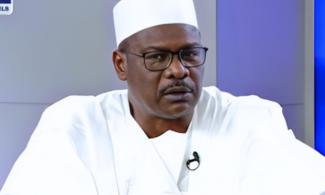
Ndume, a former Chairman of the Senate Committee on Army, said the convergence of the dry season, improved battlefield visibility and renewed intelligence collaboration with the United States has created a narrow but decisive window for Nigeria to strike hard at terrorist enclaves in the North-East and other troubled regions.
Senator Ali Ndume, the federal lawmaker representing Borno South, has warned that Nigeria must not squander a rare and critical opportunity arising from renewed United States willingness to support the country’s counter-terrorism efforts, even as he called for an urgent, full-scale military offensive against insurgents in the North.
Ndume, a former Chairman of the Senate Committee on Army, said the convergence of the dry season, improved battlefield visibility and renewed intelligence collaboration with the United States has created a narrow but decisive window for Nigeria to strike hard at terrorist enclaves in the North-East and other troubled regions.
Speaking during an interview on ARISE NEWS on Wednesday, the Borno senator said the security situation has shown signs of improvement but warned that the war against insurgency is far from over.
“The situation has changed and also improved, but it is not over until it is completely over,” Ndume said. “Now the dry season is set, visibility in the North is clearer, and with the new collaboration, intelligence sharing and some equipment support, the Nigerian Armed Forces have been able to go into the three black spots, Sambisa, Mandara Mountains and the Lake Chad region.”
According to him, the dry season traditionally offers the military a strategic advantage, as insurgents lose the cover provided by thick vegetation and flooding, making their movements easier to track and disrupt.
Ndume warned, however, that this advantage could be wasted if troops remain under-equipped and inadequately protected.
Despite acknowledging visible progress on the battlefield, Ndume insisted that the military still lacks the essential resources needed to conclusively end the war against Boko Haram, ISWAP and other terror groups.
“They still need what I call TEAM – training, equipment, ammunition and motivation,” he said. “The Nigerian Army, from top to bottom, is very committed. But no matter how committed you are, if you don’t have the morale booster, if you don’t have the equipment, soldiers will continue to die.”
The senator painted out avoidable military casualties, stressing that many recent losses were not the result of direct gun battles but of structural and logistical weaknesses.
“We lose more soldiers from landmines and IEDs,” Ndume said. “The last time we lost about eight soldiers in the Sambisa Triangle, it was because insurgents used a suicide bomber. If they had MRAPs and proper air cover from attack helicopters, they would clear these areas in a very short time.”
Ndume also drew attention to a major shift in U.S. posture towards Nigeria’s counter-terrorism campaign, revealing that American authorities, previously hesitant to share intelligence, are now more open to collaboration.
“Before now, Americans were reluctant to give us intelligence support, but now they are willing,” he said. “We must not miss this opportunity.”
On the issue of military funding, Ndume pushed back against claims that the legislature has failed to adequately support the armed forces.
He disclosed that the defence sector received the highest allocation in the current national budget but argued that the real challenge lies in delayed releases of funds by the executive arm of government.
“Defence has the highest budget this year, and if there is a need to increase it, we will do that,” he said. “But the problem is funding, the release of the money. The National Assembly budgets and approves; the executive executes. Once you bring a budget and we approve it, you should religiously follow it.”
He further clarified that the National Assembly’s oversight role does not extend to the actual release of funds, stressing that responsibility rests squarely with the executive.
“Oversight is to ensure that money released is used according to the appropriation,” Ndume said. “The responsibility of releasing funds rests squarely with the executive, with the President.”
The senator also criticised Nigeria’s broader approach to security financing, arguing that defence and other critical sectors should be treated as non-discretionary expenditures, insulated from bureaucratic delays and political bottlenecks.
“Security agencies should be prioritised like in America, where military funding is non-discretionary,” he said. “It is not something the Minister of Finance decides whether to release or not.”
When asked to comment on reports of a United States airstrike on terrorist targets in Sokoto State, the senator declined to make any substantive remarks, citing an impending closed-door briefing for lawmakers.
“It would be immature and improper for me to pre-empt what the Senate leadership will brief us on,” he said.