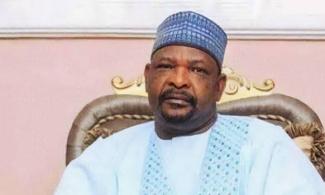
Ningi, who said he raised the issue formally, described the incident as a violation of Nigeria’s sovereignty.
Senator Abdul Ningi, who represents Bauchi Central Senatorial District, has faulted what he described as a breach of Nigeria’s territorial integrity by the United States military, insisting that no provision of the 1999 Constitution empowers the President or any arm of government to invite or approve a foreign military strike on Nigerian territory.
Speaking on ARISE Television on Thursday night, the senator said the alleged operation raises fundamental constitutional and sovereignty concerns and demands a full explanation from the Federal Government.
“First of all, we are an independent nation guided by rules and regulations and, of course, guided by the Constitution of the Federal Republic of Nigeria, which is the grand norm of the country,” Ningi said. “There’s nowhere, there’s no place in the constitution that has given anybody, including the president, any right to ask a foreign power to have a strike into the territorial integrity of the country.”
Ningi, who said he raised the issue formally, described the incident as a violation of Nigeria’s sovereignty.
“As far as we are concerned, as far as I am concerned, that brought this matter, the United States military breached the territorial integrity of Nigeria, and therefore we need an explanation on that,” he said.
The senator also questioned statements credited to federal officials suggesting that the presidency had prior knowledge of the strike and even provided intelligence used by U.S. forces.
“Even conceding that the federal executive were informed, that means the presidency and his team,” Ningi said. “When the strike took place, the Minister of Information came out with a statement, the Minister of Foreign Affairs also came out with a statement that they were informed and they provided intel that the U.S. used in launching the strike, and that is the crux of the matter.”
According to him, such actions, if true, amount to constitutional overreach.
“There’s nowhere that the constitution permits the Federal Executive Council, the president himself, in alliance with a foreign power, to take a hit into Nigeria outside the Nigeria territory,” he declared.
Ningi argued that the appropriate approach, if foreign assistance was required, should have been a coordinated operation involving Nigerian forces on Nigerian soil.
“What the presidency ought to have done is that there should be an arrangement of alliance between the American forces and our local forces,” he said. “And the hit, and the strike, if it is necessary to take place, it ought to have taken place within the Nigerian territory.”
He also dismissed arguments that the operation occurred at sea, noting that Nigeria’s maritime domain is equally protected under international and domestic law.
“We also have territorial waters,” Ningi said. “They can take this hit, we have territorial waters, and even as you are doing that, the National Assembly is not an appendix.”
The senator stressed that the legislature must not be sidelined on matters of national security.
“That is why I took time to write about Section 4 of the constitution, which makes the National Assembly a co-partner in governance, a co-partner in responsibility and accountability,” he said.
He added that while only the President and Vice President are elected within the executive branch, the National Assembly comprises 469 elected representatives with a direct mandate from the people.
“The executive has two elected officials, the president and the vice president. The entire members of the National Assembly, 109 and 360, are elected representatives of the people that should be accountable to the people,” Ningi said.
He warned that bypassing the legislature weakens democratic governance.
“The only difference between the military and a democracy is the existence of the legislature,” he said. “That is why logically the constitution of the Federal Republic of Nigeria mentioned the National Assembly first, the executive second and the judiciary third.”
Ningi concluded by cautioning against what he called the dangerous normalization of unconstitutional conduct.
“When that does not happen, everybody takes it as normal,” he said. “That means you are normalizing, you are rationalizing irrationality, you are normalizing abnormal things.”
On December 25, 2025, the U.S. carried out coordinated airstrikes in Sokoto State, targeting Islamic State–affiliated militants, reportedly in collaboration with President Bola Tinubu’s administration.