Documented evidence shows that foreign firms and Nigerian intermediaries diverted project payments from corporate accounts into personal ones, evading taxes and depriving the Federal Government of vital revenue.
A Nigerian Government concessionaire tasked with generating revenue through above-the-line advertising concessions entered into a contract with Excel-LED, a Chinese LED manufacturer also trading under the names Exel LED, Exel LED Optoelectronics, and Adsen.
The expectation was to deliver reliable airport-grade display screens that would boost non-aeronautical revenue through advertising and flight information systems.
Instead, according to 247UREPORTS, the deal collapsed into a multi-million-naira fraud spanning Enugu, Abuja, and Port Harcourt airports.
Documented evidence shows that foreign firms and Nigerian intermediaries diverted project payments from corporate accounts into personal ones, evading taxes and depriving the Federal Government of vital revenue.
At the heart of the scandal are stalled LED installations at three major airports, most notably Port Harcourt, where a verified multi-million-naira transfer was traced to a personal account.
This followed a pattern of early failures disguised as successes and eventual non-delivery.
The concessionaire had performed due diligence, confirming Excel-LED’s manufacturing credentials and its representative “Sam Lee” as capable of delivering high-traffic systems.
Initial payments were made to the company’s verified corporate account in China, and the first three screens arrived on schedule.
However, they failed technical evaluation, with one unit in Enugu sidelined for six months, costing millions in lost revenue. Despite these red flags, Excel-LED promised “redemption,” persuading the concessionaire to continue.
The scam escalated in the final phase of installations at Enugu, Abuja, and Port Harcourt. Nigerian fixer “Ndubuisi” introduced Emmanuel Shoon Patrick as Excel-LED’s local representative for logistics, fabrication, and installation.
Payments were redirected from Excel-LED’s corporate account in China to Patrick’s personal Nigerian bank account, justified as necessary for customs clearance and on-ground costs.
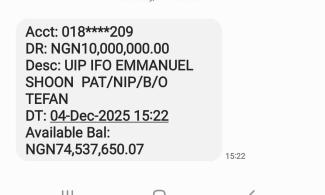
On December 4, 2025, at 15:22, the concessionaire authorized a major transfer from its project account. Bank records confirm the debit “in favour of” Emmanuel Shoon Patrick. Shoon, posing as CEO of Excel-LED Nigeria Limited, pocketed the advance and fled to China.
No delivery followed, no refund was issued, and advertising revenue losses mounted as screens remained dark. Communications with Excel-LED either went unanswered or were redirected to Shoon, clear evidence of collusion and fraud.
Experts note that corporate payments trigger Federal Inland Revenue Service (now Nigeria Revenue Service) withholding tax and VAT, while personal account transfers evade these obligations under the guise of consultancy fees or facilitation payments.
Nigeria loses billions annually to such schemes across LED displays, telecom, data centers, and power projects. The fallout in this case has been severe: concessionaires absorbed costs for site preparation and lost advertising deals, while the Federal Government lost non-aeronautical revenue that, in mature airports, can account for 30 to 50 percent of income.
Investor confidence has been shaken, stalling Nigeria’s airport digitization and smart-city ambitions.
According to the report, stakeholders describe the scam as part of a recurring playbook. Early deliveries, often flawed, are made via corporate channels to build credibility.
Midway through projects, new facilitators emerge, payments are rerouted to personal accounts, and deliveries stall amid vague excuses. Blame-shifting follows across borders.
In this case, the concessionaire is assembling a dossier of contracts, bank records, and communications with Sam Lee, Ndubuisi, and Patrick for submission to law enforcement, anti-corruption agencies, FIRS (now NRS), and aviation regulators.
Red flags abound, including intermediaries with no track record, payment redirection to personal accounts, resistance to milestone checks, and ignored technical failures.
These issues expose Nigeria’s broader vulnerabilities in digital infrastructure projects across airports, energy, signage, and telecommunications.