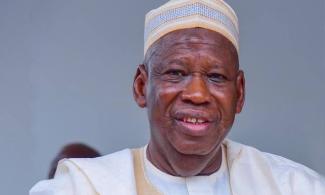
Governor Yusuf, while in opposition, repeatedly accused the Ganduje administration of corruption and misgovernance, making the issue a central theme of his campaigns.
The Kano State Government has insisted that corruption allegations levelled against former Governor Abdullahi Ganduje remain active and unresolved, despite Governor Abba Yusuf’s recent political realignment with the All Progressives Congress (APC).
The Commissioner for Information and Internal Affairs, Ibrahim Waiya, stated this during a live interview on Arise News monitored by SaharaReporters while responding to questions over the apparent contradiction between Yusuf’s long-standing attacks on Ganduje and the governor’s current political posture.
Ganduje had been under serious prosecution of corruption by the current government of Abba Yusuf. However, Governor Yusuf's recent alignment with Ganduje, a former APC National Chairman, and other top APC chieftains in the state has raised serious concerns about the credibility of the ongoing corruption litigation against Ganduje.
When asked directly whether the Kano State Government had prosecuted Ganduje, Waiya said: “Everything, all allegations, all allegations, the government has not in any way withdrawn any allegations.
“Any corruption allegation is still there and it is before the judicial processes and the government does not intend in any way to interfere in the process.
“We are not trying to give anybody a special cover. That is why His Excellency does not interfere in the judicial process.
“So that is still going on there. Nobody stopped that and nobody will stop that. That is left with the judicial process.”
Governor Yusuf, while in opposition, repeatedly accused the Ganduje administration of corruption and misgovernance, making the issue a central theme of his campaigns.
However, recent public appearances showing Yusuf alongside Ganduje, including moments where the former governor was seen raising Yusuf’s hand, have sparked widespread controversy and accusations of political betrayal.
Pressed on the “optics” of such scenes, Waiya defended the development, noting that it was not the first time political adversaries would come together.
“In Kano here, we are talking about the new Kano. The new Kano is a Kano that is now evolving, evolving in the sense that we are not trying to bring everybody on board,” he said.
“We are trying to unite. We are trying to also forge ahead and we are trying to focus on the development and progress of the state.
“So we are now, in a way, trying to set an agenda only in foundation for reconciliation, for forgiveness.”
The interviewer, however, challenged the commissioner on whether reconciliation can exist without justice, asking what residents of Kano should now believe after years of fierce accusations.
Waiya responded by stressing the presumption of innocence under Nigerian law.
“Well, as far as the Nigerian legal system is concerned, you may be accused of a number of corruption allegations, but the most important thing is it is when you are pronounced guilty by the court of law.
“No court of law has ever pronounced him to be guilty of such charges or such allegations,” he said.
“We have left that with the judicial process. We do not want to interfere, like you say. And the cases are still going on.
“And not only his own cases, there are cases of many number of people that have held number of convictions in the country and their own cases are still going on.”
The anchor also questioned the political calculations behind Yusuf’s alignment with the APC, suggesting that the move could be aimed at delivering Kano’s massive voter base to the ruling party ahead of the 2027 general election.
He noted that ahead of 2027, the ruling party is struggling with trust issues, insecurity, and economic hardship in northern Nigeria.
Waiya agreed that Nigeria faces deep-seated national challenges but denied that Yusuf’s political move was driven by 2027 ambitions.
He said, “I agree with all that. These are all issues that we have been struggling with in the country.
“And it’s not just only President Bola Ahmed Tinubu who has probably the only concern or who should be concerned about that.
“It should be all our collective concern as far as all these problems are concerned.
“And the issue of getting right or getting things right in the country is the responsibility of everybody.
“Even you that is here. You also have a role that you’re going to play to ensure that our country progresses and to ensure that we take our own country from these mess.
“This is a general responsibility of all citizens.”