
This development comes after the state spent N3.7 billion on the construction of nine guest houses in Minna between January and September 2025, according to the budget documents.
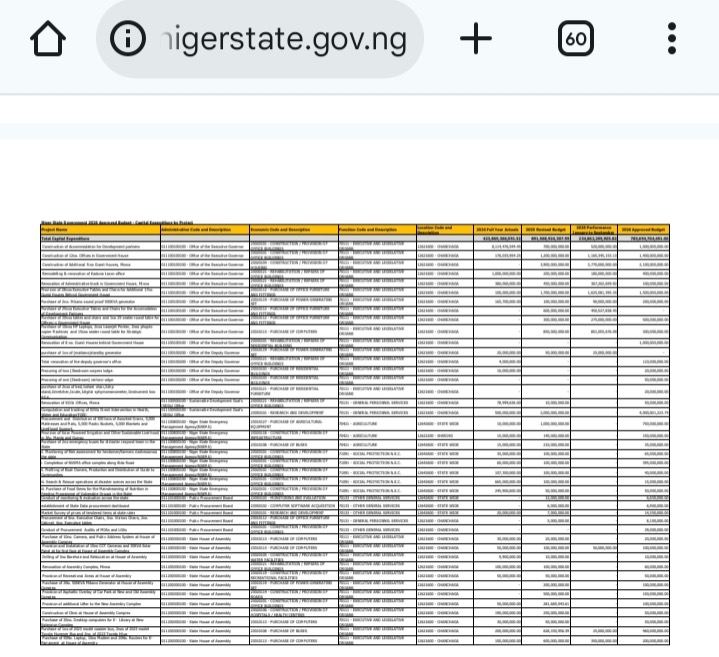
A SaharaReporters review of Niger State budget documents has shown that N1.6 billion was spent on “executive” tables and chairs for government guest houses between January and September 2025, a nine-month period.
“Provision of 28 nos Executive Tables and Chairs for additional 17 no Guest Houses behind Government House,” the budget description read.
Another N1.5 billion was also budgeted for the same expenditure in the 2026 fiscal year.
This development comes after the state spent N3.7 billion on the construction of nine guest houses in Minna between January and September 2025, according to the budget documents. An additional N2.1 billion was approved for the construction of guest houses in the 2026 financial year.
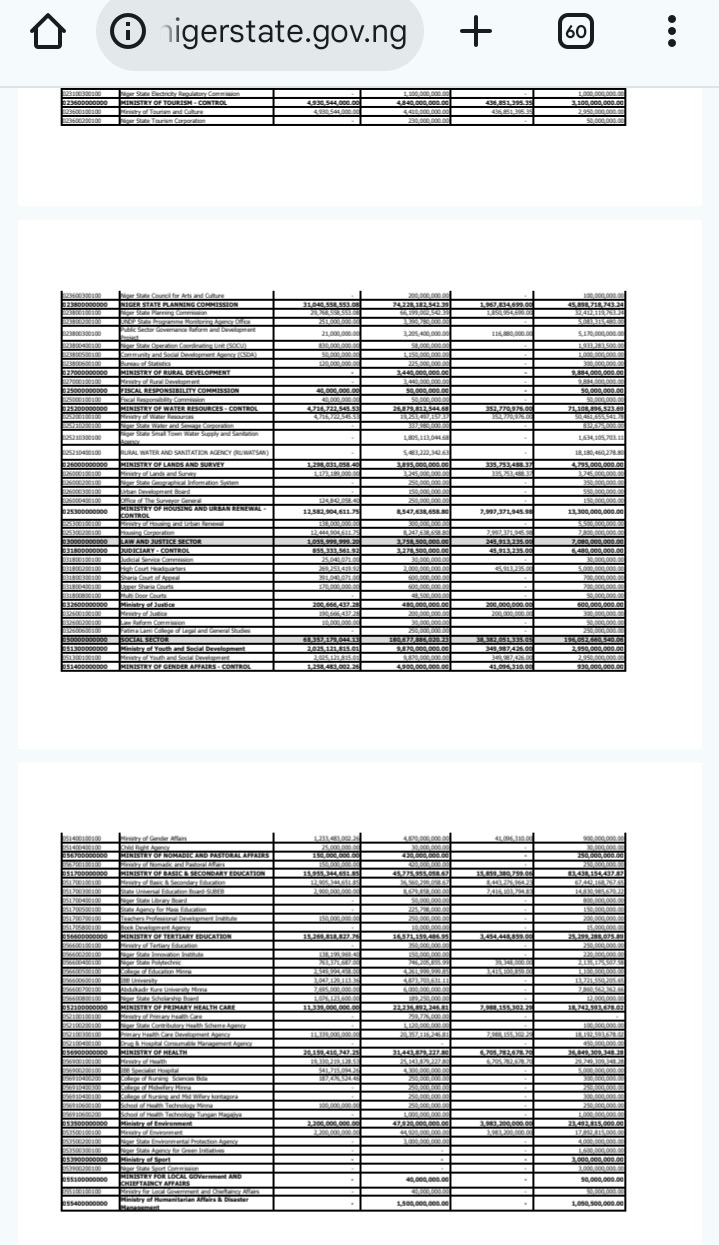
Meanwhile, only N352 million was spent on capital expenditure for the Ministry of Water Resources between January and September 2025.
Zero naira was spent on the Niger State Rural Water and Sanitation Agency’s capital expenditure within the same period. This is despite reports that many residents struggle to access clean water, relying on rivers and other unsafe sources.
A respondent told SaharaReporters that residents in some communities depend on water sources already used by cows, a situation that exposes them to diseases such as cholera and diarrhoea.
In August 2025, a civic accountability platform, MonITNG, alleged that 90% of primary healthcare centres in the state were dilapidated.
In a statement posted on X and directed at Governor Umar Bago, the organisation said: “Dear Governor @HonBago. We are aware that Niger State has about 1,355 health facilities across 25 LGAs, of which 1,322 are Primary Health Care (PHC) centers. Sadly, 80–90% of these PHCs are in deplorable condition, roofs are leaking, walls are cracked, equipment is missing, staff are absent, and many facilities are without essential drugs.
“This has left thousands of ordinary citizens stranded without access to quality healthcare.
“Instead of prioritizing the rehabilitation and upgrading of at least 300 of these existing PHCs, which would have delivered a broad impact across communities, the government has chosen to build 20 new PHCs, with suggestions that the actual plan could rise to 100. This decision raises critical questions: if Niger State cannot effectively maintain the 1,322 PHCs already on the ground, how sustainable is it to add more? Wouldn’t it be wiser to strengthen existing facilities so that people across all wards benefit?”
MonITNG urged the governor to learn from Kano State’s approach, stating, “We can look at Kano State as a clear example. Rather than embarking on building new PHCs at huge cost, the Kano State Government chose to upgrade some PHCs into fully functional General Hospitals while simultaneously renovating many existing ones. That approach spread impact, improved access, and ensured citizens actually benefited from facilities that were already within their communities.
“Niger State should learn from this model instead of channeling scarce public funds into new projects that risk becoming white elephants.”
The group further highlighted that hospitals in the state were already under strain.
“The truth is that most General Hospitals in Niger State, including those in Minna, are already struggling to function with only one or two doctors. Many rural PHCs are completely abandoned or manned by volunteers without formal training. Adding new structures without staffing, drugs, or equipment will not solve the problem,” it said.
“Healthcare is not about the number of new buildings. It is about functionality, accessibility, and quality of service delivery. A rehabilitated, well-staffed, and well-equipped PHC is far more valuable than another empty structure built for political points.”