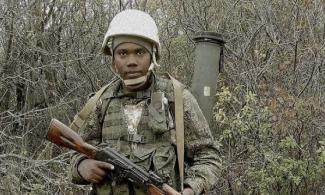
According to the DIU, Mogesa’s body was discovered by Ukrainian forces at a position previously held by Russian troops following a deadly assault operation.
A 28-year-old Kenyan national, Clinton Nyapara Mogesa, has been killed while fighting for the Russian armed forces in eastern Ukraine, Ukrainian authorities have confirmed.
Ukraine’s Defence Intelligence (DIU) disclosed that Mogesa, who was recruited into the Russian military, died during combat operations in the Donetsk region, an area that has witnessed some of the fiercest fighting since the outbreak of the war.
According to the DIU, Mogesa’s body was discovered by Ukrainian forces at a position previously held by Russian troops following a deadly assault operation.
The intelligence agency said the Kenyan was killed during what it described as a meat assault, a term commonly used to denote high-casualty frontal attacks in which soldiers, often poorly trained and inadequately equipped, are sent into combat with little regard for survival.
In a statement released by Ukrainian authorities, Mogesa was identified as a Kenyan citizen who had been living and working in Qatar before travelling to Russia.
Intelligence report said he signed a contract with the Russian military under circumstances that remain unclear, according to The Star.
“Mogesa left a job in Qatar, received minimal military training, and was subsequently sent to the combat zone, where he was killed during an assault operation,” the Defence Intelligence of Ukraine stated.
The agency said Mogesa underwent only brief training before being deployed to the front lines in eastern Ukraine and assigned to one of Russia’s assault units operating in Donetsk, a region that has recorded massive casualties on both sides of the conflict.
Ukrainian forces reportedly recovered his body after the encounter, raising fresh questions about the recruitment and deployment of foreign nationals by Russia in its ongoing war against Ukraine.
In a disturbing revelation, Ukrainian intelligence officials said that when Mogesa’s body was recovered, he was carrying passports belonging to two other Kenyan citizens.
Meanwhile, the discovery has heightened fears that more Kenyans may have been recruited and sent to the front lines under similar circumstances.
The Defence Intelligence of Ukraine said it believes the documents belong to fellow Kenyan recruits who may also be fighting for Russia, though their current status remains unknown.
The agency said that the incident indicates the possible presence of other Kenyan citizens in Russian assault units, warning that foreign nationals are being drawn into extremely dangerous combat roles.
In the same statement, Ukrainian authorities issued a warning to foreign nationals against travelling to Russia or accepting job offers linked to the country, particularly amid the ongoing war.
“The Defence Intelligence of Ukraine warns foreign citizens against travelling to the Russian Federation or accepting any form of employment on its territory, particularly illegal work,” the statement read.
“Travelling to Russia carries a real risk of being forcibly deployed to assault units without adequate training and with little to no chance of survival.”
Mogesa’s death adds to mounting reports that hundreds of Africans, including Kenyans, have been recruited to fight in the Ukraine war, often after being enticed by promises of lucrative employment, fast-track income, or residency opportunities.
Meanwhile, reports have indicated that some African nationals travelled to Russia for non-military work, only to find themselves coerced, misled, or pressured into signing military contracts upon arrival.
Kenya’s Ministry of Foreign and Diaspora Affairs has previously acknowledged receiving distress calls from Kenyan citizens stranded or trapped in the Russian Federation.
In a recent statement, the ministry said that through diplomatic interventions, 18 Kenyan citizens had been successfully rescued, issued with Emergency Travel Documents, and safely repatriated to Kenya.
However, Kenyan officials have warned that the scale of the problem may be far larger than officially acknowledged. Reports suggest that more than 200 Kenyans could have been recruited into the conflict, with the Kenyan Embassy in Moscow confirming that it has received multiple appeals for help from citizens who claim they were misled or coerced into joining the war.