
The respondents are urging the apex court to dismiss the application in its entirety, arguing that it discloses no prima facie good cause and constitutes an abuse of court process.
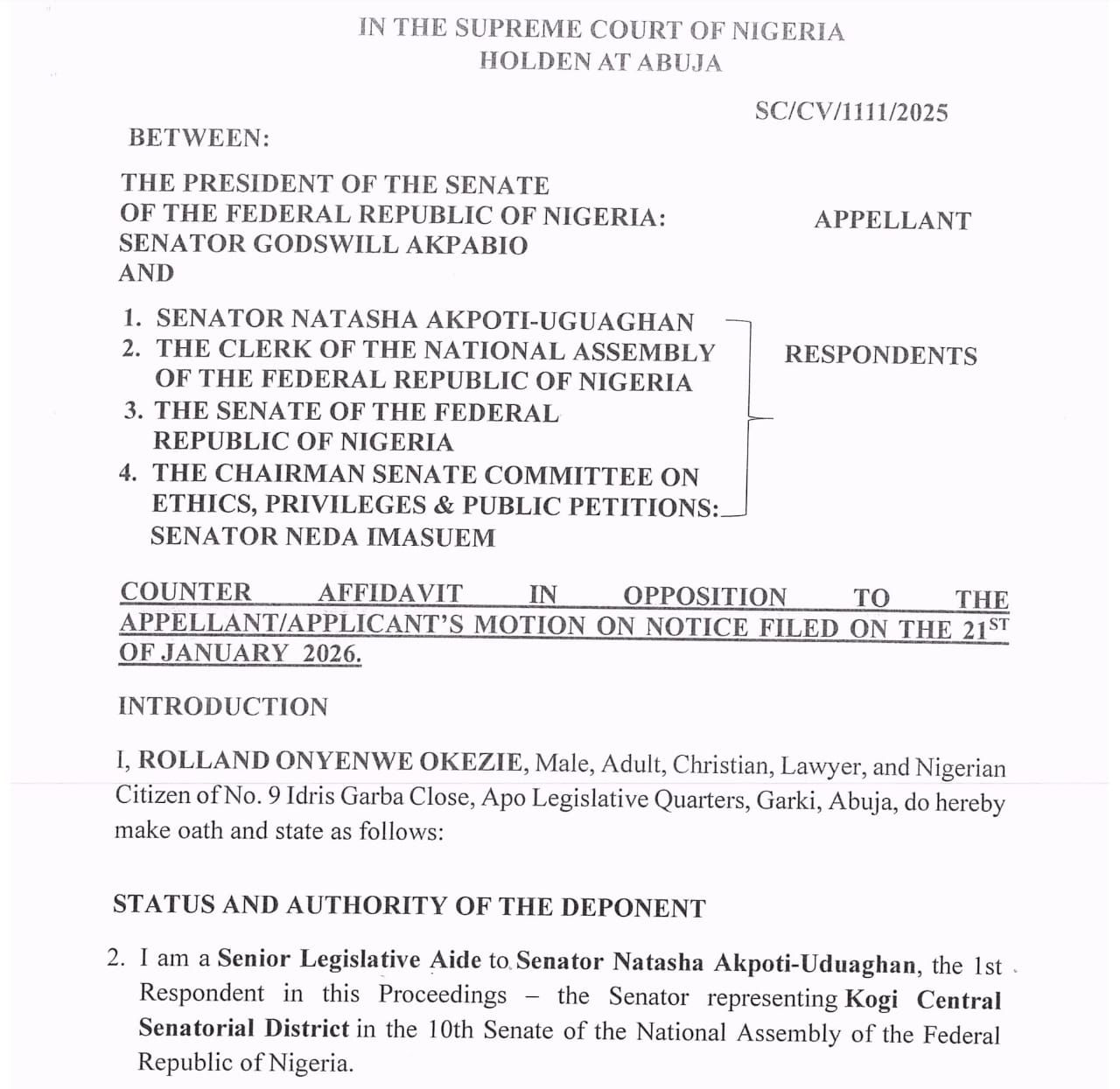
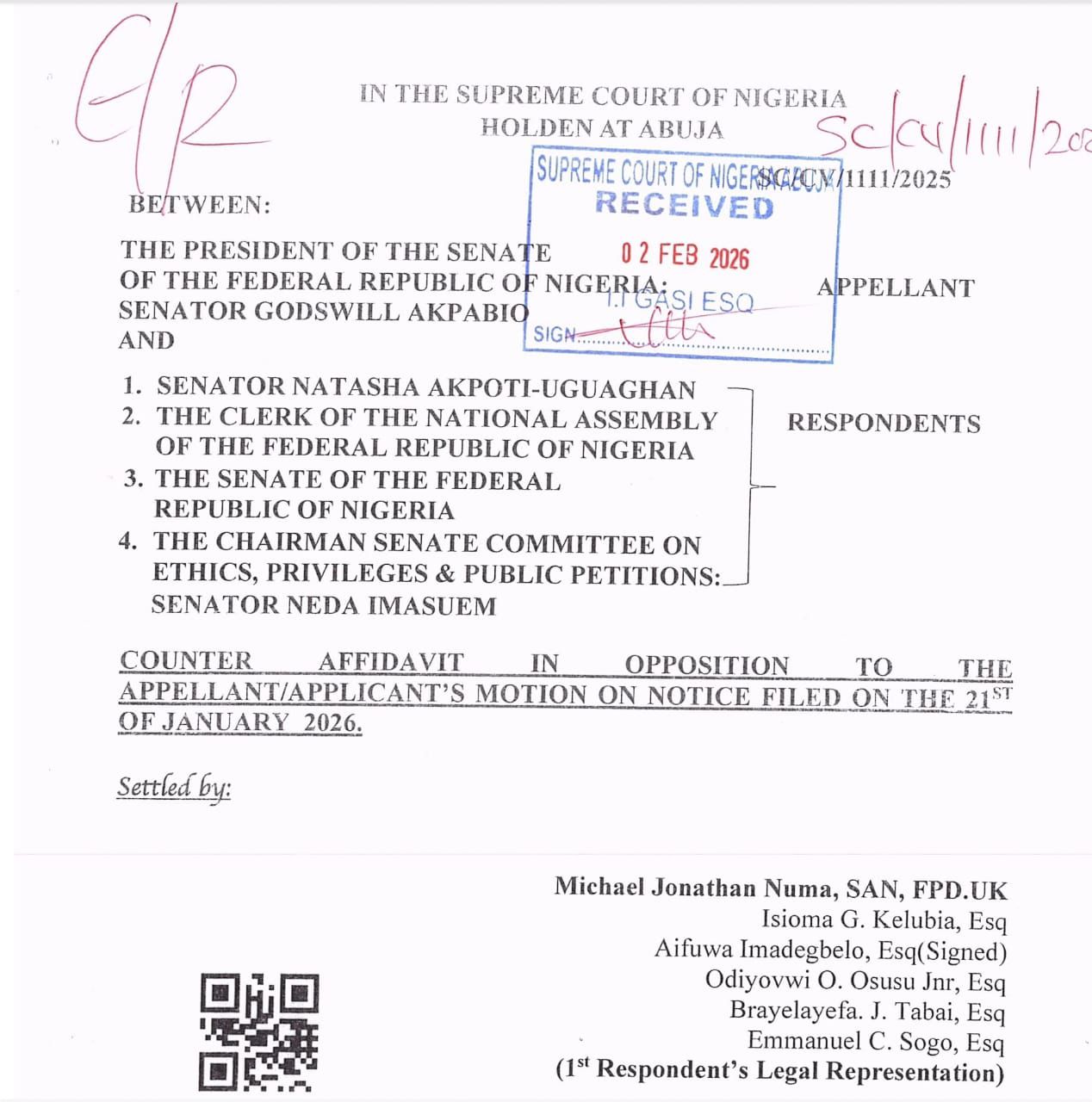
Kogi Central Senator, Natasha Akpoti-Uduaghan, has filed a counter-affidavit before the Supreme Court of Nigeria in opposition to an appeal instituted by the President of the Senate, Senator Godswill Akpabio, arising from proceedings at the Court of Appeal.
Court documents sighted in Abuja indicate that the counter-affidavit was deposed to by a senior legislative aide to Senator Akpoti-Uduaghan and filed in response to Senator Akpabio’s Motion on Notice dated January 21, 2026.
The respondents are urging the apex court to dismiss the application in its entirety, arguing that it discloses no prima facie good cause and constitutes an abuse of court process.
According to the counter-affidavit, the Court of Appeal had already concluded hearing in the substantive appeal on November 28, 2025, and reserved the matter for judgment.
The respondents contend that approaching the Supreme Court at this stage amounts to an attempt to interfere with an appellate process that has reached an advanced stage and is awaiting final determination.
The filing further maintains that Senator Akpabio was afforded ample opportunity to present his case before the Court of Appeal in strict compliance with the Rules of Court.
It asserts that the brief of argument filed by Senator Akpoti-Uduaghan was properly before the lower court, procedurally compliant, and was never formally challenged during the proceedings.
Central to the dispute is an alleged breach of the Court of Appeal Rules, 2021, which prescribe a maximum of 35 pages for briefs of argument.
The respondents contend that while the legal teams representing Senator Akpoti-Uduaghan, the Clerk of the National Assembly, and another respondent complied with the page limit, the Senate President filed a brief running well beyond the prescribed limit.
They further allege that the appellant failed to regularise the defect within the timeframe allowed by the Rules.
Consequently, the Court of Appeal is said to have declined to admit the over-length brief and proceeded to hear the appeal based on the valid and properly filed processes before it.
On the substantive legal issues, the respondents argue that the grounds of appeal relied upon by the appellant raise issues of mixed law and fact.
They insist that prior leave of court was mandatory before such grounds could be competently filed and maintain that no such leave was sought or obtained, rendering the appeal incompetent ab initio.
The counter-affidavit also addresses complaints relating to adjournment and fair hearing, maintaining that the grant or refusal of an adjournment lies within the discretionary powers of the court. It submits that the Court of Appeal exercised its discretion judicially and judiciously and that the appellant was not denied fair hearing at any stage of the proceedings.
Urging the Supreme Court to dismiss the application, the respondents describe the appeal as an attempt to stall or frustrate the delivery of judgment by the Court of Appeal.
With the matter now before the apex court, legal observers say the case is likely to test critical issues of appellate procedure, judicial discretion, and the permissible limits of post-hearing interventions within Nigeria’s judicial system.