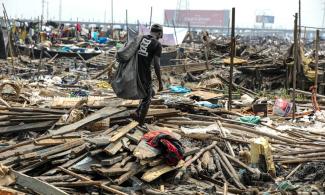
It accused Governor Babajide Sanwo-Olu’s administration of systematic ethnic cleansing of Ogu-dominated littoral settlements under the guise of urban development.
The Ogu General Assembly (OGA), a socio-cultural organisation representing the interests of the people of Ogu (Egun) descent in Lagos State, has strongly condemned the “violent demolition and forced displacement” of the Makoko waterfront community in the state.
It accused Governor Babajide Sanwo-Olu’s administration of systematic ethnic cleansing of Ogu-dominated littoral settlements under the guise of urban development.
In a position paper dated February 2, 2026, the OGA called for an immediate and permanent halt to ongoing demolitions in Makoko and neighbouring waterfront communities, warning that the exercise has escalated into a humanitarian crisis marked by deaths, mass displacement, and the destruction of livelihoods.
The position paper was signed by the OGA Convener, Prof. Jẹndele Hungbo; the Secretary, Mr. Mewhenu Hosu; members of the Board of Trustees, Dr. Tony Dansu and Dr. Babatunde Mẹsẹwaku; and a member of the Steering Committee, Prof. Ṣenayọn Ọlaoluwa.
The group stated that the Ogu people constitute the predominant population of Makoko and several other waterfront settlements in Lagos, noting that these communities date back to the 17th and 18th centuries when Ogu natives from Badagry and other parts of their cultural homeland established fishing settlements along the lagoon.
According to the OGA, generations of Ogu fishermen and traders have played a crucial role in sustaining Lagos State’s food security, supplying seafood that feeds millions of residents daily.
It argued that the ongoing demolitions threaten not only homes but also the economic and cultural foundations of these historic communities.
Allegations of Class Cleansing and Gentrification
Describing Makoko as a historic fishing settlement with an estimated population of over 300,000 people, the OGA alleged that the current demolition exercise amounts to “ruthless demolition, forced eviction, violent displacement, class cleansing, ethnic violence, and unconscionable gentrification.”
Addressing the Lagos State House of Assembly on Tuesday, February 3, Prof. Olaoluwa said, “The indigenous Ogu people within the metropolis of Lagos, about 10 years ago, Otodogbamẹ was destroyed. If you go there, nobody can identify as a native of Otodogbamẹ again because that place is now referenced as Periwinkle Island.
“Going by that antecedent, we are saying that Makoko is about to go down, and in the next couple of years, there will be no more Makoko, and when that happens, what do we say about the indigenous people who have been there since the 17th century?
“This is our concern. The Lagos State government has to convince us that there is no deliberate attempt at annihilating the only other indigenous groups in Lagos state after the Yoruba and the Ogu, and this is happening to us again and again.”
The OGA further alleged that waterfront communities are being cleared to pave the way for luxury real estate developments designed for elites and the super-rich, with no consideration for the original inhabitants.
“What is currently being perpetrated against the Makoko community reveals a disturbing pattern of land grabbing and displacement,” the group stated, adding that the actions of the Lagos State Government show that “public safety or urban regeneration” are not the true objectives of the exercise.
The OGA argued that the Makoko demolitions are not an isolated incident but part of a broader, sustained pattern of displacement affecting waterfront communities largely populated by Ogu indigenes.
It cited the destruction of the Otodogbamẹ fishing community between 2016 and 2017 as a precedent, noting that the area has since been transformed into the luxury Periwinkle Estate.
According to the group, more than 30,000 predominantly Ogu residents were forcibly evicted during that operation, with homes allegedly set ablaze and residents driven into the Lagos Lagoon.
Despite reported international condemnation and court orders prohibiting the evictions, the OGA said the government proceeded with the demolitions “in flagrant disregard for the rule of law, judicial authority, international conventions and natural law.”
The group added that many survivors of Otodogbamẹ later resettled in Makoko and are now facing displacement for a second time.
Drawing parallels between Otodogbamẹ and Makoko, the OGA listed what it described as a familiar pattern: initial justifications based on public safety, assurances of limited demolition within defined setbacks, followed by expanded clearances, deployment of armed security personnel, use of tear gas and live ammunition, and the eventual conversion of cleared land into high-end developments.
The Makoko Crisis: Timeline and Reported Violations
According to the OGA, the current demolition exercise, which began on December 23, 2025, during the Christmas holiday period, and was initially presented as a 30-metre safety setback from high-tension power lines, has expanded first to 50 metres, then 100 metres, and eventually to areas with no proximity to power infrastructure, including parts of Oko-Baba.
As of late January 2026, the group noted that reports from civil society groups documented widespread destruction and displacement.
These include the demolition of more than 3,000 homes, the destruction of five schools and two clinics, and the razing of four places of worship.
The OGA also noted that hundreds of fishing businesses had been destroyed, leaving families without income or shelter.
It said displaced residents, including infants and elderly persons, were forced to sleep in canoes, churches, or in the open, exposed to harsh weather conditions and health risks.
Deaths and Use of Force
The group highlighted several deaths linked directly to the demolition exercise and the use of force by security operatives.
Among those named were Epiphany Kpenassou Adingban, a five-day-old infant said to have died after tear gas was deployed into his family’s compound, and Morenikeji Amossou, a three-week-old baby girl who reportedly drowned after her mother slipped into the lagoon while fleeing tear gas.
The OGA also mentioned the death of Ms Albertine Ojadiklunọ, a 70-year-old woman, which it attributed to stress and trauma resulting from the demolitions.
It added that two other children and several adults had been hospitalised due to tear gas exposure and injuries.
“These deaths are not unfortunate accidents,” the group said, describing them as “inevitable and foreseeable consequences” of deploying armed force and heavy machinery in a densely populated civilian area without adequate notice or humane alternatives.
Arrests and Intimidation Allegations
The OGA further accused authorities of suppressing community advocacy and dissent.
It cited the arrest of Mr Oluwatobi Aide, identified as a youth leader who was said to have approached demolition officials on January 12, 2026, to request time for residents to retrieve their belongings.
According to the group, Aide was detained for several days despite suffering health complications linked to earlier tear gas exposure.
Cultural and Economic Implications
Beyond the immediate humanitarian impact, the OGA warned of far-reaching socio-economic and cultural consequences.
It described Makoko as more than a collection of informal structures, but a living cultural ecosystem with deep historical roots.
The group emphasised that the Makoko-Aṣejere market plays a key role in supplying affordable seafood to Lagos residents and argued that dismantling the community would disrupt critical food supply chains.
By targeting Makoko and other Ogu fishing settlements, the OGA said the state government risks erasing centuries of cultural continuity while undermining livelihoods that predate many of the upscale neighbourhoods now surrounding the waterfront.
Demands to the Lagos State Government
In response to the situation, the OGA demanded the immediate and permanent cessation of all demolitions in Makoko, Oko-Agbọn, Sogunro, and other waterfront communities.
It also called for a comprehensive and dignified resettlement plan for displaced residents, including the provision of quality housing, access to basic amenities such as schools and healthcare, and relocation sites that allow continued access to fishing livelihoods.
The group stressed that any resettlement must be free or genuinely affordable and preserve community cohesion.
The group further demanded full compensation for families of those killed, those displaced, and individuals injured during the demolitions.
This includes financial compensation, medical care, and restitution for lost property and livelihoods.
The OGA further called on the government to guarantee the safety of Makoko residents by ending the use of force, withdrawing armed personnel, releasing detained community members, and ensuring residents can return to remaining homes without fear of violence or arrest.
Call for Accountability
The OGA rejected the notion that urban development must come at the cost of marginalised communities, describing the transformation of Otodogbamẹ into Periwinkle Estate and the ongoing Makoko demolitions as a betrayal of Lagos State’s social contract.
“Lagos State cannot build a megacity on the bodies, blood and tears of its most vulnerable residents,” the group said.
The group appealed to Nigerians and the international community to demand accountability and ensure that the events of Otodogbamẹ are not repeated in Makoko.