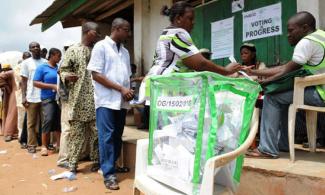
Despite this crisis of confidence, Nigeria continues to operate one of Africa’s most expensive electoral systems.
The National Conscience Platform (NCP) has warned that Nigeria is sliding dangerously toward a democratic collapse, as official figures from the Independent National Electoral Commission (INEC) reveal a dramatic decline in voter participation over the past decade.
The organisation, citing INEC, noted that voter turnout dropped from 54 percent in 2011 to 35 percent in 2019, and plummeted further to approximately 27 percent in the 2023 general elections, the lowest participation rate since the return to civilian rule in 1999.
In a statement issued jointly by Comrade Babatunde Agunbiade and Barrister Wale Ogunade, Interim Coordinators (Facilitating) of the Platform, NCP described the situation as a national crisis that goes beyond voter apathy.
The statement read, "Democracy is not only threatened by coups; it is dismantled when citizens lose faith that their votes matter."
Despite this crisis of confidence, Nigeria continues to operate one of Africa’s most expensive electoral systems.
Meanwhile, election budgets have risen consistently across cycles, involving billions of naira in public funds allocated for voter registration, logistics, technology, and security. Despite this, credibility continues to decline.
"This raises unavoidable public-interest questions: What exactly is Nigeria spending on elections, and why are outcomes worsening?” the NCP said.
"At the heart of the crisis is the continued stalling of electoral law amendments at the National Assembly. This delay is not neutral. It preserves a defective system that entrenches incumbency advantage, weakens opposition parties, narrows political space, and accelerates the erosion of multiparty democracy.”
Nigeria already has a roadmap for reform. In 2008, the Justice Mohammed Uwais Electoral Reform Committee released a comprehensive report recommending reforms to address structural flaws in the electoral system.
"These included increasing the independence of the electoral management body, stricter regulation of campaign finance, ensuring internal party democracy, and insulating elections from executive interference. Sixteen years later, most of these recommendations remain unimplemented,” the organisation said.
"Afrobarometer surveys repeatedly show that less than one-third of Nigerians believe elections reflect the will of the people. When citizens no longer trust the ballot, legitimacy fractures and governance become coercive rather than consensual.
"More troubling is the emerging pattern of administrative and regulatory pressure shrinking political competition, raising fears of a drift toward de facto one-party dominance—an outcome fundamentally incompatible with Nigeria’s Constitution and democratic history."
In response, the NCP has announced the initiation of Freedom of Information (FOI) requests to INEC and other relevant public institutions to obtain: "A detailed breakdown of electoral expenditures by election cycle.
"Procurement records for election technology and logistics. Data on party funding oversight and compliance. Legislative records explaining the delay in electoral law amendments.
“These records are public documents. Nigerians have a right to know how democracy is funded—and why it is failing.”
“Electoral reform is not a favour to opposition parties or civil society. It is a national accountability and security imperative,” the organisation stared.
NCP urged investigative journalists, civil society organisations, labour movements, youth groups, professional bodies, and faith leaders to treat this moment as a critical turning point.
"Electoral reform delayed is democracy denied. Silence now is complicity. Countries that suppress political competition do not achieve stability; they manufacture unrest," the organisation said.