The survey was endorsed by the Director-General of NAFDAC, Prof. Mojisola Christianah Adeyeye, and released on Tuesday.
A national survey conducted in collaboration with the National Agency for Food and Drug Administration and Control (NAFDAC) has revealed widespread access to alcohol among minors and underage children in Nigeria, highlighting what authorities describe as a growing public health concern linked to early exposure and abuse of alcoholic beverages.
The survey, titled “Underage Drinking and Abuse of Alcohol: Access to Alcohol and Frequency of Consumption,” was sponsored by the Distillers and Blenders Association of Nigeria (DIBAN) in collaboration with NAFDAC and conducted by Research and Data Solutions Ltd, Abuja, between June and August 2021.
The survey was endorsed by the Director-General of NAFDAC, Prof. Mojisola Christianah Adeyeye, and released on Tuesday.
According to the study, alcohol remains “one of the most widely used substances of abuse among youths,” with findings pointing to increased availability and ease of access as major drivers of consumption among children below the legal drinking age.
The report noted that “the availability and easy access to alcohol have been identified as a contributory factor to the increasing alcohol consumption among minors.”
For the purpose of the research, respondents less than thirteen (13) years of age were classified as minors, while those aged thirteen (13) to seventeen (17) years were referred to as underaged. Persons aged eighteen (18) years and above were categorised as adults.
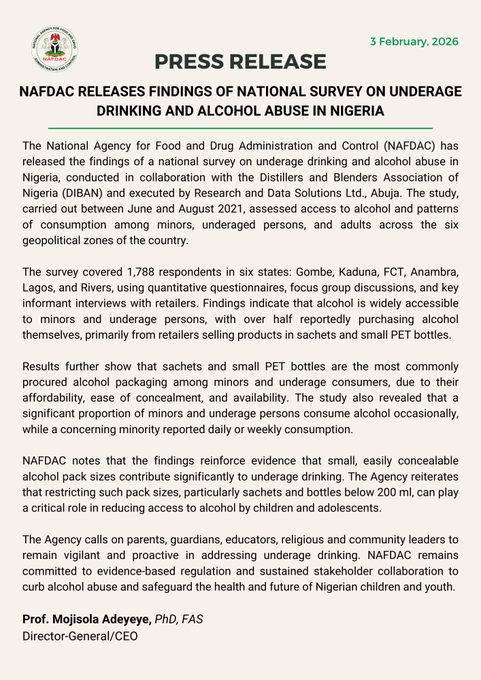
A total of 1,788 respondents drawn from six states representing Nigeria’s six geopolitical zones participated in the quantitative survey after giving consent. The study exceeded the minimum required sample size of 1,712 respondents, calculated using a 95 per cent confidence level and 80 per cent statistical power.
Data was collected using a structured multiple-choice questionnaire administered by trained enumerators.
In addition to the quantitative survey, qualitative data was gathered from 161 participants through 14 Focus Group Discussion (FGD) sessions involving male and female minors and underage children, as well as 21 Key Informant Interviews (KII) with retailers of alcoholic beverages and shop owners across the study states.
Findings from the survey showed that access to alcohol among minors and underage children is largely unrestricted.
The data indicated that “54.3% of minors and the underage obtained alcohol by themselves from various sources,” while nearly half, “49.9% of them patronised retailers of drinks sold in sachet packs and PET bottles.”
The report further showed that minors and underage children also accessed alcohol from informal channels, with “49.9%” obtaining drinks from friends and relatives and “45.9%” accessing alcohol at social gatherings. Smaller proportions reportedly sourced alcohol from liquor stores (15.4%), restaurants (12.6%), and supermarkets (7.9%).
Among those who purchased alcohol personally, sachets and PET bottles emerged as the most common packaging formats.
The study found that “47.2% of minors and 48.8% of the underage procured drinks in sachets,” while “41.2% of minors and 47.2% of the underage procured drinks in PET bottles.”
About “27.6% of the underage procured alcohol in glass bottles.”
The procurement of alcohol in sachets and PET bottles was reported most frequently in Rivers, Lagos, and Kaduna states. The report also noted disparities based on gender and location, stating that the proportion of drinks procured in sachets was higher among males (51.4%) than females (41.5%), and more prevalent in rural areas (50.1%) compared to urban locations (45.3%).
On frequency of consumption, the findings showed that alcohol use among minors and underage children is not limited to experimental or one-off exposure.
According to the survey, “54.0%” of respondents were occasional drinkers, while “24.0% drink alcohol daily” and “11.0% drink alcohol at least once a week.”
A breakdown by age category revealed that “63.2% of minors and 54.0% of the underage drink alcohol occasionally.”
However, the data also showed regular consumption patterns, with “9.3% of minors and 25.2% of underage children” consuming alcohol daily, and “11.3% of minors and 9.4% of underage children” drinking alcohol at least once a week.
Summarising the findings, the report stated that “most minors and the underage (54.3%) buy alcohol for themselves,” while access through friends, relatives, social gatherings, and parents’ homes remains common.
In its conclusions, the study warned that continued availability of easily concealable alcohol packaging contributes significantly to underage drinking. It stated that “access to alcohol by children can be limited if pack sizes that can be easily concealed are not available,” adding that “a ban on small pack sizes (sachets and bottles less than 200 ml) can reduce the menace of underage drinking.”
The report also emphasised collective responsibility, noting that “consumption of alcohol should raise an alarm for parents, teachers, religious leaders and the community at large.”