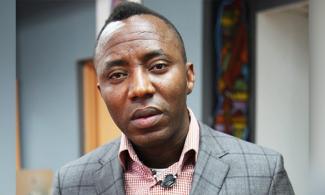
He subsequently fixed March 5, 2026, for the continuation of the cross-examination of the prosecution witness.
Justice Mohammed Umar of the Federal High Court, Abuja has adjourned proceedings in the alleged cyberstalking case instituted by the Department of State Services (DSS) against human rights activist, Omoyele Sowore, to March 5, 2026.
The adjournment was granted to allow the defence additional time to continue the cross-examination of the prosecution witness (PW1), Cyril Nosike, an operative of the Department of State Service.
Ruling after the conclusion of the proceedings on Wednesday, the presiding judge noted that the defence adjourned the case to March 5, 2026 to enable the defence counsel led by Abubakar Marshal to have more time for the cross-examination of the prosecution witness.
Justice Umar held that granting the request was necessary in the interest of justice, stressing that the court must ensure fairness and afford the defendant adequate opportunity to prepare and respond to recent developments in the case.
The judge also acknowledged concerns raised over the conduct of the criminal proceedings in recent days but emphasised that due process and fairness must remain the court’s guiding principles.
“In the spirit of fairness, I am inclined to adjourn this matter for the last time to allow for further cross-examination,” Justice Umar stated.
He subsequently fixed March 5, 2026, for the continuation of the cross-examination of the prosecution witness.
Sowore is standing trial for allegedly cyberstalking President Bola Tinubu and calling him a “criminal,” in a case brought by the DSS.
Last Tuesday, SaharaReporters reported that Sowore presented a video in which former presidential aide Reno Omokri referred to President Tinubu as an “international drug baron” during proceedings at the Federal High Court in Abuja.
At the resumed hearing before Justice Mohammed Umar last Tuesday, defence counsel Marshal commenced cross-examination of the prosecution’s first witness, Nosike (PW1), a DSS operative.
During cross-examination, Marshal questioned the witness on whether the DSS, as part of its statutory duties, conducts security and background checks on individuals nominated for sensitive positions such as ambassadors, ministers, and judges.
Nosike responded that he was not aware if the service carried out such assignments.
The witness was further asked why the DSS cleared Reno Omokri for an ambassadorial nomination despite calling President Tinubu an “international drug baron.”
Nosike stated that he could not explain the reason for Omokri’s clearance.
Nosike also surprised the court when questioned about a public statement made by President Tinubu, in which the President said he would protect the constitutional right of any Nigerian to insult, abuse, or call him names.
When asked whether he was aware of such a statement, the witness offered no definitive response.
Marshal then queried why the DSS proceeded to file charges against Sowore if the President had publicly committed to protecting free speech rights under the Constitution.
Following this, the defence sought the court’s permission to admit two video clips as evidence: one showing Omokri’s “international drug baron” comment, and another showing President Tinubu affirming the public’s right to freely criticise him.
Counsel for the DSS, Akinlolu Kehinde, SAN, objected to the move, arguing that the defence was “playing to the gallery” and that the questions were unnecessary.
He further opposed the admissibility of the video evidence on the grounds that the individual who produced the videos was not listed as a witness and therefore could not tender them in court.
Kehinde urged the court to reject the evidence, cautioning against what he described as an attempt to “smuggle” the videos into the proceedings.
In a bench ruling, Justice Umar, after briefly examining the relevance of the materials in line with the Evidence Act 2023 admitted the video clips as exhibits.
In December 2025, the Senate confirmed 64 ambassadorial nominees of President Bola Tinubu, including Reno Omokri.
The confirmation came after the President’s nominations were considered and a report from the Senate Committee on Foreign Affairs was adopted, which stated that all nominees had been screened and deemed suitable for appointment.