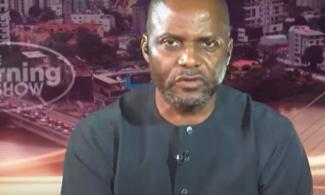
Agule made the disclosure during an interview on Arise News Television on Wednesday.
Energy expert, Nick Agule, has decried what he described as deep-rooted structural failures in Nigeria’s electricity sector, revealing that he pays more for power in Abuja than in London, despite enjoying uninterrupted electricity supply in the United Kingdom.
Agule made the disclosure during an interview on Arise News Television on Wednesday.
“There is something I will say now that will shock Nigeria before I give way. I pay for electricity in the United Kingdom, where I have a home. I pay for electricity in Nigeria, where I have a home. I am paying far more for electricity in Abuja than I pay in London. And yet in London, I get 24/7, 365 days electricity nonstop,” he said.
Speaking on the issue of electricity subsidy, Agule said states and local governments must now take responsibility following the Electricity Act signed into law in 2023.
“I agree with you, I align my views with you to say that now that the states, through the Electricity Act that was signed in 2023 by President Tinubu, have a responsibility to create electricity markets in their domains, they should also come to the table about this subsidy matter,” he said.
“And it should not only be states, it should be the local governments as well. So this should be a subsidy that is charged as a first-line charge on the federation account.”
Agule, however, criticised the Federal Government’s approach to the power sector, saying authorities were merely addressing symptoms rather than the root causes of the crisis.
“However, the government seems to be solving the symptoms, which is dealing with the accumulated debt in the electricity sector over time, instead of attacking the cause,” he said.
He questioned why power generation companies were owed trillions of naira while huge subsidies were still being budgeted.
“Because we need to ask the question: what is causing this debt? What is actually happening is that we now hear that Gencos are owed four trillion naira, and we have a subsidy of N1.2 trillion in the MTEF document for 2026 to 2028. Why so? Why is the government not subsidising telecom services, for instance? And that is where the question is. That is the real issue,” Agule added.
To explain the systemic failures, the energy expert gave a breakdown of how electricity generated is lost at various stages before reaching consumers.
“Assuming the power station in Egbin generates 1,000 megawatts of electricity. The 1,000 megawatts of electricity do not end up in the market,” he said.
He explained that “maybe 300 megawatts are not evacuated out of Egbin. It is totally stranded at the power station… because there is no transmission capacity to carry it.”
According to him, even when 700 megawatts enter the grid, only about 500 megawatts may arrive at destination.
“What happened to 200 megawatts? They are lost because of bad infrastructure, ageing equipment, and all of that. That is what you call technical losses,” he said.
Agule further disclosed that distribution companies also reject power due to poor investment.
“Then 500 megawatts arrive in Abuja. The Abuja Distribution Company, that is AEDC, quickly rejects 150 megawatts. They are not taking it,” he said.
“Why are they not taking 150 megawatts? Because they have not invested to expand the distribution network to be able to take all of the 500 megawatts that have come from Egbin.”
He added that out of the 350 megawatts accepted, only 250 megawatts are billed.
“What happened to the 100 megawatts? The 100 megawatts are either stolen or it is lost through a poor distribution network again. So that is what you call commercial losses,” he said.
Agule said revenue collection is also a major problem.
“Then the 250 megawatts that has been billed, maybe only 160 megawatts have been paid into the bank. What happened to the 90 megawatts? The 90 megawatts are customers who have refused to pay their bills,” he said.
Summarising the situation, he said: “Now 1,000 megawatts were generated in Egbin. Only 160 megawatts are money in the bank. The difference is what is causing this problem. That is where the debt is coming from.”
Agule warned that settling existing debts alone would not solve the crisis.
“So even if President Tinubu solves the accumulated debts now, because the fundamental structural issues in the power sector have not been sorted, the debts will continue to come,” he said.
Tracing the problem to the 2013 privatisation exercise, he said: “President Jonathan, in 2013, privatised the electricity sector. But he did it in a very bad way, and that is what is causing this problem.”
“What did he do? He privatised the generating companies and privatised the distribution companies. But he did not do anything with the transmission company,” Agule added.
Agule noted that the transmission bottleneck is responsible for huge energy losses.
“So that transmission bottleneck, because the government does not have money to modernise and expand the transmission capacity, is responsible for the first 300 megawatts that did not even leave Egbin. It is also responsible for the 200 megawatts that were lost through the transmission grid,” he said.
On the distribution companies, Agule said licences were given to firms without capacity.
“The Disco licences were awarded to companies that have no known history in the power sector. They have no experience, they have no managerial capacity, they have no technical capacity, they have no financial capacity,” he said.
“They scrambled for these licences. And they do not have the money to invest,” he added.
Comparing with the telecoms sector, Agule said: “When MTN and others got their licences, they first brought in their capital, either equity or debt capital, and put in over $100 billion first before they now started providing telecom services to Nigerians.”
He concluded: “How much have the operators in the power sector put in? They have not put in anything. And Nigerians are just being strangulated.”