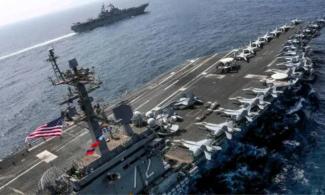
The shooting down of the Iranian drone, which the U.S. military said happened on Tuesday, has heightened tensions in the Arabian Sea amid renewed diplomatic efforts to revive nuclear talks between Washington and Tehran.
The United States military said it has shot down an Iranian unmanned aerial vehicle after it flew toward a U.S. aircraft carrier in what American officials said was a threatening maneuver.
The shooting down of the Iranian drone, which the U.S. military said happened on Tuesday, has heightened tensions in the Arabian Sea amid renewed diplomatic efforts to revive nuclear talks between Washington and Tehran.
According to the U.S. military, the Iranian Shahed-139 drone approached the USS Abraham Lincoln with what it said was “unclear intent” and was intercepted by a U.S. Navy fighter jet, according to Reuters.
Oil futures reportedly climbed by more than $1 a barrel following reports of the shootdown, reflecting market concerns over security in the region.
“An F-35C fighter jet from Abraham Lincoln shot down the Iranian drone in self-defense and to protect the aircraft carrier and personnel on board,” Reuters quoted Navy Captain Tim Hawkins, a spokesperson for U.S. Central Command, as saying.
He added that the drone had been behaving “aggressively” as it closed in on the carrier.
Hawkins said no U.S. service members were injured and no American military equipment was damaged during the incident.
Iran’s mission to the United Nations declined to comment on the development.
However, Iran’s Tasnim news agency reported that contact had been lost with a drone operating in international waters, though it said the cause of the loss was not immediately clear.
The shootdown occurred against the backdrop of escalating political and military pressure on Iran, as U.S. President Donald Trump warned that failure to reach a nuclear agreement could lead to serious consequences.
With U.S. warships moving closer to Iran’s coastline, Trump said last week that “bad things” would probably happen if negotiations collapsed.
The Abraham Lincoln carrier strike group represents the most prominent element of a broader U.S. military buildup in the Middle East following a violent crackdown on anti-government protests in Iran last month.
The unrest was described by observers as the deadliest episode of domestic turmoil in the country since the 1979 Islamic Revolution.
Although Trump ultimately refrained from intervening directly during the crackdown, he has since demanded significant nuclear concessions from Tehran while ordering additional U.S. naval forces into the region.
He said last week that Iran was “seriously talking,” a claim echoed by Iran’s top security official, Ali Larijani, who said arrangements for negotiations were underway.
Tensions were further strained by a separate confrontation later on Tuesday in the Strait of Hormuz, one of the world’s most vital oil shipping lanes.
The U.S. Central Command said Iranian forces harassed a U.S.-flagged, U.S.-crewed commercial vessel just hours after the drone incident.
“Two IRGC boats and an Iranian Mohajer drone approached M/V Stena Imperative at high speeds and threatened to board and seize the tanker,” Hawkins said.