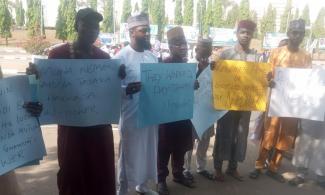
The protesters carried placards with various inscriptions including, “Renewed Hope or Recycled Neglect? N-Power,” “They Worked, Pay Them. N-Power,” and “Pay N-Power”.
Beneficiaries of the Nigerian government youth empowerment programme under the umbrella of the National Association of N-Power Beneficiaries on Wednesday staged a peaceful protest at the National Assembly complex and the Federal Ministry of Finance, Abuja, over the non-payment of their stipends for nine months.
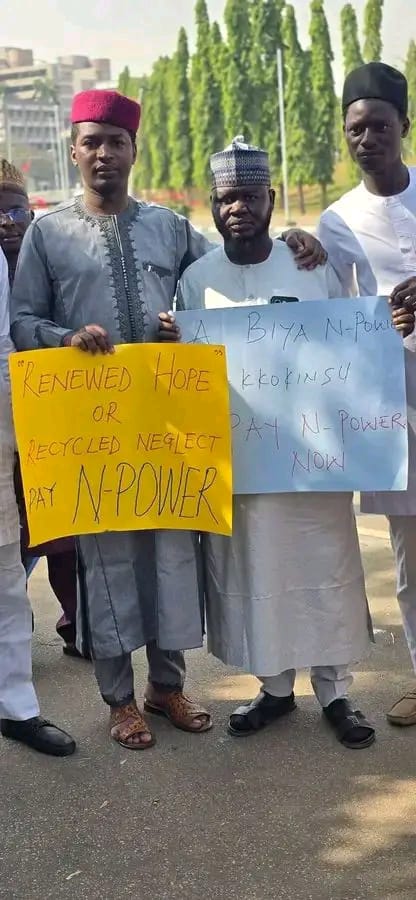
The protesters carried placards with various inscriptions including, “Renewed Hope or Recycled Neglect? N-Power,” “They Worked, Pay Them. N-Power,” and “Pay N-Power”.
The protesters accused the Nigerian Government of failing to meet its obligations to beneficiaries of the N-Power programme, despite their months of dedicated service and repeated appeals through official channels.

In a statement issued during the protest, the protesters said the prolonged delay in the payment has exposed N-Power beneficiaries across the country to severe financial hardship, emotional stress and loss of dignity, noting that the situation runs contrary to the objectives of the youth empowerment scheme.
“Our legitimate entitlements have been unjustly withheld, despite our patience and consistent service. This neglect has negatively affected the welfare of thousands of Nigerian youths who relied on the programme for sustenance,” the statement signed by the National Publicity Secretary of the association, Adeshina A. Adex, read.
The protesters said the protest was aimed at demanding immediate action, accountability and transparency from relevant government authorities on the outstanding stipends and the overall status of the programme.
The protesters demanded the immediate payment of all arrears owed to beneficiaries and clear communication from the Nigerian Government on the future of the N-Power scheme.
While reaffirming their commitment to lawful and peaceful engagement, the protesters warned that it would not remain silent in the face of what it described as continued injustice.
The controversy over the non-payment of the N-Power beneficiaries' stipend has been a lingering issue from the inception of the programme under the late President Muhammadu Buhari’s administration.
The beneficiaries have made several appeals and staged several protests demanding the payment of the nine months outstanding stipend by the Nigerian government.
In 2025, the aggrieved N-Power beneficiaries sued the President Bola Tinubu-led Nigerian government at the National Industrial Court in Abuja over the nonpayment of the stipends and entitlements.
The suit, filed through their legal team led by Barrister A. A. Hikima, listed the Federal Ministry of Humanitarian Affairs and Poverty Alleviation; the Attorney-General of the Federation; the Accountant-General of the Federation, and Mr. Akindele Egbuwalo (National Programme Manager of the N-Power sued on behalf of N-Power programme), as first to fourth defendants.
Also, SaharaReporters in November 2024 reported that human rights lawyer, Barrister Deji Adeyanju, petitioned the then-Minister of Humanitarian Affairs and Poverty Reduction, Prof. Nentawe Goshwe Yilwatda, over the nonpayment of the N-Power beneficiaries’ one-year stipends.
The N-Power beneficiaries lamented that they were not paid their stipends between October 2022 and September 2023.
They noted that though the programme had been suspended by the Nigerian government, they were engaged and their services were utilised before the suspension of the programme.
N-Power is a Nigerian government social investment programme created to address youth unemployment by providing young people with skills, work experience, and temporary income support.
It was launched in 2016 as part of the National Social Investment Programme, targeting unemployed and underemployed Nigerians, mainly between the ages of 18 and 35.
Through N-Power, beneficiaries are deployed to various public institutions where they gain practical experience while receiving monthly stipends and training. The programme includes several components, such as N-Power Teach, which places participants as teaching assistants in public schools; N-Power Health, which supports healthcare facilities; N-Power Agro, focused on agricultural extension services; and N-Power Tech, which provides digital and technology-related skills.
The initiative was designed to reduce youth unemployment, strengthen service delivery in key sectors, and equip participants with skills that would help them transition into long-term employment or entrepreneurship after the programme.
However, it has been dogged by allegations of corruption, mismanagement, and fraudulent practices since its inception.
For instance, investigations have revealed that the scheme has been plagued by "ghost beneficiaries," where fraudulent individuals or officials collect stipends for non-existent volunteers.
Reports indicate that some beneficiaries were required to pay bribes to officials for redeployment or to remain on the payroll. Many beneficiaries have complained of non-payment of monthly stipends, despite government claims of disbursement.