
The transactions have raised questions about the timing and scale of the expenditure.
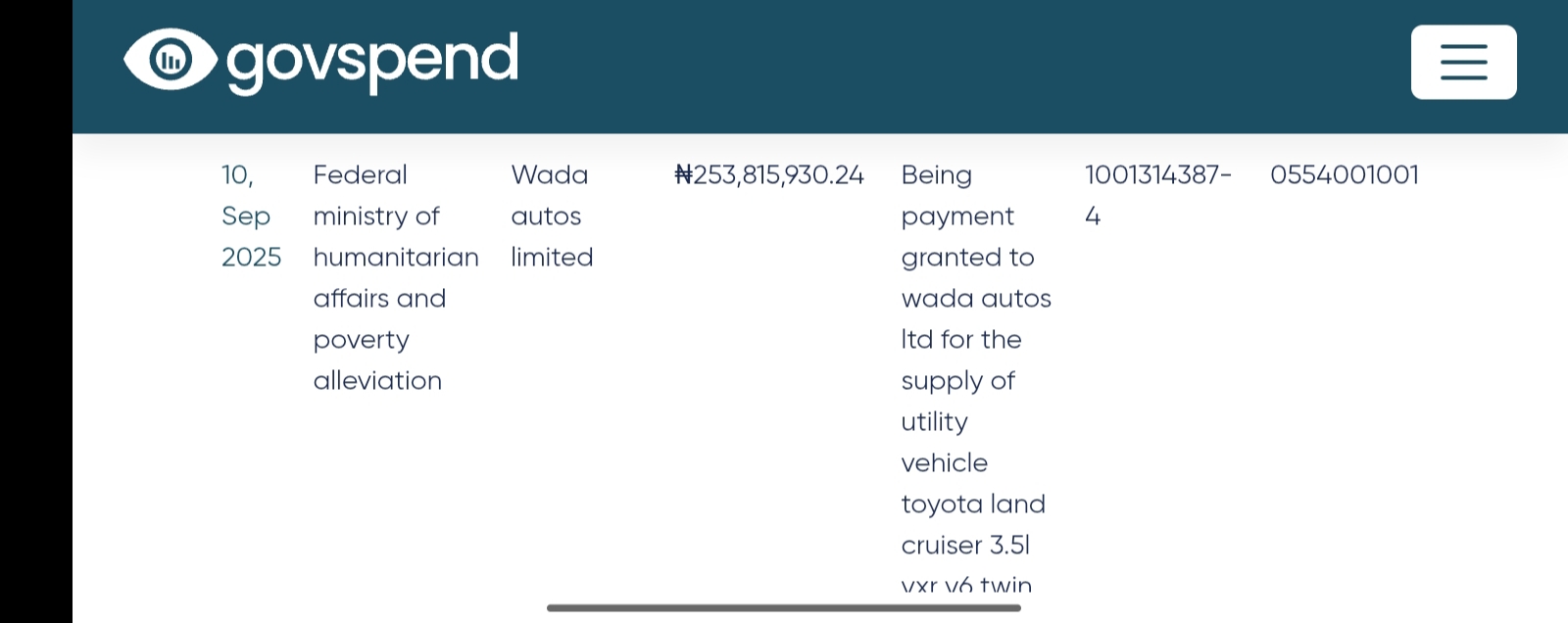
A SaharaReporters' review of the public payments portal, Govspend, has revealed that Nigeria’s Ministry of Humanitarian Affairs spent a total of N507.5million on the purchase of Toyota Land Cruisers within a span of just three days.
The transactions have raised questions about the timing and scale of the expenditure.
Records on the portal show that on September 12, 2025, the ministry paid N253.7million to A-Plus Integrated Services Limited for the supply of Toyota Land Cruisers, 2024 model.
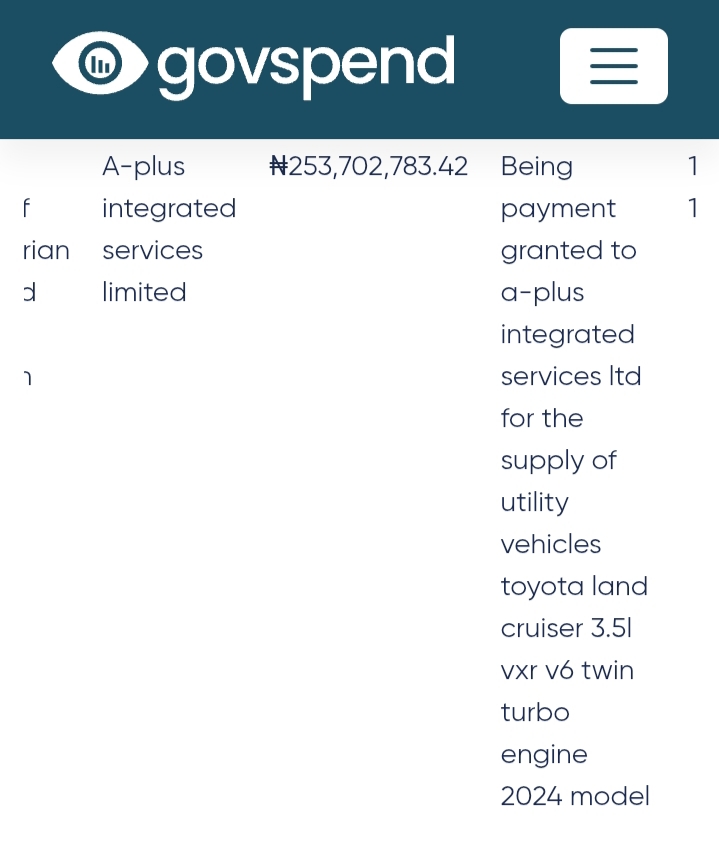
The payment description reads: “Being payment granted a-plus integrated services limited for the supply of utility vehicles Toyota Land cruiser 3.51 vxr V6 twin turbo engine 2024 model.”
Just two days earlier, on September 10, 2025, the ministry paid another N253.8 million to Wada Autos Limited, also for the supply of Toyota Land Cruisers. In total, the ministry spent N507.5 million between September 10 and September 12, according to details published on Govspend.
In a separate but related development, SaharaReporters had previously reported that the sum of N122 million was spent on the purchase of vehicles for traditional rulers in Ikeja, Lagos State. Payment records described the expenditure as “provision and supply of SUVs and cars for traditional rulers in Ikeja Federal Constituency.” The contract for the supply of the vehicles was awarded to Sparktech Global Ventures Limited, with payment executed on February 16, 2025, through the Federal Cooperative College, Kaduna.
Earlier revelations also indicated that Hon. James Faleke spent N52.4 million in November 2024 on the purchase of vehicles for traditional rulers in the same Ikeja Federal Constituency. That transaction, like the later one, was carried out through the Federal Cooperative College, Kaduna, and the contract was awarded to Sparktech Global Ventures Limited.
Faleke represents the Ikeja Federal Constituency in the House of Representatives and serves as Chairman of the House Committee on Finance.
These developments highlight a continuing pattern of large-scale government expenditure on vehicles for official and traditional purposes. The timing, the amounts involved, and the repetition of transactions with the same companies have drawn attention to how public funds are being utilized by government ministries and representatives.
Details of these payments remain accessible on the Govspend portal, providing transparency into the financial activities of the ministry.
The transactions reflect a focus on procurement of high-value vehicles within very short periods, raising questions about the planning and oversight mechanisms governing such purchases.