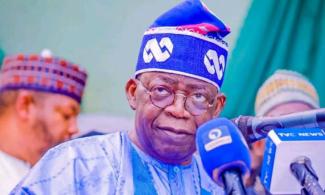
The call was made during the ongoing four-day "South East Vision 2050 Regional Stakeholders Forum (SEV2050)" which commenced on Tuesday in Enugu State.
The President General of Ohanaeze Ndigbo Worldwide, Senator John Azuta-Mbata, and the South East Development Commission (SEDC) have made a passionate plea to the President Bola Tinubu-led Nigerian government to utilise the commission as a tool for reconciliation by addressing the region's $10 billion infrastructure deficit.
The call was made during the ongoing four-day "South East Vision 2050 Regional Stakeholders Forum (SEV2050)" which commenced on Tuesday in Enugu State.
SaharaReporters reports that the summit aims to create a 25-year roadmap to transform the zone into a global investment hub.
Addressing the assembly on Wednesday, Senator Azuta-Mbata stated that the SEDC represents more than a development agency; it is a "powerful instrument of reconciliation and healing" for a region nursing deep-seated grievances.
“It would be dishonest not to acknowledge that over the years, feelings of exclusion, neglect, and unresolved grievances have taken root in parts of our region,” Azuta-Mbata said.
He argued that sentiments of marginalisation weaken national cohesion and urged the Nigerian government to provide "appropriate and sustained funding" to the SEDC to rebuild trust.
He added, “This is the time to heal. It is the time to replace suspicion with trust, despair with hope, and marginalisation with meaningful inclusion”.
In his opening address on Tuesday, the Managing Director of the SEDC, Dr. Mark Okoye, painted a stark picture of the region's economic hurdles. He revealed that the South East requires approximately $10 billion to bridge its massive infrastructure gap.
Okoye criticised "disjointed development initiatives" and urged the five states—Abia, Anambra, Ebonyi, Enugu, and Imo—to stop competing for small capital and instead pursue "large-scale, bankable projects".
He proposed the joint development of 600-megawatt power plants to drive industrialisation across the 29,000 square kilometer landmass.
The SEDC boss also highlighted the inefficient use of diaspora remittances. “While Nigeria receives approximately $22 billion in annual remittances, with an estimated $4 billion flowing into the Southeast, these funds remain largely fragmented,” he noted, challenging stakeholders to pool these resources into "legacy infrastructure projects" like gas pipelines and rail networks.
A development practitioner and wife of late former Ondo governor, Betty Anyanwu-Akeredolu, warned that the vision must not become another "aspirational document" gathering dust.
“Vision 2050 must move from paper to practice,” she asserted. “For many of our people, development begins with simple things: good roads to move farm produce, reliable electricity to power small businesses, clean water, accessible healthcare, and skills for our young people”.
She emphasised that women and youth must be central to the plan, citing her work with the BEMORE foundation in ICT and solar technology.
Representing Enugu State Governor Peter Mbah, the Secretary to the State Government, Prof Chidiebere Onyia, affirmed that no single state can achieve transformational growth in isolation.
Onyia noted that Enugu has created a safe environment for the forum to thrive and stressed the need to "institutionalise reforms" to prevent leadership transitions from derailing regional progress. He described the gathering as a "defining milestone" in overcoming the "fragmented efforts" of the past.
The forum continues on Wednesday with technical sessions focused on agriculture, the digital economy, and transportation.