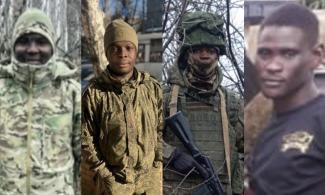
It was gathered that news of the deaths first emerged through a secret WhatsApp group created by African mercenaries fighting for Russia.
No fewer than four Nigerians recruited to fight for Russia in the ongoing war with Ukraine have been killed on the battlefield, sources familiar with the matter have disclosed.
The deceased, identified as Adam Anas, Akinlawon Tunde Quyuum, Abugu Stanley Onyeka, and Balogun Ridwan Adisa, were allegedly recruited under the false pretense of securing “security jobs” in Russia but were later conscripted and deployed to the war front after undergoing three weeks of military training, Daily Nigerian exclusively reported.
While Anas, Quyuum, Onyeka, and Abubakar Adamu, the only known survivor, reportedly travelled together to Russia in November 2025, Adisa was said to have been recruited earlier in the year.
Sources reportedly said that the Nigerian fighters died on the frontline on different dates between December 2025 and January 2026.
The Russian military did not officially notify the families of the fallen Nigerians, according to Daily Nigerian.
Sources further alleged that African mercenaries were warned against informing families of deceased fighters about their deaths.
It was gathered that news of the deaths first emerged through a secret WhatsApp group created by African mercenaries fighting for Russia.
“We heard about the death of our brother through one of his colleagues. His picture was posted in a secret WhatsApp group. Our family was never contacted by the Russian authorities,” a relative of one of the deceased fighters, Anas, was quoted as saying.
Sources said the ordeal of Mr Anas and his co-travelers began after they informally accepted a “security job offer” through a Nigerian recruiting agent identified as Emiola Muhammad.
The Russian Embassy in Abuja, allegedly acting in connivance with the agent, reportedly issued the Nigerians single-entry tourist visas without biometric capture or fulfillment of other standard application requirements.
Although the Embassy of the Russian Federation in Nigeria has cautioned applicants that submissions must be made in person and that “reliance on a third party may incur a visa denial,” the Nigerians were reportedly granted visas without personal submission.
The recruits were allegedly promised a monthly salary of 200,000 rubles (about ₦3.6 million), alongside allowances and other benefits.
Upon arrival at Sheremetyevo International Airport, Moscow, the Nigerian job-seekers were reportedly diverted from regular immigration queues to a separate passage and exempted from border control clearance.
A letter obtained by Daily Nigerian revealed that the Russian military had instructed airport authorities to grant the Nigerians entry clearance for contract enlistment into the Russian Army.
The letter, addressed to the Chief of the Border Control Detachment of the Federal Security Service of Russia at Sheremetyevo Airport, Colonel L. Yu. Yashin stated that Nigerian foreign citizens were scheduled to arrive at a recruitment centre for contract military service in Yaroslavl in November to sign military service contracts.
Immediately after arrival, the Nigerians were reportedly compelled to sign contracts written in Russian without English translation.
A translated portion of the contract reads, “During the period of military service under the contract, [you are required] to conscientiously perform all general, official, and special duties of military personnel established by legislative and other regulatory legal acts of the Russian Federation.
“To be faithful to the Military Oath (obligation), to selflessly serve the people of the Russian Federation, to courageously and skillfully defend the Russian Federation…”
After signing the documents, the Nigerians were taken to a military facility where they underwent three weeks of training.
“Our passports and phones were seized immediately, but some of us managed to sneak in a phone. After spending hours at a camp in Moscow, they waited till night time before driving us on a five-hour road trip to the military camp,” one African conscript reportedly said.
In a voice note sent before his death, Anas reportedly described the dangerous situation on the battlefield.
“Please pray for us, we are in the middle of a forest. It is a two-week journey on foot, and the road is dangerous as there are so many drones.
“So far, we have trekked for four days. We are one camp away from our destination. Because of the presence of drones, they are sending us one after another,” he said.
Anas is said survived by a wife and three young children.
While the Russian Embassy in Abuja has not released any official statement, the spokesperson for Nigeria’s Ministry of Foreign Affairs, Kimiebi Ebienfa, said the ministry was not aware of the incident.
“It is a sad development and quite unfortunate, but the Ministry is not aware,” Ebienfa was quoted as saying.
Late last year, Ukraine claimed that over 1,400 people from 36 African countries were fighting for Russia.
In November 2025, Ukrainian Foreign Minister Andrii Sybiha warned that contracts Africans are forced to sign are “equivalent to signing a death sentence.”
A December report by the French Institute of International Relations also alleged that Russian authorities confiscate African recruits’ passports and use them as cannon fodder for dangerous frontline operations.
Meanwhile, the lone known survivor, Abubakar Adamu, has appealed to the Nigerian government to intervene and secure his repatriation.
Writing through his lawyer, Mr Adamu said he was deceived into accepting a security guard job but was later forced into military service.
“Our brief revealed that our Client, a Nigerian citizen, is currently detained within the Russian Federation (11740 Military Division Unit) under the guise of military enlistment,” the letter said.
The letter added, “Our client was recruited under the false pretense of serving as a civilian security guard.
“However, upon arrival in Russia, his travel documents were confiscated, and he was coerced into signing documents written exclusively in the Russian language without the assistance of an interpreter.”
The lawyers demanded his immediate release, return of his confiscated passport, and safe repatriation to Nigeria, citing fundamental misrepresentation, non est factum, and violations of international human rights law.
“In light of the above, we demand that the Russian authorities immediately: Cease any military deployment of Abubakar Adamu; Return his confiscated passport and travel documents; and Facilitate his safe and immediate repatriation to Nigeria,” the letter stated.
On Monday, SaharaReporters reported that a Nigerian man who travelled abroad to join the Russian military fighting against Ukraine had been killed on the battlefield.
The deceased, whose identity could not ascertained, reportedly left behind his family in Nigeria to enlist with the Russian Army amid the ongoing war between Russia and Ukraine.
His death came just days after reports emerged that a 28-year-old Kenyan national, Clinton Nyapara Mogesa, was also killed while fighting for the Russian armed forces.
Meanwhile, the Nigerian man was among several foreign nationals believed to have been recruited by Russia, either through direct enlistment or inducements tied to promises of financial reward, residency opportunities, or other incentives.
The death of the Nigerian fighter was confirmed on Monday by a security expert, Zagazola Makama, in a brief post shared on social media.
Makama stated that the Nigerian man was unfortunately killed on the battlefield, though further details surrounding the circumstances of his death were not provided.
There has been growing concern across Africa over the involvement of young men from economically vulnerable backgrounds in the Russia–Ukraine war.
Several reports have indicated that Africans, including Nigerians, Ghanaians, Kenyans, Somalis and others, have been recruited into the Russian military, sometimes under controversial circumstances.
In some cases, individuals were reportedly lured with promises of lucrative jobs or educational opportunities, only to find themselves deployed to the frontlines.