
The lawmakers warned that any move to weaken the provision would undermine Nigeria’s democratic credibility and public trust in the electoral process.
Opposition lawmakers in the National Assembly, including Senators Natasha Akpoti-Uduaghan, Enyinnaya Abaribe and Aminu Tambuwal, have insisted that real-time electronic transmission of election results is still being retained in the amended Electoral Bill.
The lawmakers warned that any move to weaken the provision would undermine Nigeria’s democratic credibility and public trust in the electoral process.
The lawmakers made their positions known amid the controversy that the Senate on Wednesday rejected electronic transmission of election results from polling units in the electoral reforms.
Insisting that transparent and technology-driven result transmission remains central to credible elections and accountable governance, the lawmakers explained that what the Senate rejected on Wednesday was electronic transfer of results, while they passed real-time electronic transmission of election results.
Providing clarification on the bill passed by the Senate on Wednesday, Senator Abaribe, speaking on behalf of Senator Akpoti-Uduaghan, Tambuwal and other opposition lawmakers, stressed that the Senate did not pass electronic transfer of results as contained in the Electoral Act 2022, but rather endorsed electronic transmission of results from polling units.
"Yesterday, the Senate did not, I repeat, did not pass transfer of results which was in the 2022 Act,” Abaribe said.
“What we passed, which the Senate President himself (said), when he was doing a clarification sitting on his chair, is transmission of results.”
He stressed that senators owed their constituents clarity and honesty on the matter, noting that extensive consultations had been held before the bill was passed.
“I need to make this clear, everyone of us who is a senator, who has the privilege to represent a senatorial district, came here under the trust of their senatorial zones,” he said.
“The reason for us to go into a closed session was so that we can tidy up all the needling things, and when we come back to plenary to pass it, we will pass it without any rancour.”
Abaribe further assured Nigerians that there was consensus among lawmakers on the provision for real-time electronic transmission of results.
“I can assure you on my honour and honour of all of us who are standing here, that both the electoral committee of the Senate, the ad-hoc committee of the Senate, and in the executive session that we had, we all agreed on Section 60(3), which is electronic transmission of results real time,” he stated.
“It is transmit, not transfer. What is in 2022 is transfer, and we don't want a law that is vague, we don't want a law that will be misinterpreted by anybody. We want a law that is clear, concise and can be interpreted by all and that is unambiguous. So, it is electronic transmission of results.”
The opposition lawmakers argued that technological transparency in elections is no longer optional but essential for rebuilding trust between citizens and democratic institutions.
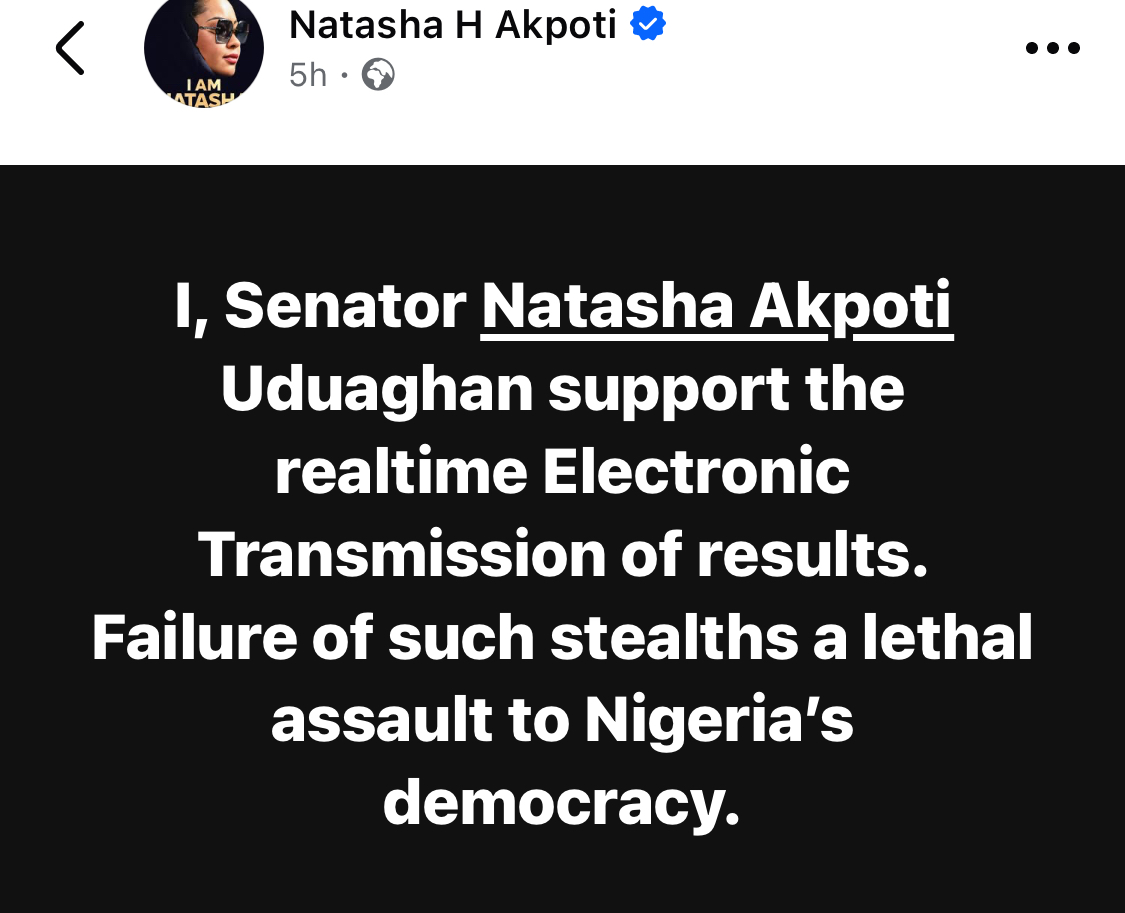
In a post on Facebook, Senator Akpoti-Uduaghan described real-time electronic transmission of results as a critical safeguard against electoral manipulation, warning that its removal would pose a serious threat to Nigeria’s democracy.
“I, Senator Natasha Akpoti-Uduaghan, support the real-time electronic transmission of results. The failure to retain this provision constitutes a lethal assault on Nigeria’s democracy,” she said.
The Kogi Central senator emphasised that credible elections depend on transparency at every stage of voting and collation, insisting that Nigerians must be confident that their votes truly count.
Echoing similar views, Senator Abaribe underscored the responsibility placed on lawmakers by the electorate, urging his colleagues to act in line with democratic values and national interest.
He warned that any attempt to weaken transparency mechanisms in the electoral framework would betray that trust and further erode public confidence in governance.
Other opposition figures, including former Sokoto State governor, Senator Tambuwal, also aligned with the call to preserve electronic transmission of results, arguing that Nigeria must sustain reforms that reflect global democratic standards and evolving electoral best practices.
The renewed insistence comes amid an intense national controversy over the proposed amendments to the Electoral Act, with civil society groups and election observers urging lawmakers to prioritise transparency, accountability and institutional credibility ahead of future polls.