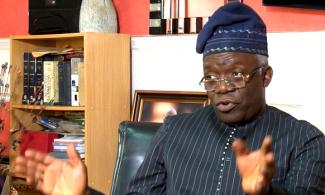
Falana emphasised that under Nigeria’s democratic dispensation, such offences fall under civilian criminal law and must be prosecuted in a regular court of law.
Renowned human rights lawyer Femi Falana SAN has stated that the alleged coup plotters arrested for conspiring against President Bola Tinubu’s administration cannot legally be tried by a military tribunal.
Falana emphasised that under Nigeria’s democratic dispensation, such offences fall under civilian criminal law and must be prosecuted in a regular court of law.
In a detailed legal analysis, Falana explained that the current legal framework clearly distinguishes between military discipline and acts of treason against a democratically elected government.
He noted that while some military officers and civilian collaborators were reportedly involved in the October 2025 plot, military tribunals have no jurisdiction over civilians, nor can they try crimes aimed at removing an elected president.
“Since the military officers implicated in the coup plot had wanted to remove an elected President from office, it is a grave crime that has to be tried under the Criminal Code Act,” Falana said.
“It is pertinent to state that the alleged coup plotters can only be tried under section 41 of the Criminal Code Act which stipulates that anyone who forms an intention to depose the President, during his term of office, or to overawe the government by criminal force, and manifests such intention by an overt act, is guilty of a felony and liable to life imprisonment.”
He further cited historical precedents to underscore his point. According to the senior lawyer, in the past, alleged coup plotters under military regimes were often tried under special decrees, such as the Treason Decree of 1986 and the Treason and Treasonable Offences Decree No. 29 of 1993.
He noted that those decrees were anti-democratic and have since been repealed.
Falana added that today, under the 1999 Constitution, treasonable acts against a civilian government fall under the jurisdiction of the Federal High Court.
He said, “However, with the overthrow of President Shehu Shagari on December 31, 1983, the Constitution was suspended and modified while the country was ruled by decrees and edicts promulgated by the head of state and governors respectively.
“Some of the obnoxious decrees were hurriedly enacted to deal with perceived political opponents. For instance, when the military president, General Ibrahim Babangida discovered that General Mamman Vatsa and the other military officers could only be sentenced to life imprisonment under section 41 of the Criminal Code Act, the Treason and Other Offences (Special Military Tribunal) Decree 1 of 1986 was promulgated.
“The Treason Decree provided the death penalty for treason and treasonable felony. Even though the alleged coup plotters had been arrested in December 1985, they were tried under the Treason Decree that was promulgated on January 6, 1986. Thus, they were convicted by a military tribunal and executed in a premeditated manner.”
Falana also noted that the alleged involvement of civilians in the plot is another reason why the coup suspects cannot be tried by a court-martial.
“Since the indicted civilians are not subject to service law, they cannot be tried in a military court,” he said.
“Even in the case of Chief Moshood Kashimawo Olawale Abiola v The Federal Republic of Nigeria (1995) 1 NWLR (Pt.370) 155, the defendant was charged with treasonable felony at the Federal High Court. Similarly, in the case of Ameh Ebute V State (1994) 8 NWLR (Pt 360) 66, the defendants including Senator Ahmed Bola Tinubu (now President) were charged with treason at the Federal High Court.”
The lawyer recalled several landmark rulings, including the 2025 Supreme Court decision in Uganda, which declared that military courts lack jurisdiction to try civilians.
He said, “The illegal practice of prosecuting civilians in military courts has just been stopped by the Supreme Court of Uganda in the case of Dr. Kizza Besigye & Another v Attorney General & Another (Miscellaneous Cause 31 of 2025) [2025] UGHCCD 29 (24 February 2025).
“In that case, Dr. Kizza Besigye and Haji Obeid Lutale were brutally abducted from Nairobi, Kenya on 16 November 2024, transferred to Uganda, and illegally detained at Makindye military barracks. They were arraigned before the General Court Martial (GCM) on 20 November 2024 for charges including security offenses and possession of firearms.”
“They challenged the legal competence of the trial. On January 31, 2025, the Supreme Court held that military courts lack jurisdiction to try civilians and ordered officials to halt all ongoing military trials of civilians and transfer them to the country’s civilian court system,” Falana added.
He concluded by urging the Federal Government to immediately transfer the case file of the alleged plotters to the office of the Attorney-General of the Federation for proper prosecution.
“In view of the foregoing, the case file of the alleged coup plotters should be forwarded to the office of the Attorney-General of the Federation without any further delay,” Falana said.
“Upon the receipt of the case file, the Attorney-General should study it and file a charge of treasonable felony at the Federal High Court pursuant to section 251(2) of the 1999 Constitution.”
“The military authorities who have threatened to try the alleged coup plotters in a military court should be advised to appreciate that the plot to sack a civilian regime is not a military affair,” Falana added.
The remarks come amid ongoing discussions about the arrest of several military officers, ranging from captains to brigadier generals, and their civilian collaborators, who were reportedly planning to overthrow President Tinubu’s government in October 2025.
While the military had initially indicated that the alleged plotters would face court-martials, Falana noted that such a move would violate established democratic and legal principles.
“In any case, the decree for the trial of coup plotters being relied on by the military officers has been repealed while treasonable felony is not one of the offences listed in the Armed Forces Act,” he said.